


Can a Cracked Tooth Be Saved or Does It Need to Be Extracted?
Can a Cracked Tooth Be Saved or Does It Need to Be Extracted?

“I felt a sharp crack while eating, and now my tooth hurts when I bite down. Can this tooth be saved, or will I lose it?”
Discovering you have a cracked tooth triggers immediate anxiety. Teeth are meant to be permanent, and the thought of losing one feels like a significant bodily loss. The fear intensifies when you imagine gaps in your smile, difficulty eating, or the expense and complexity of tooth replacement.
The uncertainty is often worse than the crack itself. Will this crack spread? How much will treatment cost? Will I need multiple painful procedures? What if the dentist says extraction is the only option?
Here’s the reassuring truth: Modern dentistry can save many cracked teeth that would have been extracted decades ago. Advances in bonding materials, crown technology, root canal techniques, and diagnostic imaging mean that dentists now have sophisticated tools for preserving teeth that would have been considered hopeless in the past.
However, not all cracks are created equal. The critical factors determining whether your tooth can be saved versus needing extraction include the crack’s location (which tooth and where on that tooth), depth (does it reach the nerve or extend into the root?), direction (vertical, horizontal, or oblique?), and whether symptoms indicate irreversible damage.
This comprehensive guide explains the different types of tooth cracks, which ones are treatable versus requiring extraction, what treatment options exist to save cracked teeth, how dentists diagnose crack severity, and what happens if extraction becomes necessary. Whether you’ve just discovered your cracked tooth or you’ve been avoiding the dentist hoping the crack will somehow heal itself (spoiler: it won’t), this information empowers you to make informed decisions about preserving your dental health.
Understanding Tooth Cracks: Why They Happen and Why They Matter
Before exploring treatment options, it’s essential to understand what causes teeth to crack and why even small cracks require professional attention.
Why Teeth Crack
Teeth are remarkably strong — enamel is the hardest substance in the human body. Yet they’re also subjected to tremendous forces. Your back teeth withstand up to 200 pounds of pressure during chewing.
Common causes of tooth cracks include:
Chewing hard objects — ice, hard candy, popcorn kernels, hard nuts, pen caps, or using teeth as tools to open packages.
Trauma — sports injuries, falls, car accidents, or any impact to the face can fracture teeth.
Large existing fillings — teeth with substantial fillings have less structural integrity. The remaining tooth structure can crack around old fillings, particularly if the filling is very large.
Teeth grinding (bruxism) — chronic grinding, especially during sleep, subjects teeth to repeated stress that eventually creates cracks. Many people grind their teeth without realizing it.
Temperature extremes — rapid temperature changes, like drinking hot coffee then immediately eating ice cream, create expansion and contraction that can propagate cracks over time.
Age-related wear — as we age, teeth accumulate micro-cracks from decades of chewing forces. Sometimes these micro-cracks coalesce into visible, symptomatic cracks.
Weakened tooth structure — teeth that have had root canal treatment, extensive decay, or multiple fillings are more prone to cracking because less healthy tooth structure remains.
💡 Quick Tip: If you wake up with jaw soreness or headaches, you might be grinding your teeth at night without knowing it. Ask your dentist about evaluation for bruxism — treating grinding prevents both new cracks and progression of existing ones.
Why Even Small Cracks Matter
“It’s just a tiny crack — why does my dentist seem so concerned?”
Cracks don’t heal. Unlike bone, which can repair fractures, tooth enamel and dentin cannot regenerate. Once a crack forms, it will remain — and often progress.
Even hairline cracks create pathways for bacteria to penetrate deeper tooth layers. Over time, this leads to:
- Decay developing along the crack line
- Pulp (nerve) inflammation or infection
- Deepening or lengthening of the crack
- Eventual tooth fracture into pieces
- Pain that progressively worsens
Early intervention while the crack is small and confined to the outer tooth layers offers the best chance of saving the tooth. Delayed treatment allows cracks to extend deeper, often making treatment more complex or extraction inevitable.
🔑 Key Takeaway: All tooth cracks require professional evaluation. While some cracks are minor and easily managed, others represent dental emergencies requiring immediate attention. Only your dentist can determine crack severity through examination and diagnostic imaging.
Types of Tooth Cracks: Understanding What Determines Prognosis
Not all cracks are equally concerning. The type, location, and extent of the crack dramatically influence whether the tooth can be saved and what treatment it requires.
Craze Lines: The Benign Cracks
Craze lines are tiny, superficial cracks limited to the outermost enamel layer. They’re extremely common, especially in adults over 40.
Characteristics:
- Appear as fine, vertical lines on the tooth surface
- Only affect enamel, not deeper tooth structures
- Don’t cause pain or sensitivity
- Don’t extend below the gumline
- More visible on front teeth due to light transmission
Prognosis: Excellent. Craze lines are cosmetic concerns only, not structural problems.
Treatment: Usually none required. If aesthetic appearance bothers you, options include tooth whitening (sometimes makes them less visible) or veneers for front teeth. Otherwise, monitoring is sufficient.
Fractured Cusp: The Broken Corner
Fractured cusps occur when a pointed part of the tooth’s chewing surface breaks off. This commonly happens around large fillings where remaining tooth structure is thin.
Characteristics:
- Piece of tooth breaks away from the chewing surface
- Usually doesn’t affect the tooth pulp (nerve)
- May cause sensitivity but often surprisingly comfortable
- More common in back teeth with fillings
Prognosis: Very good. Most fractured cusps don’t require extraction.
Treatment: Typically a dental crown to restore tooth shape and protect remaining structure. If the pulp is exposed or inflamed, root canal treatment may precede crown placement.
💡 Quick Tip: If a piece of your tooth breaks off while eating, save the fragment if possible and call your dentist immediately. While the fragment usually can’t be reattached, bringing it helps your dentist assess the fracture severity.
Cracked Tooth: The Vertical Fracture
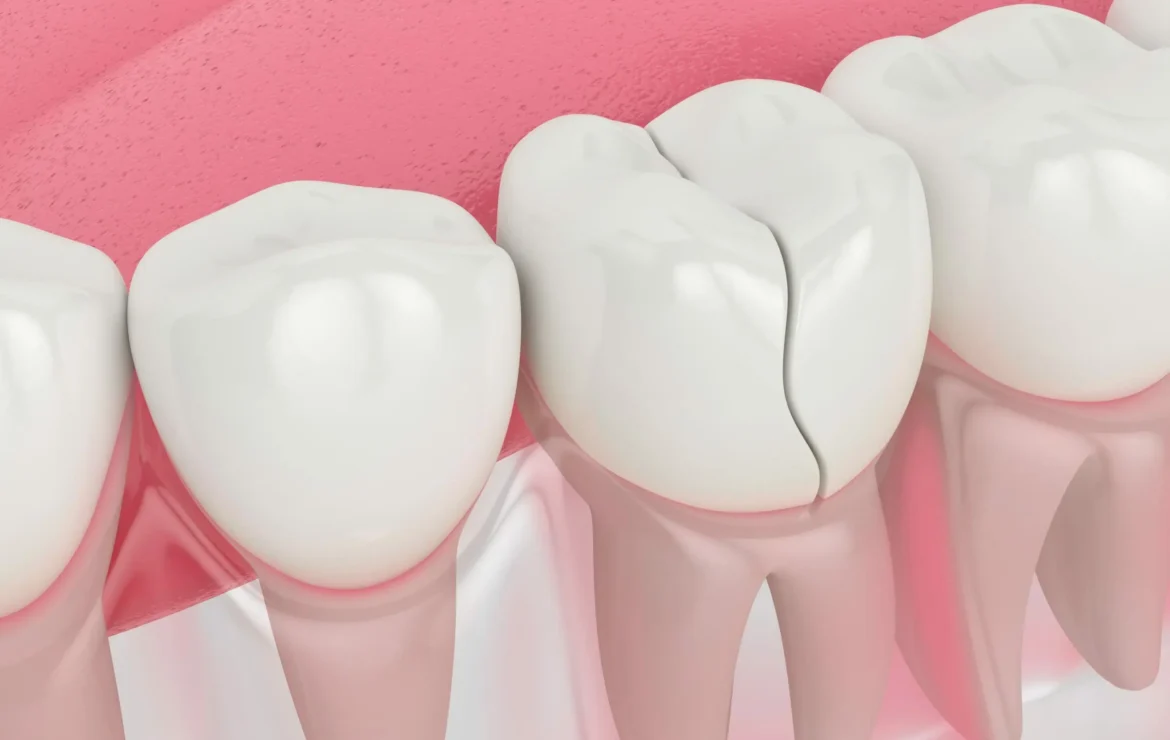
Cracked tooth (also called cracked tooth syndrome) describes a crack extending vertically from the chewing surface toward the root.
Characteristics:
- Vertical crack that may extend through enamel, dentin, and sometimes into the pulp
- Sharp pain when biting down, especially when releasing bite pressure
- May hurt with temperature extremes
- Pain often difficult to pinpoint — patients struggle to identify which tooth hurts
- Crack may be invisible on x-rays and hard to detect clinically
Prognosis: Variable, depending on crack depth and location.
Treatment:
- If crack hasn’t reached the pulp: Crown to prevent progression
- If crack has reached the pulp: Root canal followed by crown
- If crack extends below the gumline: Extraction often necessary
- If crack splits the tooth vertically through the root: Extraction required
This is the most clinically challenging crack type because early diagnosis is difficult yet critically important for successful treatment.
Split Tooth: The Divided Tooth
Split tooth represents advanced progression of cracked tooth syndrome — the tooth has actually separated into distinct segments.
Characteristics:
- Tooth fractured into two or more pieces
- Usually the result of an untreated cracked tooth
- Often involves the root
- Segments may be mobile
- Usually quite painful
Prognosis: Poor to hopeless for saving the entire tooth. Sometimes a single segment can be saved.
Treatment:
- Extraction is usually necessary
- In rare cases, one segment might be saved through endodontic treatment and crown
- Replacement options include dental implant, bridge, or partial denture
Vertical Root Fracture: The Hidden Crack
Vertical root fractures begin at the root and extend toward the chewing surface — the opposite direction of typical cracks.
Characteristics:
- Often occur in teeth that have had root canal treatment
- May have minimal symptoms initially
- Infection develops around the fracture line
- Bone loss visible on x-rays
- Sometimes detected only when infection causes obvious swelling or pain
Prognosis: Very poor. Root fractures rarely heal.
Treatment: Extraction is usually necessary. Occasionally, if only one root of a multi-rooted tooth is fractured, that root alone can be removed (root amputation), preserving the tooth.
Crack Severity Assessment: How Dentists Determine If Your Tooth Can Be Saved
Understanding how dentists evaluate crack severity helps you appreciate the diagnostic process and the factors influencing treatment recommendations.
| Crack Type | Symptoms | Diagnostic Methods | Can Be Saved? | Typical Treatment |
|---|---|---|---|---|
| Craze Lines | None | Visual inspection | ✓ Yes | None needed; cosmetic treatment optional |
| Fractured Cusp | Mild sensitivity; piece broke off | Visual + X-ray | ✓ Yes (usually) | Crown; root canal if pulp exposed |
| Cracked Tooth (superficial) | Pain on biting | Transillumination, staining, explorer | ✓ Yes | Crown to prevent progression |
| Cracked Tooth (deep to pulp) | Pain on biting + cold sensitivity | Transillumination, CBCT scan | ✓ Sometimes | Root canal + Crown |
| Cracked Tooth (below gumline) | Severe pain; looseness | Clinical exam, probing, X-ray/CBCT | ✗ Usually not | Extraction |
| Split Tooth | Tooth separated into pieces | Visual inspection; obvious | ✗ Rarely | Extraction (occasionally save one segment) |
| Vertical Root Fracture | Persistent infection, swelling | CBCT scan, surgical exploration | ✗ Almost never | Extraction |
The Clinical Examination Process
Visual inspection under magnification reveals cracks that might otherwise be invisible to the naked eye.
Transillumination uses a bright light shone through the tooth. Cracks interrupt light transmission, appearing as dark lines that help identify crack location and extent.
Bite test has you bite on a specialized instrument. Sharp pain upon release indicates a cracked tooth — the crack opens when you bite down, irritating the nerve, then closes rapidly when pressure releases, causing sudden pain.
Staining with methylene blue dye can reveal cracks. The dye infiltrates crack lines, making them visible.
X-rays show some cracks, particularly horizontal or oblique fractures, but many vertical cracks remain invisible on standard x-rays.
CBCT scans (3D imaging) provide detailed views of tooth structure from all angles, identifying cracks that standard x-rays miss.
Probing measures periodontal pocket depths around the tooth. Isolated deep pockets may indicate a crack extending below the gumline.
For comprehensive evaluation using advanced diagnostic technology at our dental clinic in Gandhinagar, patients benefit from precise crack assessment that determines the most appropriate treatment approach.
💡 Quick Tip: If your dentist recommends a CBCT scan for crack evaluation, it’s worth the additional imaging. Standard x-rays miss many cracks that CBCT clearly shows, and accurate diagnosis prevents inappropriate treatment that wastes time and money.
Treatment Options to Save a Cracked Tooth
When your dentist determines your cracked tooth is savable, several treatment approaches might be appropriate depending on crack characteristics.
Dental Bonding: For Minor Surface Cracks
Dental bonding involves applying tooth-colored composite resin material to fill and seal minor cracks.
When it’s appropriate:
- Shallow cracks limited to enamel
- Small chips or fractures on front teeth
- Craze lines that bother you cosmetically
The procedure: The tooth surface is prepared with etching gel, bonding agent is applied, composite resin is shaped to fill the crack or repair the chip, and the material is hardened with a curing light. The dentist then polishes the repair to blend with surrounding tooth structure.
Advantages:
- Conservative — minimal tooth structure removed
- Completed in a single appointment
- Relatively inexpensive compared to crowns
- Good aesthetic results for front teeth
Limitations:
- Not strong enough for back teeth bearing heavy chewing forces
- Won’t prevent progression of deeper cracks
- Material can stain or chip over time
- Lifespan shorter than crowns (5-10 years typically)
Dental bonding works well for minor aesthetic repairs but isn’t appropriate for structural cracks requiring more substantial restoration.
Dental Crown: The Gold Standard for Cracked Teeth
A dental crown encases the entire visible portion of the tooth, holding cracked segments together and preventing crack progression.
When it’s appropriate:
- Fractured cusps
- Cracked teeth where the crack hasn’t extended into the root
- Teeth weakened by large fillings that are at high risk for fracturing
- After root canal treatment on cracked teeth
The procedure: The tooth is shaped to accommodate the crown, impressions or digital scans are taken, a temporary crown protects the tooth while the permanent crown is fabricated (usually 1-2 weeks), and the permanent crown is cemented onto the prepared tooth.
Advantages:
- Provides maximum protection against crack progression
- Restores full chewing function
- Lasts 15-20+ years with proper care
- Can be made to look completely natural
Limitations:
- Requires removal of healthy tooth structure to make room for crown
- More expensive than bonding
- Requires multiple appointments
- If crack extends below the gumline, crown won’t prevent continued problems
For most cracked teeth diagnosed early, crowns represent the treatment most likely to preserve the tooth long-term.
Root Canal Therapy: When Cracks Reach the Pulp
Root canal treatment becomes necessary when a crack extends into the tooth’s pulp (nerve chamber), causing inflammation or infection.
Symptoms indicating pulp involvement:
- Persistent sensitivity to hot or cold that lingers after the stimulus is removed
- Spontaneous pain (hurts without any trigger)
- Pain when lying down
- Swelling or pimple-like bump on gums near the tooth
- Discoloration of the tooth
The procedure: The pulp tissue is removed from the tooth’s interior, canals are cleaned and shaped, the empty canal space is filled with a rubber-like material (gutta-percha), and the tooth is sealed and crowned.
Following root canal treatment, a crown is essential — not just to prevent crack progression but because root canal-treated teeth become more brittle and prone to fracture without crown protection.
Success rate: Root canal treatment followed by crown placement has a 85-95% success rate when the crack hasn’t extended into the root.
At Nova Dental Hospital’s painless root canal treatment facility, modern techniques and sedation options make endodontic treatment comfortable and stress-free, saving teeth that would otherwise require extraction.
🔑 Key Takeaway: The treatment sequence often involves multiple procedures — root canal if the nerve is affected, followed by crown placement to stabilize the tooth structurally. This combination approach saves many cracked teeth that the crown or root canal alone couldn’t salvage.
Monitoring and Conservative Management: When Immediate Treatment Isn’t Required
For very superficial craze lines or tiny cracks with no symptoms, active monitoring without immediate treatment might be appropriate.
This approach involves:
- Regular dental examinations (possibly more frequent than standard six-month intervals)
- Avoidance of risk factors (hard foods, grinding)
- Immediate treatment if symptoms develop or crack progresses
When monitoring is reasonable:
- Asymptomatic craze lines in enamel only
- Very minor cracks with no pain, sensitivity, or visual progression
- Patients who cannot currently afford definitive treatment but need time to plan financially
Risks of delaying treatment: Cracks can progress unpredictably. What seems minor today might extend significantly before your next appointment. Early intervention is almost always less complex and expensive than treating a crack that has worsened.
💡 Quick Tip: If cost concerns make you hesitant about treating a cracked tooth, discuss payment options with your dentist. Many practices offer payment plans. The investment in saving the tooth now prevents the greater expense of extraction and replacement later.
When Extraction Becomes Necessary: Understanding the Decision
No dentist wants to extract a tooth — the goal is always preservation when reasonably possible. However, certain crack characteristics make retention impossible or unwise.
Cracks That Typically Require Extraction
Vertical cracks extending below the gumline cannot be sealed or stabilized effectively. The crack continues into the root structure beneath the bone, creating a persistent pathway for infection.
Severely split teeth where the tooth has fractured into multiple mobile segments usually cannot be saved as a functional unit. While occasionally one segment might be salvageable, complete extraction is more common.
Vertical root fractures in root canal-treated teeth propagate along the root length. These fractures don’t heal and create chronic infections that don’t respond to retreatment.
Cracks associated with extensive bone loss indicate that even if the tooth structure could theoretically be repaired, the supporting foundation has been compromised beyond recovery.
Horizontal root fractures in the apical third (near the root tip) sometimes heal, but those in the middle or cervical third (near the crown) typically don’t.
How Dentists Make the Extraction Decision
The decision isn’t arbitrary. Dentists consider:
Restorability: Can enough healthy tooth structure be preserved to support a restoration?
Periodontal support: Is adequate bone present to support the tooth long-term?
Functional value: How important is this tooth for chewing and bite stability?
Adjacent teeth: Will losing this tooth create problems for neighboring teeth?
Patient health: Can the patient undergo the procedures needed to save the tooth?
Prognosis: Even if the tooth can technically be saved, what’s the likelihood of long-term success?
Cost-benefit analysis: Is the investment in saving the tooth reasonable given its prognosis?
Sometimes extraction is actually the most conservative, cost-effective choice when the alternative involves extensive, expensive treatment with questionable long-term success.
Tooth Replacement Options After Extraction
If extraction proves necessary, multiple options exist for replacing the tooth and restoring function and aesthetics.
Dental Implant: The Premium Replacement
A dental implant involves placing a titanium post into the jawbone that fuses with the bone, then attaching a crown to the implant.
Advantages:
- Most closely replicates natural tooth function
- Preserves jawbone by providing stimulation like a natural root
- Doesn’t require affecting adjacent teeth
- Lasts 20+ years with proper care
- Looks and feels like a natural tooth
Considerations:
- Most expensive option
- Requires surgical procedure and 3-6 months healing
- Requires adequate bone (grafting may be needed first)
For comprehensive dental implant treatment in Gandhinagar, modern techniques and advanced materials provide excellent long-term outcomes for tooth replacement following extraction.
Dental Bridge: The Traditional Alternative
A bridge uses adjacent teeth as anchors, supporting an artificial tooth that fills the gap.
Advantages:
- Fixed (non-removable) restoration
- Completed in 2-3 weeks (faster than implants)
- Less expensive than implants
- No surgery required
Considerations:
- Requires grinding down healthy adjacent teeth for crowns
- Those supporting teeth bear increased forces
- Doesn’t prevent bone loss under the replacement tooth
- Lifespan 10-15 years typically
Partial Denture: The Removable Option
A removable partial denture replaces one or more missing teeth with a prosthesis you remove for cleaning.
Advantages:
- Least expensive option
- Non-invasive — no surgery or tooth preparation
- Can be adjusted if you lose additional teeth later
Considerations:
- Removable — must be taken out for cleaning
- Less stable than fixed options
- Doesn’t prevent bone loss
- May feel bulky initially
- Requires periodic adjustments
No Replacement: When Is This Appropriate?
Some extracted teeth don’t require replacement, particularly:
- Wisdom teeth
- Second molars if you have wisdom teeth
- Teeth with opposing tooth already lost
- When significant medical issues make replacement procedures inadvisable
However, most teeth should be replaced to prevent adjacent teeth shifting, opposing teeth over-erupting, bite problems developing, and bone loss accelerating.
For comprehensive discussion of tooth replacement options, our team at Nova Dental Hospital helps you understand which approach best suits your clinical situation, lifestyle, and budget.
🔑 Key Takeaway: Extraction isn’t the end — it’s simply changing from “how do we save this tooth” to “how do we restore function after losing this tooth.” Modern dentistry provides excellent replacement options that restore both function and aesthetics effectively.
Prevention: Protecting Teeth from Cracking
While not all cracks are preventable, several strategies significantly reduce your risk.
Protect Teeth from Trauma
Wear a mouthguard during contact sports, skateboarding, mountain biking, or any activity where facial impact is possible. Custom mouthguards from your dentist provide better protection than over-the-counter versions.
Wear a seatbelt consistently. Motor vehicle accidents cause many dental injuries.
Childproof your home if you have young children learning to walk — padded furniture corners and safety gates on stairs prevent many toddler dental injuries.
Avoid Damaging Habits
Don’t chew ice, hard candy, popcorn kernels, hard nuts, or other very hard objects. These create forces teeth aren’t designed to withstand.
Don’t use teeth as tools — no opening packages, tearing tape, holding nails, or biting fingernails.
Don’t chew on pens, pencils, or other hard objects during work or study.
Address Teeth Grinding
Bruxism (teeth grinding) subjects teeth to forces far exceeding normal chewing — sometimes hundreds of pounds of pressure for hours during sleep.
A custom night guard worn during sleep absorbs grinding forces, protecting teeth from fracture. If you wake with jaw soreness, tooth pain, or headaches, ask your dentist about bruxism evaluation.
Night guards from dental offices are superior to drugstore versions because they’re custom-fitted, more durable, and designed specifically for your bite pattern.
Maintain Good Oral Hygiene
Decay weakens teeth, making them more prone to fracture. Brushing twice daily, flossing daily, and attending regular dental check-ups prevent decay and identify problems early.
Large fillings necessitated by extensive decay leave less healthy tooth structure, increasing fracture risk. Preventing decay prevents the need for large fillings that weaken teeth.
Support Tooth Structure
Consider preventive crowns on teeth with very large fillings before cracks develop. The investment in a crown prevents eventual tooth loss from fracture.
Complete recommended root canal treatment promptly. Delaying endodontic treatment on infected teeth risks fracture of the weakened tooth structure. Crowns placed after root canals protect the brittle tooth from fracturing.
For patients throughout Gandhinagar seeking comprehensive preventive care including cavity treatment and protective restorations, proactive dental care prevents many problems before they require emergency attention.
💡 Quick Tip: If you’ve had a root canal on a back tooth but haven’t crowned it yet, schedule that crown appointment soon. Root canal-treated teeth are significantly more prone to fracture without crown protection — and a cracked tooth often means losing the tooth you invested in saving.
What to Do If You Suspect a Cracked Tooth
“I think I might have a cracked tooth — what should I do right now?”
Immediate Steps
Call your dentist as soon as possible to schedule an evaluation. Even if you’re not in severe pain, cracks can progress rapidly. Early diagnosis and treatment offer the best chance of saving the tooth.
Avoid chewing on the affected tooth. Use the opposite side of your mouth for eating until you’ve seen your dentist.
Avoid temperature extremes. Skip the ice water and hot coffee — thermal stress can propagate cracks.
Take over-the-counter pain relievers if you’re uncomfortable. Ibuprofen (Advil, Motrin) often works well for dental pain because it reduces inflammation.
Rinse with warm salt water to keep the area clean and soothe irritation.
Don’t ignore symptoms hoping they’ll improve. Tooth cracks don’t heal, and delayed treatment usually means more complex, expensive intervention — or tooth loss.
What to Tell Your Dentist
Describe your symptoms precisely:
- When did you first notice the problem?
- Did you feel or hear a crack, or did symptoms develop gradually?
- What makes it hurt — biting, hot, cold, sweet foods?
- Is pain constant or only when stimulated?
- Can you point to the specific tooth, or is it difficult to localize?
Mention relevant history:
- Do you grind your teeth?
- Have you had previous dental work on this tooth?
- Was there recent trauma?
This information helps your dentist narrow diagnostic possibilities and plan appropriate evaluation.
Don’t Delay Treatment
“Can I wait until after the holidays/vacation/busy season to deal with this?”
Waiting risks crack progression that could transform a savable tooth into one requiring extraction. The tooth won’t improve on its own, and temporary comfort doesn’t mean the problem has resolved.
If financial concerns make you hesitant, discuss this openly with your dentist. Options might include phased treatment, payment plans, or focusing on stabilizing the tooth now with definitive treatment later.
Special Situations: Cracked Teeth in Unique Circumstances
Cracked Wisdom Teeth
Wisdom teeth that crack often don’t warrant the effort and expense of saving since these teeth are commonly extracted anyway.
If your wisdom tooth cracks, extraction is usually the most straightforward solution. The missing wisdom tooth won’t typically be replaced since these teeth aren’t essential for chewing or aesthetics.
For comfortable wisdom tooth removal in Gandhinagar, modern extraction techniques and sedation options make the procedure much easier than many patients anticipate.
Cracked Baby Teeth
Children’s primary (baby) teeth that crack require evaluation even though they’ll eventually fall out naturally.
Depending on the child’s age and how long until natural shedding, treatment might involve:
- Stainless steel crowns for molars needing several more years of service
- Smoothing or bonding for minor fractures
- Extraction if the tooth is very close to natural shedding time or if infection develops
Baby teeth are important for holding space for permanent teeth, supporting proper chewing and speech development, so preserving them when reasonable is worthwhile.
For expert pediatric dental care in Gandhinagar, child-friendly treatment approaches ensure comfortable, effective care for cracked baby teeth.
Cracked Teeth During Pregnancy
Pregnancy hormones can affect gum health, sometimes making dental problems more symptomatic.
If you develop a cracked tooth during pregnancy, dental treatment including x-rays (with appropriate shielding), local anesthesia, and most procedures are safe during the second trimester. However, extensive elective procedures are often postponed until after delivery when possible.
Don’t skip necessary dental treatment because of pregnancy — untreated dental infections can affect both you and your baby more negatively than appropriate dental care would.
🔑 Key Takeaway: Cracked teeth in special situations require individualized assessment. Don’t make assumptions about whether treatment is necessary — schedule an evaluation so your dentist can recommend the most appropriate approach for your specific circumstances.
The Emotional Side of Losing a Tooth
Tooth loss carries emotional weight beyond just physical changes. Understanding this helps you process the experience if extraction becomes necessary.
Many patients report feeling:
- Grief over losing a body part
- Anxiety about appearance and chewing ability
- Anger at themselves for not preventing the crack
- Worry about the financial investment in replacement
- Self-consciousness during the gap period before replacement
These feelings are completely normal and valid. Teeth are intimately connected to our self-image, social confidence, and daily functioning.
Give yourself permission to feel disappointed or frustrated if a tooth can’t be saved. Then shift focus to the excellent replacement options available and the reality that modern dentistry can restore both function and aesthetics effectively.
Most patients report that after completing tooth replacement, they rarely think about the lost tooth — the replacement functions so normally that it becomes a non-issue in daily life.
Why Choose Nova Dental Hospital for Cracked Tooth Treatment
The difference between saving a cracked tooth and losing it often comes down to early detection, accurate diagnosis, and appropriate treatment by experienced professionals.
At Nova Dental Hospital in Gandhinagar, we approach cracked tooth evaluation and treatment with the thoroughness that maximizes tooth preservation:
Advanced diagnostic technology including digital x-rays, intraoral cameras, and access to CBCT scanning allows precise crack assessment that standard examination might miss.
Comprehensive treatment options from dental bonding and crowns to root canal therapy and implant placement mean all approaches for addressing cracked teeth are available in one location.
Experienced clinical judgment from Dr. Happy Patel and our skilled team ensures treatment recommendations are based on proven protocols and realistic prognosis.
Pain management excellence through nitrous oxide sedation and gentle technique makes even complex procedures comfortable and manageable.
Honest communication about prognosis, treatment options, costs, and alternatives empowers you to make informed decisions rather than being pressured toward any particular approach.
Conveniently located near PDPU and Gift City, we serve patients throughout Gandhinagar who seek both clinical excellence and compassionate care for emergency and complex dental situations.
Visit our Google Business profile to see what patients say about their experiences with comprehensive dental care at our practice.
Frequently Asked Questions
How do I know if my tooth is cracked if I can’t see anything obvious?
Many tooth cracks are invisible or barely visible to the naked eye but cause definite symptoms. Classic signs include sharp pain when biting down that’s difficult to pinpoint to a specific tooth, pain that’s worse when you release bite pressure than when you first bite, sensitivity to temperature that wasn’t present before, and pain that comes and goes unpredictably. Sometimes you might feel rough edges with your tongue or notice a line on the tooth surface when it catches light at certain angles. The diagnostic challenge with cracks is that they often don’t show on x-rays, especially vertical cracks that run parallel to x-ray beams. This is why dentists use multiple diagnostic techniques including transillumination (shining light through the tooth to reveal cracks), bite tests, special staining, and sometimes CBCT scans. If you have symptoms suggesting a crack but nothing visible, trust those symptoms and get evaluated — early diagnosis dramatically improves outcomes.
Can I just live with a cracked tooth if it doesn’t hurt much?
While you physically can delay treatment, this is generally not advisable. Cracks don’t heal — they only stay the same or worsen. Even if your cracked tooth isn’t very painful now, bacteria can penetrate the crack line causing decay or pulp infection over time. The crack itself may deepen or extend, particularly if you grind your teeth or regularly chew hard foods. Many patients with minimally symptomatic cracks eventually experience sudden, severe pain when the crack extends into the pulp or the tooth fractures completely. At that point, treatment becomes more complex, expensive, and often less successful than early intervention would have been. Additionally, waiting until symptoms worsen may mean losing a tooth that could have been saved with earlier treatment. If cost concerns make you hesitant about immediate treatment, discuss options with your dentist — perhaps a protective crown can be placed now with monitoring, or a payment plan can make comprehensive treatment manageable. Benign neglect of dental cracks rarely ends well.
What’s the success rate of saving a cracked tooth with a crown?
Success rates vary significantly based on crack characteristics, but for cracks that haven’t extended into the root, crown placement has a 80-90% success rate for preserving the tooth long-term. Factors affecting success include: crack depth (surface cracks do better than those reaching the pulp), crack location (cracks confined to the crown portion of the tooth do better than those extending into the root), whether root canal treatment is needed (adds complexity but often still successful), and patient factors like grinding habits and bite forces. The most important determinant of success is treatment timing — cracks caught early while confined to outer tooth layers have excellent prognosis, while delayed treatment allowing crack progression significantly reduces success rates. If your dentist recommends a crown for a cracked tooth, asking about your specific prognosis based on crack characteristics helps set realistic expectations. In many cases, the alternatives to treating the crack are extraction or living with progressive symptoms, making crown placement a worthwhile investment even when success isn’t guaranteed to be 100%.
Does dental insurance cover treatment for cracked teeth?
Most dental insurance plans cover medically necessary treatment for cracked teeth because cracks represent structural damage requiring repair to prevent tooth loss. Coverage typically includes diagnostic procedures (x-rays, exams), restorative treatment (crowns, root canals, bonding), and extraction if necessary. However, coverage details vary significantly by plan — some policies cover a percentage of treatment costs (often 50-80% for major procedures like crowns), have annual maximum benefits that might not cover extensive treatment in a single year, require waiting periods before covering major procedures if you recently enrolled, or have specific limitations on crown materials covered. Before proceeding with treatment, your dental office can submit a pre-authorization request to your insurance company detailing the recommended treatment and estimated costs, providing a clear picture of what will be covered. Even without insurance, treating a cracked tooth is usually more cost-effective than dealing with complications from an untreated crack or replacing a tooth that had to be extracted because treatment was delayed.
What should I do if I crack a tooth on a weekend or after dental office hours?
If you experience a dental emergency including a newly cracked tooth, take immediate steps to manage the situation until you can see a dentist. Rinse your mouth with warm water to clean the area. If there’s swelling, apply a cold compress to the outside of your cheek. Take over-the-counter pain medication as directed on the label — ibuprofen often works well for dental pain. Avoid chewing on the affected side and avoid temperature extremes. If a piece of tooth has broken off, save it and bring it to your dental appointment even though it typically can’t be reattached. For severe symptoms including significant pain, visible tooth fragments moving independently, fever, or swelling extending to your face or neck, seek immediate care at an emergency dental clinic or hospital emergency room. For less urgent cracks, call your dentist’s office Monday morning or as soon as they open — many practices reserve appointment slots for emergencies and can see you the same day. Most dental offices have an emergency contact number on their voicemail providing guidance for after-hours situations. Even if you’re not in severe pain, don’t delay scheduling an evaluation — early assessment and treatment offer the best outcomes for cracked teeth.

Related posts

Write a Comment
Recent Posts

Can a Cracked Tooth Be Saved or Does It Need to Be Extracted?

Will My Dental Crown Look Natural or Will People Notice It?

How Long Does It Take for a Dental Implant to Heal Completely?

