


The Advantage of Having an In-House CBCT Machine : Why It Matters for Your Dental Care
The Advantage of Having an In-House CBCT Machine : Why It Matters for Your Dental Care

“My dentist needs a 3D scan before placing my dental implants. They gave me a referral to a diagnostic center across town. Do I really need to make a separate appointment there, or is there an easier way?”
If you’ve been through this—the referral slip, the phone calls to schedule imaging at an unfamiliar facility, the separate appointment at a scan center where nobody knows your dental history, then waiting days for results to get back to your dentist—you know how unnecessarily complicated dental care can become.
Here’s what most patients don’t realize: This entire hassle is completely avoidable when your dental practice has CBCT imaging equipment on-site.
The difference between clinics that outsource imaging versus those with in-house CBCT capabilities isn’t just about convenience (though convenience matters). It’s about fundamentally better care—faster diagnosis, more coordinated treatment, lower overall costs, and better communication throughout your entire treatment journey.
This comprehensive guide explains why in-house CBCT scanning represents a massive advantage for patients, what actually happens when you’re referred to external imaging centers versus getting scans done on-site, how this affects treatment timelines and outcomes, the real cost implications beyond just the scan fee, and why choosing a dental practice with advanced imaging capabilities matters more than you might think.
Whether you’re planning dental implants, need wisdom tooth evaluation, or require any complex dental procedure, understanding the in-house versus outsourced imaging difference helps you make smarter decisions about where to receive care.
The Traditional Approach: External Referrals for CBCT Scans
To appreciate why in-house CBCT is such an advantage, let’s first understand the traditional workflow most dental clinics still use.
How External Imaging Referrals Work
Most dental clinics don’t own CBCT machines. The equipment costs hundreds of thousands of rupees, requires dedicated space, needs specialized training to operate, and involves ongoing maintenance expenses.
So when your dentist needs a 3D scan, here’s what typically happens:
Step 1: Your dentist determines you need CBCT imaging and writes a referral to an external diagnostic center or radiology facility.
Step 2: You call the imaging center to schedule an appointment—which might be days or weeks away depending on their availability.
Step 3: You travel to the imaging center (often in a different part of the city), navigate their parking, fill out their paperwork, and wait your turn.
Step 4: A radiology technician who knows nothing about your dental case performs the scan.
Step 5: The imaging center processes the scan and sends results to your dentist—sometimes electronically same-day, sometimes via CD that takes days to arrive.
Step 6: You schedule another appointment with your dentist to review the scan results and discuss treatment planning.
Step 7: Treatment finally begins—days or weeks after the initial consultation.
The Hidden Problems with This Approach
“That seems like a reasonable process—what’s wrong with it?”
On the surface, it works. You eventually get the scan, your dentist eventually sees it, treatment eventually happens. But look at what this workflow actually costs you:
Time lost to multiple appointments. You make at least three separate trips—initial consultation, imaging center visit, follow-up consultation—when the entire process could happen in one visit.
Treatment delays. Days or weeks pass between “you need a scan” and “here’s your treatment plan.” Dental problems don’t pause while you wait for imaging appointments.
Communication gaps. The imaging center technician doesn’t understand why your dentist needs this scan or what they’re looking for. Your dentist reviews images without being able to ask the imaging team about anything unusual.
Coordination failures. If the scan reveals something unexpected requiring different imaging views, you need another referral, another appointment, another delay.
Additional costs. External imaging centers charge facility fees, professional interpretation fees, and sometimes CD/report fees that integrated care avoids.
Fragmented experience. You’re shuttling between facilities where nobody has your complete history or understands your overall treatment goals.
The fundamental problem is that your care is split across multiple locations and multiple teams that don’t communicate efficiently. And you—the patient—become the messenger carrying information between them.
💡 Quick Tip: If a dental practice refers you to external imaging for routine cases (not just rare complex situations), this suggests they’re not equipped for advanced dentistry. Practices serious about implants, oral surgery, and complex treatment invest in on-site imaging.
🔑 Key Takeaway: External imaging referrals aren’t just inconvenient—they create systemic problems in care coordination, treatment timing, and overall patient experience. The workaround has become so normalized that most patients don’t realize it’s a workaround at all.
What Changes with In-House CBCT: The Integrated Approach
Now imagine the same scenario at a dental practice with in-house CBCT capabilities.
The Streamlined Workflow
You arrive for your initial consultation. Your dentist examines you and determines CBCT imaging is needed.
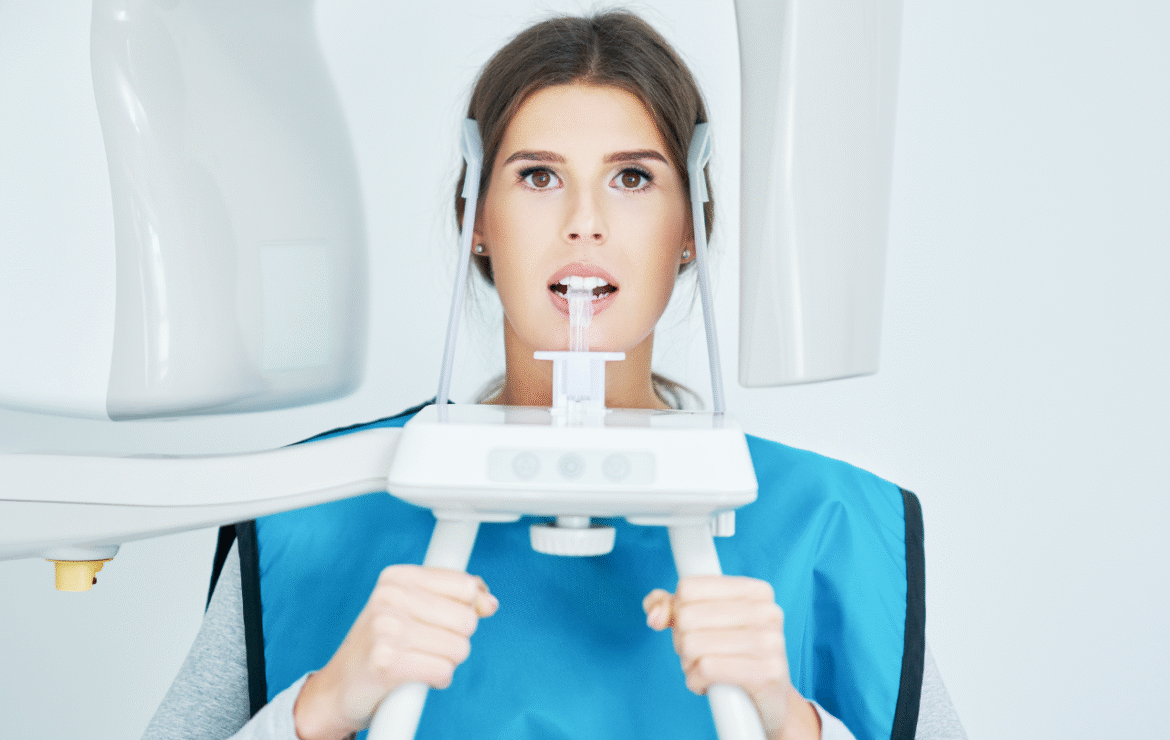
The scan happens immediately—you walk down the hall to the imaging room, the scan takes 20 seconds, and you return to the treatment room.
Your dentist reviews the scan while you wait—no days of delay, no separate appointments, no waiting for external reports.
Treatment planning happens immediately. Your dentist shows you the 3D images, explains findings, discusses treatment options, and can even start certain procedures the same day if appropriate.
One appointment. One location. Complete care coordination.
The Real Advantages You Experience
Time savings are immediate and substantial. What used to require 2-3 appointments over several weeks now happens in a single visit. For busy professionals working in Gift City or students at PDPU, eliminating multiple appointments is genuinely life-changing.
Treatment starts sooner. Dental problems don’t wait. The faster imaging happens and treatment planning is complete, the sooner actual treatment begins. Days or weeks of delay disappear entirely.
Better communication. Your dentist controls both imaging and treatment—they know exactly what views they need, can adjust imaging protocols on the fly, and understand scan findings in the context of your complete dental history.
Immediate problem-solving. If the scan reveals something unexpected, your dentist sees it immediately and adjusts the treatment plan right then—no additional appointments, no separate referrals, no extended delays.
Lower overall costs. While we’ll explore this more later, eliminating external facility fees, separate consultation charges, and time off work for multiple appointments typically makes in-house care more economical despite potentially similar scan fees.
Coordinated care. When everything happens under one roof with one team, everyone involved knows your case completely. Nothing gets lost in translation between facilities.
For patients seeking comprehensive CBCT 3D imaging in Gandhinagar, in-house capabilities represent this integrated approach to dental diagnostics and treatment.
Specific Clinical Situations Where In-House CBCT Makes a Dramatic Difference
Understanding the concept is one thing. Seeing how this plays out in specific scenarios makes it concrete.
Dental Implant Planning and Placement
“I’m getting dental implants—how does in-house imaging affect my experience?”
With external referrals:
- Consultation appointment: “You need implants. Here’s a referral for a CBCT scan.”
- Travel to imaging center, get scan, wait for results (1-2 weeks)
- Second consultation: Review scan, plan treatment, order implant components
- Wait for implant delivery (1-2 weeks)
- Third appointment: Implant surgery finally happens Total timeline: 3-5 weeks from initial consultation to surgery
With in-house CBCT:
- Consultation appointment: “You need implants” → walk to imaging room → scan done → return to treatment room → review scans together → plan treatment → order implants
- Wait for implant delivery (1-2 weeks)
- Second appointment: Implant surgery Total timeline: 1-2 weeks from initial consultation to surgery
The difference? You start healing 2-3 weeks sooner. Your new teeth are in place weeks earlier. Time matters when you’re living with missing teeth.
Additionally, having imaging on-site means your surgeon can reference the 3D scans during surgery if needed, verify positioning, and make real-time adjustments—something impossible when scans were done weeks ago at an external facility.
For comprehensive dental implant treatment in Gandhinagar, in-house CBCT scanning dramatically streamlines the entire process from consultation to completed restoration.
Wisdom Tooth Evaluation and Extraction
Impacted wisdom teeth often require CBCT scanning to visualize nerve proximity before safe extraction.
With external referrals:
- Initial consultation: “Your wisdom tooth is impacted. I need a CBCT scan before extraction.”
- Referral given, appointment scheduled at imaging center
- Scan completed, results sent to dentist (days pass)
- Follow-up consultation to review scan and schedule extraction
- Extraction appointment (might be weeks later based on schedule)
With in-house CBCT:
- Initial consultation: “Your wisdom tooth is impacted” → scan immediately → review shows safe extraction possible → “We can extract this today if you’d like, or schedule for later this week”
The advantage? Symptomatic wisdom teeth cause pain. Every day you wait for imaging appointments and follow-ups is another day of discomfort. In-house scanning can reduce this timeline from weeks to hours.
For comfortable wisdom tooth removal in Gandhinagar, immediate access to 3D imaging means safer extractions and faster relief from wisdom tooth pain.
Complex Root Canal Cases
Some root canal cases require CBCT imaging to visualize complex root anatomy, identify extra canals, or assess previous treatment failures.
Often, the need for CBCT only becomes apparent mid-treatment—your dentist is performing the root canal and encounters anatomy they can’t navigate with standard x-rays alone.
With external referrals:
- Root canal appointment interrupted
- Temporary filling placed
- You’re sent to imaging center for CBCT
- Days later, return to complete root canal based on scan findings
With in-house CBCT:
- Complex anatomy encountered during root canal
- Patient taken to imaging room for CBCT (5 minutes)
- Treatment team reviews scan immediately
- Root canal completed same appointment using 3D guidance
The advantage? Your tooth isn’t left partially treated for days with a temporary filling. Treatment is completed efficiently without interruption. Success rates improve because treatment planning adapts in real-time to anatomical findings.
TMJ Disorder Evaluation
TMJ (jaw joint) problems often require 3D imaging to assess joint anatomy, bone changes, and structural abnormalities.
With external referrals:
- You’re experiencing jaw pain and clicking
- Dentist suspects TMJ disorder, refers for CBCT
- Travel to imaging center, get scan
- Wait for results and interpretation
- Return for consultation to discuss findings and treatment options
- Treatment begins (if needed) at subsequent appointment
With in-house CBCT:
- You describe jaw pain and clicking
- Immediate CBCT of TMJ joints
- Review images together: “Here’s what’s happening in your joint—see this bone change?”
- Discuss treatment options immediately
- Begin treatment (appliance, therapy, or referral as needed)
The advantage? TMJ pain is debilitating. Collapsing multiple appointments into one means faster diagnosis and faster relief. You’re not waiting weeks wondering what’s wrong—you get answers immediately.
The Hidden Cost Factor: In-House vs. External Imaging
“Don’t in-house scans cost more since the dental clinic has to pay for the equipment?”
This is a common misconception. Let’s examine the real economics.
What External Imaging Actually Costs
The scan fee itself might be ₹3,000-5,000 at an external diagnostic center. But that’s not the total cost:
Travel expenses: Fuel, parking, or transportation to get to the imaging center and back.
Time off work: Taking 2-3 hours off work for the imaging appointment, potentially losing income.
Multiple consultation fees: Your dental clinic might charge separate consultation fees for the initial visit and the follow-up to review scan results.
Treatment delays: Days or weeks of delay might mean more extensive (expensive) treatment if the problem worsens while you wait.
Coordination errors: If imaging doesn’t capture what your dentist needs, you might need repeat scans at additional cost.
Hidden facility fees: Some imaging centers charge separate fees for CD copies, professional interpretation, or report generation.
When you calculate true total cost—including time and indirect expenses—external imaging often costs more than integrated in-house care.
How In-House Imaging Changes Economics
In-house scan fees might be similar to external centers (₹3,000-5,000 range), but the overall cost structure is different:
No travel costs since imaging happens where you already are.
No additional time off work for separate imaging appointments.
Consolidated consultation fees since evaluation and treatment planning happen in one visit rather than multiple appointments.
Faster treatment means problems don’t worsen during imaging delays.
Better first-time capture because your dentist controls imaging and gets exactly what they need.
Additionally, some practices with in-house equipment offer package pricing where imaging is included in treatment costs rather than charged separately—impossible when outsourcing to external centers.
The Value Beyond Pure Cost
Even if costs were identical (which they often aren’t when calculating true total cost), the value of in-house imaging extends beyond rupees:
Time is valuable. Eliminating 1-2 extra appointments saves hours of your life.
Coordination is valuable. Treatment with better communication produces better outcomes.
Speed is valuable. Starting treatment weeks sooner means faster resolution of dental problems.
Convenience is valuable. Not juggling multiple facilities and appointments reduces stress and complexity.
For most patients, in-house CBCT represents better value even before considering the pure financial cost comparison.
At our dental clinic in Gandhinagar, integrated imaging ensures patients receive comprehensive care efficiently without the hidden costs and delays that external referrals create.
💡 Quick Tip: When comparing dental practices, ask not just “How much does the scan cost?” but “Will I need to travel to a separate imaging center, or do you have CBCT on-site?” The second question reveals far more about your total experience and costs.
The Clinical Quality Advantage
Beyond convenience and cost, in-house CBCT capabilities affect the actual clinical quality of your treatment.
Real-Time Treatment Modification
Dental treatment rarely goes exactly as initially planned. Anatomy varies, unexpected findings emerge, complications arise.
With in-house imaging, your dentist can adapt immediately:
- Mid-implant surgery, if bone quality is different than expected: pause, take additional scans, modify approach
- During root canal, if extra canals are suspected: confirm with immediate CBCT, adjust treatment
- If initial treatment plan proves inappropriate based on findings: revise and implement new approach same visit
Without in-house imaging, these scenarios mean aborted procedures, additional appointments, and treatment delays while imaging is obtained externally.
Better Communication = Better Outcomes
When the same team controls both imaging and treatment, communication is seamless.
Your dentist can:
- Request specific imaging views knowing exactly what they need
- Adjust scan protocols mid-scan if additional information would help
- Correlate imaging findings with clinical examination immediately
- Discuss unusual findings with imaging technicians who understand the clinical context
With external imaging, you get whatever standard protocol the imaging center uses. Your dentist can’t request adjustments, can’t discuss findings with imaging staff in real-time, and must work with whatever images arrive—adequate or not.
Immediate Problem Identification
Some scan findings require urgent attention that delayed diagnosis undermines.
Examples:
- Infection or pathology requiring immediate treatment
- Anatomical variations making planned treatment unsafe
- Unexpected complications from previous treatment
- Critical anatomical proximity to nerves or sinuses
With in-house scans, these findings are identified and addressed immediately. With external referrals, days or weeks pass before your dentist even sees the scans—during which conditions might worsen.
Higher Standards Through Integration
Practices that invest in CBCT equipment typically maintain higher overall standards. The investment signals commitment to advanced care, not just basic dentistry.
If a practice has spent lakhs on CBCT technology, they’ve also likely invested in:
- Advanced training for their dentists
- Modern treatment techniques requiring 3D imaging
- Surgical capabilities that imaging supports
- Overall facility and equipment excellence
In-house CBCT isn’t just one piece of equipment—it’s typically an indicator of practice-wide commitment to clinical excellence.
🔑 Key Takeaway: In-house imaging isn’t just about convenience—it fundamentally improves treatment quality through real-time adaptation, better communication, immediate problem identification, and the overall practice standards it represents.
Comparing In-House vs. External: The Complete Picture
| Factor | External Imaging Referral | In-House CBCT |
|---|---|---|
| Number of Appointments | 3+ (consult, imaging center, follow-up) | 1-2 (often everything in one visit) |
| Time from Consult to Treatment | 2-4 weeks typically | Days or same-day for urgent cases |
| Travel Required | Yes—to imaging center and back | No—everything in one location |
| Imaging-Treatment Coordination | Fragmented—different facilities | Seamless—same team |
| Real-Time Problem Solving | Not possible—days between imaging and review | Immediate—adjustments happen on the spot |
| Cost Transparency | Multiple facility fees, travel costs, time off work | Consolidated—fewer hidden costs |
| Treatment Delays | Common—waiting for imaging appointments and results | Minimal—scan-to-treatment happens rapidly |
| Communication Quality | Low—imaging center doesn’t know your case | High—your dentist controls both imaging and treatment |
| Flexibility | Limited—stuck with whatever imaging center captured | High—can rescan or adjust protocols immediately |
| Patient Stress | Higher—multiple facilities, appointments, waiting | Lower—streamlined, single-location care |
| Emergency Situations | Problematic—can’t get urgent imaging quickly | Manageable—immediate access to imaging |
| Treatment Quality | Good but limited by coordination gaps | Superior through integrated care |
| Overall Experience | Fragmented, time-consuming | Efficient, patient-friendly |
What Patients Actually Say About the Difference
Real patient experiences reveal why in-house imaging matters beyond theoretical advantages.
Before: External Referral Experience
“I needed dental implants. My dentist referred me to a diagnostic center in another part of the city. I scheduled the appointment for the following week since they were booked. Took half a day off work, drove across town, waited 45 minutes past my appointment time, got the scan, drove back. A week later, my dentist finally got the results. Then we scheduled another consultation to discuss treatment. By the time implant surgery actually happened, it had been five weeks since my initial visit. The whole process felt so inefficient.” — Patient experience with external referral
After: In-House CBCT Experience
“I went to Nova Dental Hospital for implant consultation. Dr. Patel examined me, said I needed a 3D scan, and had me walk to the imaging room immediately. Twenty seconds later, the scan was done. We went back to the treatment room, he showed me the 3D images on his screen, measured everything, explained exactly what would happen, and scheduled my implant surgery for the following week. One appointment, maybe 45 minutes total. I couldn’t believe how simple it was compared to what friends had told me to expect.” — Patient experience with in-house CBCT
The contrast is stark. Five weeks versus one week. Multiple facilities versus one location. Uncertainty versus clarity.
💡 Quick Tip: When evaluating dental practices, read reviews specifically for mentions of convenience, appointment efficiency, and “getting everything done in one place.” These comments often indicate in-house imaging capabilities even when not explicitly stated.
For Complex Cases: Why In-House CBCT Is Essential
Some dental situations absolutely require in-house imaging for optimal outcomes.
Full Mouth Rehabilitation
Patients needing multiple implants and extensive restoration benefit enormously from in-house capabilities.
Full mouth rehabilitation involves:
- Multiple CBCT scans at different treatment phases
- Constant reference to imaging during surgery
- Treatment modifications based on healing progression
- Coordination between multiple specialists
With external imaging, each scan means separate appointments, delays, and coordination complexity. With in-house CBCT, imaging is obtained whenever needed without disrupting the treatment flow.
For comprehensive full mouth rehabilitation in Gandhinagar, integrated imaging is essential for coordinating the complex, multi-phase treatment these cases require.
Bone Grafting and Surgical Planning
Bone grafting before implants requires precise imaging to assess deficits and plan graft volume.
Often, the need for grafting only becomes clear after detailed CBCT evaluation. If that evaluation happens at an external center days after initial consultation, you’ve lost time. If it happens in-house immediately, grafting can be scheduled right away.
Additionally, post-grafting healing monitoring might require follow-up CBCT scans. In-house capabilities make this monitoring seamless rather than requiring repeated referrals.
Surgical Complications and Emergencies
Dental emergencies don’t schedule themselves around imaging center hours.
If complications arise during or after dental surgery requiring immediate imaging—a suspected bone fracture, unusual bleeding indicating sinus perforation, concern about implant positioning—in-house CBCT means immediate evaluation.
External centers might not have emergency availability. Your dentist might not be able to get you scanned for days. In emergencies, this delay is unacceptable.
Choosing a Dental Practice: The Imaging Capability Factor
“I’m choosing where to get my dental implants done. How much weight should I give to whether they have in-house CBCT?”
Significant weight. Here’s why.
It Signals Overall Practice Commitment
Investing in CBCT equipment costs lakhs. Practices make this investment because they’re committed to advanced dentistry—implants, oral surgery, complex cases.
A practice with in-house CBCT is telling you:
- We do advanced procedures requiring 3D imaging regularly
- We’ve invested in your convenience and treatment quality
- We have the patient volume to justify this equipment (meaning experience)
- We’re equipped for complex cases, not just basic dentistry
Practices referring everything out for imaging might be excellent at cleanings and fillings but are likely not equipped for advanced procedures.
Questions to Ask When Evaluating Practices
“Do you have CBCT imaging on-site, or do I need to go elsewhere for scans?”
The answer reveals their capabilities immediately.
“If I need a 3D scan, how does that process work?”
Listen for whether they describe an in-house workflow or a referral process.
“How quickly can treatment start after deciding I need dental implants?”
Practices with in-house imaging can typically start within 1-2 weeks. Practices outsourcing imaging might quote 3-4 weeks.
“Can I see the 3D images during treatment planning?”
In-house capabilities make this easy. External referrals might mean your dentist shows you images on their computer but the experience is less immediate.
Red Flags
Be cautious if:
- The practice routinely refers simple cases out for imaging (suggests lack of advanced capabilities)
- They’re defensive when you ask about in-house imaging (“We don’t need that—external centers work fine”)
- They can’t give you a clear timeline from consultation to treatment start
- Reviews mention multiple appointments and fragmented care
The Future Is Integrated Care
Dentistry is moving toward integrated digital workflows where imaging, planning, and treatment happen seamlessly in one location.
Practices without in-house CBCT are increasingly finding themselves at a competitive disadvantage. Patients expect convenience. They expect speed. They expect coordination. External referrals for routine advanced imaging no longer meet these expectations.
Forward-thinking practices recognize that in-house capabilities aren’t optional extras—they’re essential components of modern dental care.
If you’re choosing where to receive treatment, choosing practices with advanced in-house capabilities positions you for better experiences and better outcomes.
Why Nova Dental Hospital in Gandhinagar for Your 3D Dental Imaging
At Nova Dental Hospital, Gandhinagar, we built our practice around integrated, efficient patient care.
Our in-house CBCT and OPG imaging facility means:
Same-day consultation and imaging for patients needing 3D scans before implant surgery, wisdom tooth removal, or complex procedures.
Immediate treatment planning as Dr. Happy Patel reviews your scans with you present, answers questions, and discusses options—not days later after results arrive from external centers.
Faster treatment timelines from consultation to completed treatment, eliminating the weeks of delay that external referrals create.
Better coordination between imaging and surgical teams since we control both—no information lost between separate facilities.
Lower overall costs through consolidated care that eliminates travel, multiple appointments, and hidden external facility fees.
Advanced treatment capabilities including complex implants, full mouth rehabilitation, surgical extractions, and procedures requiring 3D guidance—all supported by immediate access to diagnostic imaging.
Conveniently located near PDPU and Gift City, we serve patients throughout Gandhinagar who expect efficient, modern dental care without the fragmentation that external imaging referrals create.
Visit our Google Business profile to see what patients say about experiencing truly integrated dental care.
Frequently Asked Questions
Is a 3D dental scan really necessary, or is it just an expensive add-on?
For certain procedures, CBCT 3D scans are medically necessary—not optional extras or upsells. Dental implant placement absolutely requires 3D imaging to see bone dimensions, nerve locations, and sinus proximity that 2D x-rays cannot show. Complex wisdom tooth extractions need 3D imaging to visualize nerve proximity and avoid permanent numbness. Difficult root canal cases require 3D visualization of root anatomy. TMJ evaluations need 3D imaging of joint structures. However, routine cleanings, simple fillings, and basic procedures don’t need 3D imaging—standard x-rays work fine. The question isn’t “is 3D imaging necessary” in general but rather “is it necessary for my specific procedure.” If your dentist recommends CBCT for an advanced procedure like implants, they’re following appropriate medical standards. If they recommend it for a simple filling, question why. But don’t confuse legitimate medical necessity with unnecessary upselling—they’re different situations entirely.
How much does a 3D dental scan cost in Gandhinagar, and is in-house more expensive?
3D dental scan costs in Gandhinagar typically range from ₹3,000-6,000 depending on the imaging area and facility. In-house dental clinic scans often cost similar to or less than external diagnostic centers because clinics can offer competitive pricing when imaging is integrated into overall treatment costs. However, the true cost comparison must include travel expenses, time off work, multiple consultation fees, and treatment delays when using external centers. When calculating total costs including indirect expenses, in-house imaging usually proves more economical despite potentially similar scan fees. Some practices with in-house equipment include imaging in treatment package pricing rather than charging separately—impossible when outsourcing externally. The bigger question isn’t “which scan fee is lower” but “what’s my total cost and time investment for complete treatment.” In-house capabilities almost always win on total value even when isolated scan fees appear comparable.
Can’t my dentist just refer me to a good diagnostic center—why does in-house matter?
External diagnostic centers can provide quality scans, but they cannot provide integrated care. The scan quality might be excellent, but you still face multiple appointments, treatment delays, communication gaps, and fragmented care. Even the best diagnostic center doesn’t know your dental history, understand your specific treatment plan, or communicate efficiently with your dentist beyond sending images. In-house imaging isn’t primarily about scan quality (though modern in-house equipment is excellent)—it’s about care integration, treatment speed, real-time problem-solving, and patient convenience. Think of it this way: An external radiology center can take a perfect MRI of your knee, but would you want orthopedic surgery at a separate hospital where the surgeon hasn’t been involved in your imaging evaluation? In-house capabilities mean the people treating you control the diagnostic process from start to finish. That integration produces better overall experiences and often better clinical outcomes regardless of isolated scan quality.
What if I’ve already had a CBCT scan done elsewhere—will a new dentist accept those images?
Most dentists can review CBCT scans done elsewhere if the images are recent and of good quality. You’ll need to obtain a CD or digital copy of your scans from the original facility (they’re legally required to provide this). However, several situations might require new scans: if previous scans are more than 6-12 months old and anatomy might have changed, if scan quality was poor or didn’t capture necessary views, if your new dentist needs different imaging protocols for their specific treatment planning, or if you’re getting complex treatment where your dentist wants complete control over imaging parameters. Practices with in-house CBCT are more flexible about reviewing external scans since they can easily supplement with additional views if needed. Practices without CBCT equipment have no choice but to work with whatever external scans you provide. Ask your new dentist during consultation whether previous scans are adequate or if new imaging is recommended—and listen to their reasoning about why.
Do all dental procedures require going to a teeth scan center, or just certain treatments?
Only specific advanced procedures require 3D CBCT scans—routine dental care uses standard x-rays. CBCT scanning is specifically indicated for: dental implant planning (essential), wisdom tooth evaluation when impacted or near nerves (often necessary), complex root canal cases with unusual anatomy (sometimes needed), TMJ disorder evaluation (helpful for diagnosis), surgical extractions with complications (sometimes required), orthodontic treatment for specific cases (occasionally useful), and evaluation of jaw pathology or cysts (diagnostic). Regular procedures that don’t need CBCT include: routine cleanings, simple cavities and fillings, standard crowns and bridges, uncomplicated tooth extractions, basic gum disease treatment. With in-house CBCT capabilities, your dentist can immediately obtain 3D imaging when clinically indicated without referring you elsewhere. Without in-house equipment, even cases requiring CBCT must be sent to external scan centers. The advantage of choosing a practice with in-house capabilities isn’t that you’ll necessarily have more scans—it’s that when scans are medically necessary, they happen conveniently and efficiently.

Related posts
Write a Comment
Recent Posts


