


Space Maintainers for Children: What They Are and Why Early Tooth Loss Matters
Space Maintainers for Children: What They Are and Why Early Tooth Loss Matters

The Problem Most Parents Do Not Know to Watch For
When a child loses a baby tooth — whether from decay, trauma, or an extraction — the natural parental assumption is that the situation will resolve itself. The permanent tooth is on its way, and eventually everything will sort out. This assumption is correct when a tooth falls out naturally at the right developmental time. It is significantly incorrect when a tooth is lost before its time — weeks, months, or years earlier than the normal shedding sequence would have produced.
Early tooth loss — premature loss of a primary tooth before the permanent successor is close to erupting — sets in motion a predictable chain of events in the developing jaw. The teeth on either side of the gap begin to drift into the space. The tooth opposing the gap may begin to over-erupt into it. The arch length decreases. And when the permanent tooth eventually attempts to erupt into the position its predecessor held, it finds the space partially or completely blocked — erupting in an abnormal position, becoming impacted, or failing to erupt at all without orthodontic intervention.
A space maintainer is the clinical intervention that prevents this chain of events. It is a simple, well-established dental appliance that holds the space open after premature tooth loss until the permanent tooth is ready to erupt — at which point it is removed and the permanent tooth takes its place. This guide explains what space maintainers are, which teeth and situations require them, what types are available, how they are fitted and managed, and what happens when they are not used.
🔑 Key Takeaways
- A space maintainer is a dental appliance — fixed or removable — placed after premature loss of a baby tooth to hold the gap open until the permanent successor is ready to erupt.
- When a baby tooth is lost early, adjacent teeth begin drifting into the space within weeks. This reduces or eliminates the space available for the permanent tooth, which may then erupt in the wrong position, become crowded, or fail to erupt without orthodontic intervention.
- Not every early tooth loss requires a space maintainer — the decision depends on which tooth was lost, how old the child is, how close the permanent successor is to erupting, and whether adjacent teeth have already drifted.
- Space maintainers are most commonly indicated for premature loss of primary second molars — the baby teeth that hold space for the permanent premolars, which typically do not erupt until age 10 to 12.
- The appliance is simple, well-tolerated by children, and requires only minor home care. It is removed when X-rays confirm the permanent tooth is close enough to eruption to maintain the space on its own.
- The cost of a space maintainer is a fraction of the cost of the orthodontic treatment that is frequently required when space is not maintained — and the earlier an assessment is made after tooth loss, the more options are available.
Why Baby Teeth Hold Space — The Architecture of the Developing Jaw
To understand why a space maintainer is necessary, it helps to understand the functional role that primary teeth play in the developing jaw — a role that extends well beyond chewing food.
The Primary Teeth as Space Holders
The 20 primary teeth are not simply placeholders that occupy space until the permanent teeth arrive. They are active guides for jaw development and tooth eruption. Each primary tooth maintains the arch length and position for the permanent tooth developing in the bone beneath it. The roots of the primary teeth provide a pathway that the erupting permanent tooth follows as it moves upward through the bone. The contact between adjacent primary teeth holds the teeth in their correct positions relative to each other and prevents the slow drift that begins the moment a contact point is lost.
The permanent teeth — all 28 of them, excluding wisdom teeth — are developing in the jaw throughout childhood. They are not waiting passively in fixed positions; they are slowly moving upward through the bone on a trajectory that ends at the position their primary predecessor holds. If that position has changed — because adjacent teeth have drifted into the gap left by an early extraction — the permanent tooth follows a different, abnormal trajectory.
What Happens When a Baby Tooth Is Lost Early
The sequence of events following premature primary tooth loss is predictable and well-documented. Within days to weeks of the extraction, the teeth adjacent to the gap begin to drift. The mesial drift tendency — the natural inclination of teeth to move toward the front of the mouth — means that the tooth behind the gap moves forward. The tooth in front of the gap tips backward. The opposing tooth begins to supra-erupt (move downward or upward) into the unoccupied space.
Over months and years, this drift progressively reduces the space available in the arch. When the permanent tooth finally reaches the point of eruption, it finds a space that is smaller than it needs — sometimes significantly smaller. Depending on the degree of space loss, the permanent tooth may: erupt in a rotated or tipped position; erupt partially and become impacted; fail to erupt and remain buried in the bone; or displace an adjacent tooth to make room, causing a secondary crowding problem.
The clinical significance of this sequence is that it is preventable — a space maintainer placed promptly after premature tooth loss stops the drift before it begins. And it is time-sensitive — the earlier the assessment after tooth loss, the more likely it is that drift has not yet occurred and the easier the intervention.
Which Teeth Matter Most — and Why the Second Primary Molar Is Critical
Not All Early Losses Are Equal
The clinical significance of premature tooth loss varies by tooth position and by the child’s age and stage of development. A baby central incisor lost at age 5 — two years before it would normally shed — in a child with adequate spacing and no signs of adjacent drift may not require a space maintainer. A primary second molar lost at age 6 in a child who will not have the permanent premolar erupting for another four to six years almost certainly does.
The primary second molar (the second baby back tooth on each side) is the most clinically significant tooth for space maintenance. It is the last primary tooth to be shed — not replaced until the second premolar erupts at approximately age 10 to 12. If it is lost prematurely — from decay, infection, or extraction — the first permanent molar behind it drifts significantly forward over the years between the extraction and the second premolar’s eruption. The resulting space loss frequently produces severe crowding that requires extensive orthodontic treatment to correct.
The Front Teeth
Space maintenance for the primary incisors (front teeth) is less commonly indicated for arch length reasons — the permanent incisors are typically close to erupting within a year or two of when the primary incisors naturally shed, and the space tends to be maintained adequately by the remaining teeth in most cases. However, premature loss of upper primary incisors from early childhood caries may warrant assessment for aesthetic and functional reasons, particularly if the gap is affecting speech development or the child’s confidence.
The First Primary Molar
The first primary molar is shed at approximately age 9 to 11, replaced by the first premolar. Premature loss of the first primary molar may warrant a space maintainer if the first permanent molar has not yet erupted (which would provide a distal stop to prevent forward drift) and if the age of the child means the premolar is still several years away from erupting.
| Tooth Lost | Normal Shedding Age | Permanent Successor Erupts | Space Maintainer Usually Needed? |
| Primary central incisor | 5–7 years | 6–8 years | Often no — successor close; assess case by case |
| Primary lateral incisor | 6–8 years | 7–9 years | Often no — assess case by case |
| Primary canine | 9–12 years | 9–11 years | Sometimes — if lost very early; assess |
| Primary first molar | 9–11 years | 10–12 years (premolar) | Often yes — if first permanent molar not yet erupted |
| Primary second molar | 10–12 years | 11–13 years (premolar) | Almost always yes — highest priority for space maintenance |
Types of Space Maintainers — Fixed and Removable
Space maintainers come in fixed and removable forms. The choice depends on the tooth position, the number of teeth lost, the child’s age and cooperation, and the clinical judgement of the dentist.
Band and Loop Space Maintainer
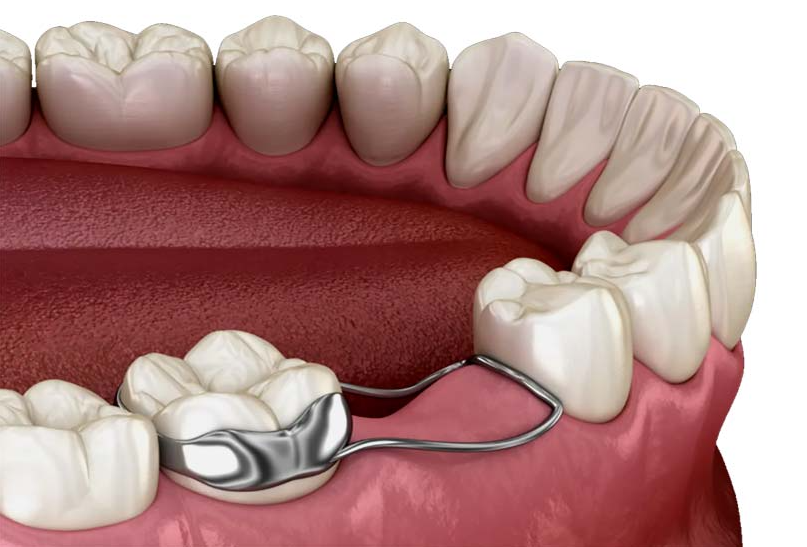
The most commonly used fixed space maintainer. A stainless steel band is cemented around the tooth adjacent to the gap (typically the first permanent molar), and a wire loop extends from the band across the gap to rest against the tooth on the other side. The loop holds the adjacent teeth in their current positions and prevents drift into the gap. It is fixed — the child cannot remove it — which makes compliance straightforward.
Band and loop maintainers are simple, durable, and well-tolerated by children. They do not interfere significantly with eating or speech. The main home care requirement is to avoid very sticky foods (chewing gum, toffee, sticky sweets) that could dislodge the cemented band, and to brush carefully around the loop and band margins.
Distal Shoe Space Maintainer
Used specifically when the first permanent molar has not yet erupted. Unlike a band and loop — which requires an erupted tooth to anchor against — the distal shoe has a small metal extension that is placed beneath the gum tissue to guide the erupting first permanent molar into its correct position while simultaneously holding the space. It is the most technically demanding space maintainer to place and requires regular monitoring as the permanent molar erupts. It is replaced by a band and loop once the first permanent molar has fully erupted.
Nance Holding Arch and Transpalatal Arch
Used when multiple teeth have been lost on both sides of the upper arch. These are bilateral fixed appliances that connect across the palate — the Nance arch has an acrylic button that rests against the palate, while the transpalatal arch is a wire that crosses the palate without the acrylic pad. Both prevent the upper molars from drifting forward and the arch from narrowing.
Lingual Arch
The lower jaw equivalent of the Nance and transpalatal arch — a wire connecting the lower molars that runs along the inside of the lower front teeth, preventing the molars from drifting forward.
Removable Space Maintainer
A removable appliance — similar in appearance to a retainer — with artificial teeth replacing the missing primary teeth. Used primarily for cosmetic and functional reasons (speech, eating, aesthetics) when multiple upper front teeth are missing. Removable appliances depend on patient compliance — they must be worn consistently to be effective. For very young children or children with limited cooperation, fixed appliances are generally preferred.
| Type | How It Works | Best For | Key Consideration |
| Band and Loop | Wire loop from a banded adjacent tooth holds the space | Single missing back tooth; most common type | Avoid sticky foods; brush carefully at band margins |
| Distal Shoe | Metal extension beneath gum guides erupting first molar | Loss of second primary molar before first permanent molar has erupted | Most complex type; requires close monitoring during molar eruption |
| Nance / Transpalatal Arch | Palatal wire connects upper molars bilaterally | Multiple upper teeth lost; bilateral space loss | Good compliance with oral hygiene essential |
| Lingual Arch | Wire connects lower molars along inside of lower teeth | Multiple lower teeth lost; bilateral lower space loss | Brush carefully along the wire |
| Removable Appliance | Removable plate with artificial teeth | Multiple front teeth missing; cosmetic and functional needs | Compliance-dependent; less reliable for back tooth space maintenance |
How a Space Maintainer Is Fitted
The Assessment
When a primary tooth is extracted or lost, the paediatric dentist assesses whether a space maintainer is indicated. This involves a clinical examination of the remaining teeth — looking for any early drift that has already occurred — and an X-ray to assess the position of the permanent successor. The X-ray gives the most important single piece of information: how far the permanent tooth is from eruption. If the permanent tooth is within six to twelve months of erupting, a space maintainer may not be warranted. If it is two to five years away, space maintenance is almost always the correct recommendation.
Fitting the Band and Loop
For the most common type — the band and loop — the appointment involves selecting and fitting a stainless steel band to the adjacent tooth, taking an impression of the fitted band and the gap, and sending the impression to a dental laboratory for the loop to be fabricated. The fabricated appliance is cemented at a second appointment, typically one to two weeks later. The whole process involves two appointments, neither of which requires local anaesthesia, and the appliance is in place and functional from the day of cementation.
Monitoring and Removal
The space maintainer is monitored at every check-up — the band margins are checked for any loosening, the wire loop is checked for any distortion, and an X-ray is taken at appropriate intervals to monitor the eruption progress of the permanent successor. When the permanent tooth is confirmed by X-ray to be close to erupting — with the root sufficiently formed and the tooth close enough to the surface that it will erupt without losing the space — the space maintainer is removed. Removal requires only a band remover instrument and takes a matter of minutes. No anaesthesia is needed.
What Happens Without a Space Maintainer
The clinical consequences of not placing a space maintainer after premature tooth loss are predictable and well-documented. They range from moderate to severe depending on the tooth lost, the age at loss, and how long the space was left unmanaged.
Crowding of the Permanent Dentition
The most common consequence. Adjacent teeth drift into the gap, reducing arch length. When the permanent successor attempts to erupt, it finds insufficient space. It erupts in a rotated or tipped position, or displaces an adjacent tooth. The result is a crowded permanent dentition that requires orthodontic treatment to correct — typically fixed braces or clear aligners and in many cases extractions to create enough space for alignment.
Impaction of the Permanent Tooth
In more severe cases, the permanent tooth becomes impacted — unable to erupt because the space is blocked. An impacted premolar or canine may require surgical exposure and orthodontic traction to bring it into position — a significantly more complex and expensive intervention than a space maintainer would have been.
Bite Problems
Drifting and over-eruption of the teeth adjacent to and opposing the gap can alter the bite relationship, producing an uneven bite, a midline shift, or a posterior open bite. These bite problems compound the crowding and add to the complexity of the orthodontic correction required.
The Cost Comparison
A space maintainer is a simple appliance placed over one or two appointments. It is significantly less expensive than the orthodontic treatment required to correct the crowding and impaction that result from its absence. For parents weighing the cost of a space maintainer against the anticipated cost of ‘just fixing it with braces later’, the orthodontic correction of severe crowding — particularly if it involves impacted teeth — is considerably more expensive, more time-consuming, and more uncomfortable for the child than the preventive intervention.
⚠️ Signs That Warrant Prompt Assessment After a Child Loses a Tooth Early
- Any primary tooth extracted due to decay or infection — request a space assessment at the same appointment or immediately after
- A baby tooth that came out unexpectedly early — earlier than the typical shedding age for that tooth position
- A child whose permanent tooth has not erupted within six months of the baby tooth falling out naturally
- Visible drifting of teeth adjacent to a gap — teeth appear to be leaning into the space
- A permanent tooth erupting in an unusual position — behind the baby tooth, to the side, or in a rotated position
- A parent who was not informed about space maintenance at the time of the extraction — seek a second assessment
Managing a Space Maintainer at Home
✅ Home Care for a Space Maintainer
- Brush carefully around the band and loop twice daily — plaque accumulates at the band margins and around the wire, which can lead to decay at the band margin if not cleaned regularly.
- Avoid sticky foods — chewing gum, toffee, sticky sweets, and hard lollies can dislodge the cemented band. These should be avoided for the duration of appliance wear.
- Do not attempt to adjust or bend the wire — if the loop seems distorted or is catching on something, contact the clinic rather than attempting to fix it at home.
- Report any loosening immediately — a loose band or loop provides no space maintenance benefit and can be swallowed or aspirated if it detaches entirely. Any sensation of looseness warrants a prompt appointment.
- Attend all scheduled check-up appointments — the space maintainer needs to be monitored and the eruption of the permanent tooth needs to be tracked by X-ray at regular intervals.
Frequently Asked Questions
FAQ 1: My child just had a baby tooth pulled out. Do they definitely need a space maintainer?
Not necessarily — the decision depends on which tooth was extracted, how old your child is, and how close the permanent successor is to erupting. The best way to find out is a prompt assessment at Nova Dental Hospital’s paediatric dentistry team, ideally at the extraction appointment or very shortly after. The dentist will take an X-ray to assess the permanent tooth’s position and advise whether space maintenance is clinically indicated. The earlier this assessment happens, the more likely it is that no drift has yet occurred and the simpler the intervention if one is needed.
FAQ 2: My child lost a front tooth early. Does that need a space maintainer?
For front teeth, space maintenance for arch length reasons is less commonly indicated than for back teeth — the permanent incisors are usually close enough to erupting that the space does not close significantly in most children. However, an assessment is still worthwhile to confirm this, and a removable appliance with an artificial tooth may be recommended for aesthetic and speech reasons if multiple front teeth are missing. The loss of upper front teeth from early childhood caries in a very young child — before age 4 — is a different situation from natural early shedding and warrants assessment regardless.
FAQ 3: How long does a space maintainer need to stay in?
Until the permanent successor is close enough to erupting that it will erupt into the maintained space without further support. The dentist monitors the eruption progress at check-up appointments with periodic X-rays. In most cases, the maintainer stays in place for months to a few years — depending on how far the permanent tooth was from erupting when the primary tooth was lost. A second primary molar lost at age 6 may require space maintenance for four to five years until the second premolar erupts. A primary first molar lost at age 8 may only require it for one to two years.
FAQ 4: Will my child need braces even if they have a space maintainer?
A space maintainer prevents the specific crowding that results from space loss after premature tooth loss — it does not address other factors that may contribute to a need for orthodontic treatment, such as jaw size discrepancy, crowding from tooth size-arch size mismatch, or other bite issues. A child with a space maintainer may still need orthodontic treatment for reasons unrelated to the early tooth loss. What the space maintainer prevents is the need for orthodontic treatment that would otherwise specifically be required to correct the space loss and its downstream consequences. It limits the orthodontic complexity, even if it does not eliminate the need for any orthodontics entirely.
FAQ 5: My child’s baby tooth fell out and the gap has been there for six months. Is it too late for a space maintainer?
Not necessarily — but the assessment is more urgent the longer the gap has been present, because drift progresses over time. An X-ray will show how much drift has already occurred and whether the permanent tooth position has been affected. If some drift has occurred but the space is still largely intact, a space maintainer can prevent further loss. If significant drift has already closed the space, the approach shifts to whether orthodontic treatment to reopen the space is appropriate. The longer the assessment is delayed, the more complex the situation becomes. Book a paediatric dental check-up and bring it to the dentist’s attention — even if the gap has been there a while, an assessment is always better than no assessment. Patients are welcome to read about paediatric care experiences on our Google Business Profile.
🔑 Key Takeaways
- Space maintainers prevent the arch space collapse that follows premature baby tooth loss — a predictable consequence that almost always leads to crowding and orthodontic complexity if not managed.
- The primary second molar is the highest-priority tooth for space maintenance. Lost years before the permanent premolar is ready to erupt, its gap attracts forward drift from the permanent molar behind it.
- Assessment should happen promptly after any early tooth loss — the earlier the assessment, the more likely that drift has not yet occurred and the simpler the intervention.
- Band and loop space maintainers are the most commonly used type — simple, fixed, durable, and well-tolerated by children from around age 4 upward.
- The cost of a space maintainer is a fraction of the cost of the orthodontic treatment required when space is not maintained. Prevention is significantly more economical than correction.
- Regular monitoring at dental check-ups is essential — the maintainer needs to be confirmed intact, and the permanent tooth’s eruption progress tracked by X-ray.
Conclusion: Prevention That Costs Far Less Than the Alternative
Space maintainers are one of the most cost-effective interventions in paediatric dentistry — simple to place, well-tolerated by children, and highly effective at preventing a chain of developmental consequences that is difficult and expensive to correct once it has progressed.
The parents most likely to need a space maintainer for their child are those whose child has had a primary molar extracted due to decay — which is why addressing childhood caries early, as covered in our blog on cavities in children, is the first preventive priority. When an extraction is unavoidable, the space maintainer is the second line of prevention — keeping the consequences of that extraction from cascading into the permanent dentition.
If your child has had a baby tooth extracted or lost prematurely, book an assessment at Nova Dental Hospital’s paediatric dentistry team in Gandhinagar. A brief clinical examination and an X-ray give a clear picture of whether space maintenance is needed — and if it is, placing the appliance promptly is the simplest and most economical path forward.

Related posts

Write a Comment
Recent Posts


