


How to Keep Your Child’s Teeth Healthy Between Dental Visits (Room-by-Room Guide)
How to Keep Your Child’s Teeth Healthy Between Dental Visits (Room-by-Room Guide)

QUICK ANSWER
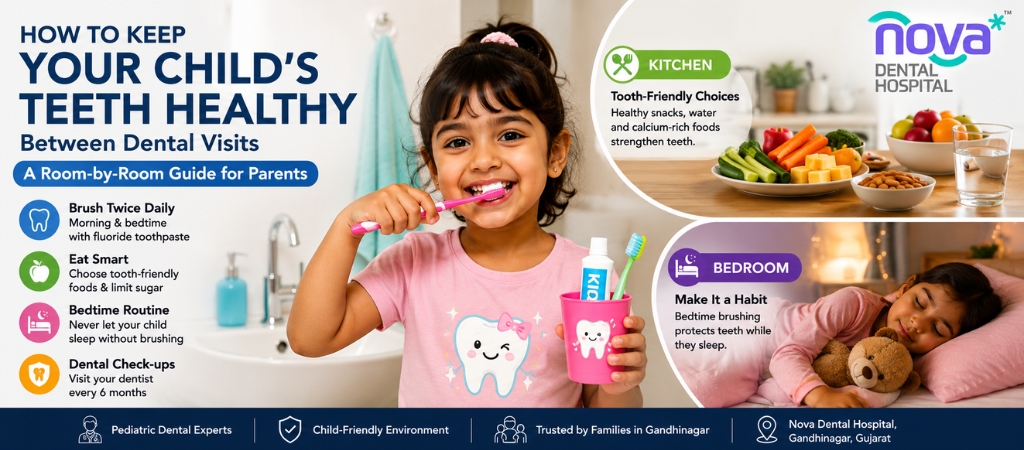
To keep your child’s teeth healthy between dental visits, build a consistent room-by-room routine: brush twice daily with age-appropriate fluoride toothpaste, floss from age 6+, choose tooth-friendly snacks in the kitchen, limit sugary drinks, and make bedtime brushing non-negotiable. These daily habits, combined with professional check-ups every 6 months, are the most reliable way to prevent cavities and protect your child’s smile. |
QUICK SUMMARY — Key Takeaways
• Brush teeth twice a day — morning and bedtime — using fluoride toothpaste suited to your child’s age. • Flossing should begin as soon as two teeth touch, usually around age 2–3. • The kitchen is the #1 source of dental risk — limit sugar, encourage water and dairy. • Bedrooms are where the habit is made or broken — never let children sleep without brushing. • Bathrooms should have child-friendly, visible dental tools to encourage consistency. • Tooth-friendly snacks (cheese, vegetables, nuts) actively help remineralise enamel. • A dental visit every 6 months catches problems before they become painful or expensive. • Early habits formed before age 5 are the strongest predictor of lifelong oral health. |
Introduction
Most parents think good dental health begins and ends at the dentist’s chair. In reality, the six months between professional visits are where the real work happens — in your bathroom, kitchen, and bedroom, every single day.
As a parent, you play a more powerful role in your child’s oral health than any dentist can. The routines you establish at home determine whether your child walks into their next appointment with healthy teeth — or with cavities that need treatment.
This room-by-room guide gives you practical, clinically grounded actions you can start today, no matter your child’s age.
The Bathroom: Where Good Habits Are Built
The bathroom is command central for your child’s dental routine. Getting this space right makes consistency effortless.
Brushing: The Foundation
Children should brush twice daily — once in the morning after breakfast and once at bedtime. For children under 3 years, use a smear of fluoride toothpaste (the size of a grain of rice). For ages 3 to 6, use a pea-sized amount. From age 6 onwards, children can use a standard amount under adult supervision.
| Expert Insight #1 — Brushing Technique Matters More Than Duration Most parents focus on how long their child brushes (2 minutes), but direction matters equally. Teach children to use gentle circular motions, not harsh back-and-forth scrubbing. Aggressive brushing erodes enamel over time and causes gum recession — even in young children. Supervise brushing until at least age 8. |
Flossing
Flossing is commonly skipped, yet it removes plaque from between teeth where brushing cannot reach. Begin flossing as soon as two teeth touch — often as early as age 2 or 3. Floss picks designed for children make this significantly easier.
Make It Visible and Fun
| Bathroom Tip | Why It Works |
| Store their toothbrush at eye level | Children are more likely to use what they can see |
| Use a 2-minute sand timer or brushing app | Teaches the correct duration without nagging |
| Let them choose their toothbrush | Ownership increases compliance dramatically |
| Replace brushes every 3 months | Worn bristles clean 30% less effectively |
| Use child-friendly fluoride toothpaste | Fluoride strengthens enamel and prevents decay |
Bathroom Checklist • Age-appropriate fluoride toothpaste is in use • Child brushes morning AND bedtime (not just one) • Flossing happens at least 3–4 nights per week • Toothbrush is replaced every 3 months • Child brushes for a full 2 minutes |
The Kitchen: The Biggest Dental Risk Zone
What your child eats between dental visits has a profound impact on their teeth. Sugar is not the only villain — frequency of consumption matters just as much as quantity.
Every time a child consumes sugar or refined carbohydrates, bacteria in the mouth produce acid that attacks tooth enamel for approximately 20 minutes. Frequent snacking — even on ‘healthy’ foods like fruit juice or dried fruit — keeps this acid attack continuous throughout the day.
| Expert Insight #2 — It’s Not Just Sugar, It’s Frequency A child who eats one piece of cake at a birthday party causes far less damage than a child who sips juice repeatedly over 3 hours. Each sugar exposure triggers a 20-minute acid attack. Three snacks = 60 minutes of enamel exposure. Teaching children to eat at set meal and snack times — rather than grazing — is one of the most effective cavity-prevention strategies available. |
Foods That Protect Teeth
| Food Category | Examples | Dental Benefit |
| Dairy | Milk, cheese, paneer, curd | Rebuilds enamel, neutralises acid |
| Crunchy Vegetables | Carrot, cucumber, celery | Stimulates saliva, scrubs teeth naturally |
| Water | Plain water (not juice) | Rinses away food debris and sugar |
| Nuts & Seeds | Almonds, sesame seeds | Contains calcium and phosphorus |
| Whole Fruits | Apple, pear (not juice) | Better than juice — less concentrated sugar |
Foods to Limit
- Sticky sweets (toffees, lollipops, gummies) — cling to enamel for extended periods
- Fruit juices and flavoured drinks — high sugar, often acidic
- Biscuits, crackers, and maida-based snacks — convert to sugar rapidly
- Carbonated drinks — combine sugar with enamel-eroding acidity
- Dried fruits — surprisingly sticky and high in concentrated sugar
| Practical Kitchen Rule for Parents After every meal or snack, encourage your child to rinse with water. This simple 10-second habit washes away residual sugar and reduces acid exposure significantly — especially helpful when brushing isn’t immediately possible. |
The Bedroom: Where Habits Are Made or Broken
The bedroom is where the most damaging dental habits occur — and where the most important preventive habit must happen. Bedtime brushing is non-negotiable in any child’s dental care routine.
During sleep, saliva production drops significantly. Saliva is the mouth’s natural defence against bacteria and acid. Without adequate brushing before bed, food debris and bacteria remain active all night, dramatically accelerating enamel breakdown and cavity formation.
The Bedtime Bottle Problem
One of the most common causes of early childhood tooth decay in India is the bedtime bottle. Giving a baby or toddler a bottle of milk, formula, or juice at bedtime — or allowing them to sleep with it — exposes their teeth to sugar for hours. This condition is called Early Childhood Caries (ECC), also known as ‘Baby Bottle Tooth Decay’, and it affects milk teeth as early as age 1.
| Expert Insight #3 — Bedtime Brushing is the Single Most Important Daily Habit If you can only do one thing consistently, make it bedtime brushing. The overnight period — typically 8 to 10 hours — is the longest gap without food or water. Any sugar or plaque left on the teeth before sleep has the ideal environment (no saliva flow, no rinsing) to cause significant damage. Missing a morning brush is far less consequential than missing the bedtime brush. |
Bedtime Dental Rules
- Brush teeth immediately before sleeping — not 30 minutes before.
- No food or sugary drinks after brushing.
- Water is the only acceptable drink after bedtime brushing.
- Never let infants or toddlers sleep with a bottle containing milk or juice.
- For young children, a parent should supervise or assist brushing.
Myths vs Facts: Children’s Dental Health
| Myth | Reality | What to Do Instead |
| Baby teeth don’t matter — they fall out anyway | Baby teeth hold space for permanent teeth and affect speech, eating, and confidence | Treat milk teeth as seriously as permanent teeth |
| Brushing once a day is fine for kids | Once-daily brushing leaves 8–12 hours of plaque activity unchecked | Brush morning and bedtime, every day |
| If it doesn’t hurt, there’s no problem | Cavities in children are often painless until they are severe | Schedule check-ups every 6 months regardless of symptoms |
| Fruit juice is healthy for teeth | Fruit juice has high sugar content and is acidic — damaging to enamel | Offer whole fruit and water instead |
| Children don’t need to floss | Flossing is essential wherever teeth touch, regardless of age | Begin flossing as soon as teeth are adjacent |
Common Mistakes Parents Make (And How to Fix Them)
| Common Mistake | Better Approach |
| Using adult toothpaste for young children | Use age-appropriate fluoride toothpaste with correct dosage (smear under 3, pea-size 3–6) |
| Allowing children to brush unsupervised too early | Supervise brushing until age 8 — children lack the dexterity for effective technique before this |
| Skipping dental visits because ‘nothing hurts’ | Cavities are painless in early stages; 6-month check-ups catch problems before they escalate |
| Rewarding good behaviour with sweets | Replace sweet rewards with stickers, screen time, or small toys instead |
| Giving bedtime milk bottle or sippy cup | Switch to water after age 1 and establish a clear ‘no food after brushing’ rule |
Questions Parents Forget to Ask Their Dentist
• Is my child’s brushing technique actually effective, or should we change it? • What fluoride toothpaste amount is right for my child’s current age and weight? • Does my child show any early signs of crowding or bite issues? • Are dental sealants appropriate for my child at this stage? • What foods are specifically affecting my child’s teeth based on what you can see? • When should I be concerned about thumb-sucking or mouth breathing? • Is my child at high or low risk of cavities, and what does that mean for our home routine? |
Practical Action Plan: Start This Week
| Day / Timeframe | Action |
| Today | Check your child’s toothpaste — is it age-appropriate with fluoride? |
| This Week | Establish a fixed bedtime brushing routine — same time, every night |
| This Week | Remove sugary drinks from your child’s regular diet; replace with water |
| Within 2 Weeks | Introduce flossing if your child’s teeth are adjacent |
| Within 1 Month | Audit kitchen snacks — replace sticky sweets with cheese, vegetables, nuts |
| Every 6 Months | Book a professional dental check-up at a trusted pediatric dentist |
Nova Dental Expert Summary
At Nova Dental Hospital, Gandhinagar, our pediatric dental team works closely with families to build home routines that genuinely protect children’s teeth. We believe that the most effective dental care is preventive care — and that begins at home, long before any chair-side treatment is needed. Every child’s oral health journey is unique. Our team provides personalised guidance on brushing technique, fluoride levels, dietary adjustments, and early orthodontic monitoring — all in a child-friendly environment designed to build positive associations with dental care from an early age. If your child is due for a check-up — or if you have concerns about their oral health — a consultation with our team in Gandhinagar or Ahmedabad is the right next step. |
How Nova Dental Hospital Can Help
Nova Dental Hospital provides comprehensive pediatric and family dental care across Gandhinagar and Ahmedabad. Our child-friendly approach ensures that every visit is comfortable, educational, and supportive — helping children grow up without fear of the dentist.
Our team offers early growth monitoring, preventive treatments such as fluoride application and dental sealants, personalised dietary counselling, and early orthodontic assessment. We partner with parents to bridge the gap between professional visits with practical, science-backed guidance tailored to each child’s specific needs.
Key Takeaways • Brush twice daily — bedtime brushing is the most critical of the two. • Use age-appropriate fluoride toothpaste in the correct amount. • Floss from the moment two teeth are adjacent to each other. • Sugar frequency matters more than total sugar quantity. • The kitchen and bedroom are the two highest-risk rooms for dental health. • Milk teeth are not disposable — they affect speech, spacing, and confidence. • Never put a baby to bed with a bottle of milk or juice. • Visit a pediatric dentist every 6 months, even without symptoms. • Replace sweet rewards with non-food rewards to break the sugar-treats cycle. • Home habits formed before age 5 are the strongest predictor of lifelong oral health. |
Frequently Asked Questions (FAQs)
Q1: How often should my child visit the dentist? |
Children should visit a dentist every 6 months for a check-up and professional cleaning. High-risk children — those with a history of cavities or poor diet — may be recommended more frequent visits by their dentist. |
| Q2: At what age should a child first visit the dentist? |
The recommended age for a first dental visit is within 6 months of the first tooth appearing, or by age 1 — whichever comes first. Early visits help identify problems early and build a positive relationship with dental care. |
Q3: What type of toothpaste should I use for my child? |
Use fluoride toothpaste suited to your child’s age. For children under 3, use a smear (grain-of-rice size). For ages 3–6, use a pea-sized amount. Children under 2 should use low-fluoride toothpaste; ask your pediatric dentist for a specific recommendation. |
Q4: When should children start flossing? |
Flossing should begin as soon as two teeth are touching, which can happen as early as age 2–3. For children under 8, a parent should assist with flossing. Floss picks designed for children are far easier to use than traditional floss. |
Q5: Is it harmful if my child swallows toothpaste? |
Swallowing small amounts of fluoride toothpaste occasionally is not harmful, but regular ingestion in large quantities can cause dental fluorosis (white spots on teeth). Use the recommended amount and teach children to spit from age 3 onwards. |
Q6: My child hates brushing. What can I do? |
Try a two-minute brushing song or timer app, let your child choose their own toothbrush, make it a shared family activity, or use flavoured child-appropriate toothpaste. Consistency is more important than perfection — keep the routine going even on difficult days. |
Q7: Are milk teeth really important if they fall out anyway? |
Yes, critically so. Milk teeth hold space for permanent teeth, support speech development, and affect eating and confidence. Early tooth loss due to decay can cause permanent teeth to erupt in the wrong position, creating orthodontic problems that require treatment later. |
Q8: Can diet really affect my child’s dental health that much? |
Diet is one of the top two factors in childhood cavities (alongside brushing). Sugar feeds the bacteria that produce enamel-eroding acid. Reducing sugar frequency — not just quantity — and choosing dairy, water, and crunchy vegetables significantly reduces cavity risk. |
Q9: What is Early Childhood Caries and how can I prevent it? |
Early Childhood Caries (ECC) is tooth decay in children under 6, often caused by prolonged bottle feeding, frequent sugary drink consumption, or poor brushing habits. Prevention involves eliminating bedtime bottles with milk or juice, brushing as soon as the first tooth appears, and regular dental visits. |
Q10: Is a pediatric dentist different from a regular dentist? |
Yes. A pediatric dentist has additional specialised training in child dental development, behavior management, and child-specific oral health conditions. They are trained to create a comfortable, non-threatening experience for children, which is particularly important for building lifelong positive dental attitudes. |
Q11: Is there a good pediatric dentist in Gandhinagar? |
Nova Dental Hospital in Gandhinagar offers dedicated pediatric and family dental care with a child-friendly approach, preventive treatment focus, and experienced dental professionals trained in managing children’s oral health from infancy through adolescence. |
Q12: What foods are best for my child’s teeth? |
The best foods for children’s dental health include dairy products (milk, cheese, paneer, curd), plain water, crunchy vegetables (carrot, cucumber), whole fruits (not juice), and nuts. These either strengthen enamel, stimulate saliva production, or help clean teeth naturally. |

Related posts

Write a Comment
Recent Posts


