Milk Teeth vs Permanent Teeth: A Parent’s Complete Guide to What Changes and When
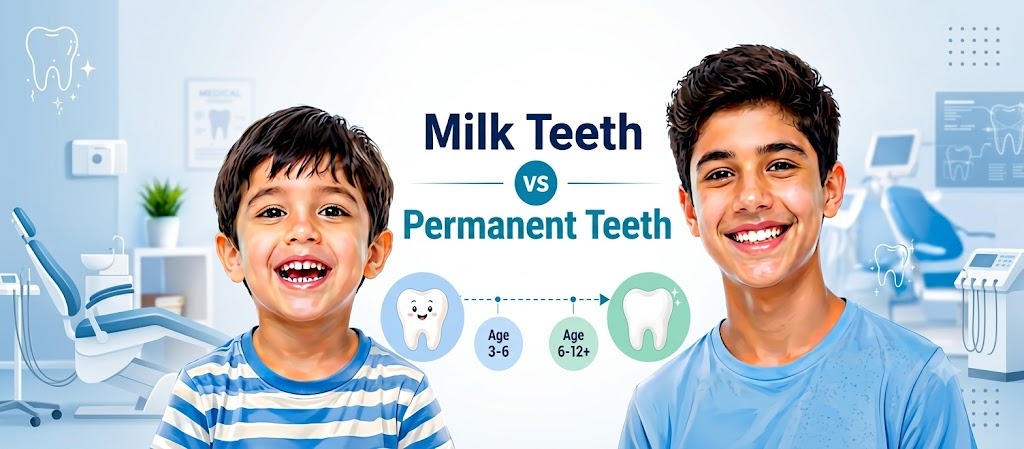
Milk Teeth vs Permanent Teeth: A Parent’s Complete Guide to What Changes and When

“Doctor, my son has a new tooth growing right behind his baby tooth — is that normal?” This is one of the most common questions we hear every week at Nova Dental Hospital in Gandhinagar. If you have noticed something similar in your child’s mouth, take a breath — in most cases, this is simply nature’s way of moving your child from milk teeth to permanent teeth.
Quick answer: Milk teeth (also called baby teeth) are a child’s first set of 20 temporary teeth, appearing from around 6 months of age. From about age 6, these begin to be replaced by 32 permanent teeth, which are larger, stronger, and designed to last a lifetime. The full transition usually continues until around age 12–13.
Understanding this process helps you recognise what is normal, what needs attention, and how small daily habits during the tiffin years and festival seasons can protect your child’s smile for decades. In this guide, we will walk through what milk teeth and permanent teeth are, how they differ, when each stage happens, common problems Indian parents notice, and how to know when a visit to a pediatric dentist is worthwhile.
What Are Milk Teeth?
Milk teeth, also known as baby teeth or primary teeth, are the first set of teeth that appear in a child’s mouth. They typically begin erupting around 6 months of age and are usually all present by the time a child turns 3.
- Number: Children have 20 milk teeth in total — 10 in the upper jaw and 10 in the lower jaw.
- Purpose: They allow a young child to chew food properly, support clear speech development, and give the face its natural shape.
- Why they matter: Milk teeth also act as placeholders, guiding the jawbone and gums to grow correctly and reserving space for the permanent teeth that will follow.
Many parents in India assume that because milk teeth will eventually fall out, cavities in them do not matter much. This is one of the most common misconceptions in pediatric dentistry — and we will explain why it is not true a little later in this guide.
What Are Permanent Teeth?
Permanent teeth, sometimes called adult teeth or secondary teeth, are the second and final set of teeth. They begin replacing milk teeth from around age 6 and continue erupting until the late teens or early twenties, when the wisdom teeth (if present) come in.
- Number: A full adult set has 32 permanent teeth, including four wisdom teeth.
- Function: These teeth handle a lifetime of chewing, speaking, and supporting facial structure — there is no further replacement set after this.
- Importance: Because permanent teeth must last a lifetime, the habits formed during childhood — brushing, diet, and regular checkups — directly determine how long they stay healthy.
Milk Teeth vs Permanent Teeth: Key Differences
Here is a side-by-side comparison to help you quickly understand how the two sets of teeth differ:
| Feature | Milk Teeth (Baby Teeth) | Permanent Teeth (Adult Teeth) |
| Total number | 20 teeth | 32 teeth (including wisdom teeth) |
| Size | Smaller | Larger |
| Colour | Whiter, more opaque | Slightly yellowish-white, less opaque |
| Strength | Thinner enamel, more delicate | Thicker enamel, stronger and more durable |
| Root structure | Shorter roots that dissolve naturally | Longer, firmly anchored roots |
| Lifespan | Temporary (a few years) | Meant to last a lifetime |
| Main function | Chewing, speech, holding space for adult teeth | Chewing, speech, and lifelong oral function |
| Why they matter | Guide jaw growth and alignment of future teeth | Final, permanent structure of the smile and bite |
When Do Baby Teeth Fall Out?
Baby teeth usually begin to loosen and fall out around age 6, though some children start as early as 5 and others closer to 7 — both are considered within the normal range. The process generally follows the same order in which the teeth first appeared:
- Lower and upper central incisors (front teeth) are usually the first to fall, around age 6–7.
- Lateral incisors follow around age 7–8.
- First molars are typically lost between age 9 and 11.
- Canines (the pointed teeth) loosen around age 9–12.
- Second molars are usually the last milk teeth to fall, around age 10–12.
It is completely normal for siblings, or even classmates of the same age, to lose teeth at slightly different times. A two-year variation in either direction is rarely a cause for concern.
When Do Permanent Teeth Erupt?
Permanent teeth generally erupt in the same sequence as the milk teeth they replace, though the timeline can vary slightly from child to child:
| Approximate Age | Teeth That Usually Erupt |
| 6–7 years | Lower and upper central incisors (front teeth); first permanent molars |
| 7–8 years | Upper central incisors and lateral incisors |
| 9–10 years | Canines (lower) and first premolars |
| 10–11 years | Upper canines and second premolars |
| 11–12 years | Second permanent molars |
| 17–21 years | Third molars / wisdom teeth (not in every child) |
Notice that the first permanent molars (the “six-year molars”) erupt behind the existing milk teeth rather than replacing one — this often surprises parents who were not expecting a new tooth without a baby tooth falling out first.
Why Milk Teeth Are More Important Than Many Parents Think
It is tempting to think of milk teeth as temporary and therefore less important. In reality, healthy milk teeth lay the foundation for a child’s long-term oral health in several ways:
- Speech development: Front milk teeth help children form certain sounds correctly while learning to talk.
- Chewing ability: Healthy milk teeth allow proper nutrition during the years when a child’s body and brain are developing fastest.
- Jaw development: Milk teeth stimulate healthy jawbone growth, which affects how much space is available for permanent teeth.
- Space maintenance: Each milk tooth holds the exact spot for the permanent tooth beneath it. Losing one too early can let neighbouring teeth drift into that space.
- Confidence and smile development: A child who is comfortable smiling and speaking in school tends to feel more confident among classmates.
Common Problems During Tooth Transition
Most children move through this transition without major issues, but a few situations are common enough that Indian parents should know what they mean:
- Delayed eruption: If a permanent tooth has not appeared a year or more after the expected age, it is worth getting an X-ray to check its position.
- Early tooth loss: Losing a milk tooth well before its time (often due to decay or injury) can allow neighbouring teeth to shift and crowd the space.
- Crowding: When the jaw does not have enough room, permanent teeth can come in overlapping or twisted.
- Misalignment: Teeth erupting at an angle, or a bite that does not meet evenly, may need orthodontic monitoring.
- Shark teeth (double row of teeth): This happens when a permanent tooth erupts behind a milk tooth that has not yet loosened. It looks alarming but is usually resolved once the milk tooth falls out naturally or is removed by a dentist.
- Tooth decay in milk teeth: Frequent festival sweets, chocolates, and sugary snacks left on teeth overnight are a leading cause of cavities in young children in India.
How Parents Can Support Healthy Dental Development
Most dental problems during childhood are preventable with consistent daily habits:
- Brushing habits: Encourage brushing twice daily with a fluoride toothpaste suited to your child’s age, and supervise younger children to ensure they brush properly.
- Healthy eating: Favour fruits, vegetables, milk, and home-cooked meals over packaged snacks and sugary drinks in the daily tiffin.
- Limiting sugary foods: Festival sweets and chocolates do not need to be avoided entirely, but try to limit frequency and encourage rinsing or brushing afterward.
- Regular dental checkups: A checkup every six months allows small problems to be caught before they become painful or expensive to treat.
- Monitoring tooth eruption: Keep a rough note of when teeth fall out and new ones appear — this makes it easier to flag genuine delays to your dentist.
When Should You Visit a Pediatric Dentist?
While most of this process is completely normal, certain signs deserve a professional opinion rather than a “wait and watch” approach:
- A permanent tooth has not appeared more than 12 months after the expected age
- Persistent pain, sensitivity, or discomfort while chewing
- Swelling, redness, or pus around a tooth or gum
- Visible crowding or teeth erupting at unusual angles
- A tooth knocked loose or out due to a fall or sports injury
- A milk tooth lost much earlier than expected due to decay or accident
If you notice any of these, an early consultation with a pediatric dentist is far simpler and more comfortable for your child than waiting until the problem grows.
Pediatric Dental Care at Nova Dental Hospital, Gandhinagar
At Nova Dental Hospital in Gandhinagar, Gujarat, we see this exact transition — from milk teeth to permanent teeth — in children every single day, and we understand how confusing it can feel for first-time parents.
Our approach to pediatric dental care focuses on making each visit comfortable and reassuring for children, while giving parents clear, honest guidance rather than unnecessary alarm. This includes:
- Child-friendly dental care: A calm, gentle approach designed to help children feel at ease, especially during their first few visits.
- Preventive dentistry: Fluoride applications, pit and fissure sealants, and oral hygiene guidance to reduce the risk of cavities in milk and permanent teeth alike.
- Regular dental checkups: Routine reviews that track eruption patterns specific to your child rather than generic age charts.
- Early diagnosis: Identifying delayed eruption, crowding, or alignment concerns while there is still time for simple, less invasive solutions.
- Growth monitoring: Keeping track of jaw and bite development through the school years, since this stage often determines whether future orthodontic treatment will be needed.
- Family-focused care: Many families bring siblings and even parents to the same visit, making dental care a manageable part of family life rather than a separate, stressful errand.
If you are looking for a pediatric dentist in Gandhinagar to understand your child’s tooth development or to schedule a child dental checkup, our team is happy to guide you through what is normal and what may need attention — without pressure or exaggerated claims.
Questions Most Parents Forget to Ask
Does every child lose teeth at the same age?
No. While there are average age ranges, genetics, nutrition, and even gender can cause variation of a year or more in either direction. This is usually nothing to worry about.
What if a permanent tooth erupts before a milk tooth falls out?
This is the “shark teeth” situation described earlier. It is common, especially in the lower front teeth, and the milk tooth usually loosens and falls out on its own within a few weeks to months.
Can milk teeth affect future braces treatment?
Yes. Early loss of milk teeth, prolonged thumb-sucking, or crowding noticed during the milk teeth stage can all influence whether a child needs orthodontic treatment later, and tracking this early can sometimes reduce the complexity of future treatment.
How does early tooth loss impact jaw development?
When a milk tooth is lost too early, neighbouring teeth can drift into the empty space, leaving too little room for the permanent tooth and sometimes affecting jaw alignment. A dentist may recommend a simple space maintainer in such cases.
Expert Summary Box
In short, for busy parents: • Children have 20 milk teeth and will eventually grow 32 permanent teeth. • Milk teeth usually start falling out around age 6 and the process continues until about age 12–13. • Permanent teeth are larger, stronger, and meant to last a lifetime — they deserve just as much daily care as milk teeth. • A one- to two-year variation in eruption timing between children is usually normal. • Watch for delayed eruption beyond a year, persistent pain, swelling, crowding, or early tooth loss — these are good reasons to see a pediatric dentist. • Six-monthly dental checkups make it far easier to catch small issues before they become big ones. |
Key Takeaways
- Children grow 20 milk teeth first, followed by 32 permanent teeth from around age 6 onward.
- Permanent teeth are larger, stronger, and have no further replacement — they need to last a lifetime.
- The full transition from milk teeth to permanent teeth usually completes by age 12–13.
- Milk teeth are not “unimportant” — they shape speech, chewing, jaw growth, and space for adult teeth.
- A double row of teeth (“shark teeth”) is common and usually resolves on its own.
- Limiting sugary snacks, consistent brushing, and six-monthly checkups prevent most childhood dental problems.
- See a pediatric dentist if eruption is delayed by over a year, or if there is pain, swelling, or early tooth loss.
FAQ Section
1. At what age do children lose their milk teeth?
Most children begin losing milk teeth around age 6, starting with the lower front teeth, and the process continues until around age 12–13 when the last milk molars are replaced.
2. How many milk teeth does a child have?
A child has 20 milk teeth in total — 10 in the upper jaw and 10 in the lower jaw.
3. Are permanent teeth stronger than milk teeth?
Yes. Permanent teeth have thicker enamel and longer, firmly anchored roots, making them generally stronger and more durable than milk teeth.
4. What happens if a milk tooth falls out too early?
Neighbouring teeth can drift into the empty space, leaving insufficient room for the permanent tooth. In such cases, a dentist may recommend a space maintainer to hold the gap open.
5. Is it normal for permanent teeth to grow behind milk teeth?
Yes, this is a common and usually harmless occurrence often called “shark teeth.” The milk tooth typically loosens and falls out naturally within a few weeks to months.
6. When should my child first visit a dentist?
Pediatric dentists generally recommend a first visit by the child’s first birthday, or as soon as the first tooth appears, to establish good habits early.
7. How can I protect my child’s permanent teeth?
Consistent brushing twice daily, a balanced diet with limited sugary snacks, fluoride use as advised by your dentist, and six-monthly checkups are the most effective ways to protect permanent teeth.
8. Do all children lose teeth at the same age?
No. Eruption and shedding timelines vary by up to a year or two between children due to genetics, nutrition, and individual growth patterns, and this is considered normal.
9. Can cavities in milk teeth affect permanent teeth?
Yes. Untreated decay in milk teeth can spread infection to the gum and bone, potentially affecting the developing permanent tooth underneath, and may also cause early tooth loss that disrupts spacing.
10. How often should children visit a dentist?
A dental checkup every six months is generally recommended for children, allowing the dentist to monitor eruption patterns and catch problems early.
11. When should I take my child to a pediatric dentist in Gandhinagar?
You should consider a visit if a permanent tooth is delayed by more than a year, if your child has persistent pain or swelling, or simply for a routine six-monthly checkup. Many families in Gandhinagar also bring children in after noticing a loose tooth or a new tooth appearing unexpectedly.
12. How do I choose the best child dentist in Gandhinagar?
Look for a dentist with specific experience in pediatric dentistry, a calm and child-friendly clinic environment, and a focus on preventive care rather than only treatment. Reading about a clinic’s approach to family-focused care can also help you decide.
13. Where can I get a child dental checkup in Gandhinagar?
Nova Dental Hospital in Gandhinagar, Gujarat offers pediatric dental checkups, preventive care, and growth monitoring for children, with a family-focused approach to make visits comfortable for both children and parents.

Related posts


Write a Comment
Recent Posts