


Peri-Implantitis: How to Protect Your Dental Implants for Life
Peri-Implantitis: How to Protect Your Dental Implants for Life

Quick Answer
| Peri-implantitis is an inflammatory condition that damages the gum and bone supporting a dental implant, and if untreated, can lead to implant loss. It begins as peri-implant mucositis (reversible gum inflammation) and progresses to bone loss when plaque bacteria are left uncontrolled. It is largely preventable with consistent daily cleaning, regular professional maintenance visits, and early attention to bleeding, swelling, or looseness around an implant. |
Quick Summary
- Peri-implantitis is inflammation with bone loss around a dental implant, usually caused by bacterial plaque.
- It typically starts as peri-implant mucositis, a reversible gum-only inflammation.
- Smoking, diabetes, a history of gum disease, and irregular check-ups raise the risk.
- Early signs include bleeding gums, mild swelling, and a bad taste near the implant.
- Left untreated, it can loosen and eventually cause loss of the implant.
- Daily interdental cleaning plus professional maintenance every 3–6 months is the single most effective prevention strategy.
- Non-surgical cleaning resolves many early cases; advanced cases may need regenerative or surgical care.
- Regular dental check-ups allow early detection, when treatment is simplest and most successful.
Introduction
Dental implants are one of the most reliable ways to replace a missing tooth, and most implants function well for many years when properly cared for. But an implant is not “maintenance-free” simply because it isn’t a natural tooth. The tissue around an implant can still become infected — a condition dentists call peri-implantitis. Understanding what it is, why it happens, and how to prevent it is one of the most valuable things an implant patient can learn, because catching the problem early makes all the difference between a simple cleaning and a complex repair.
What Is Peri-Implantitis?
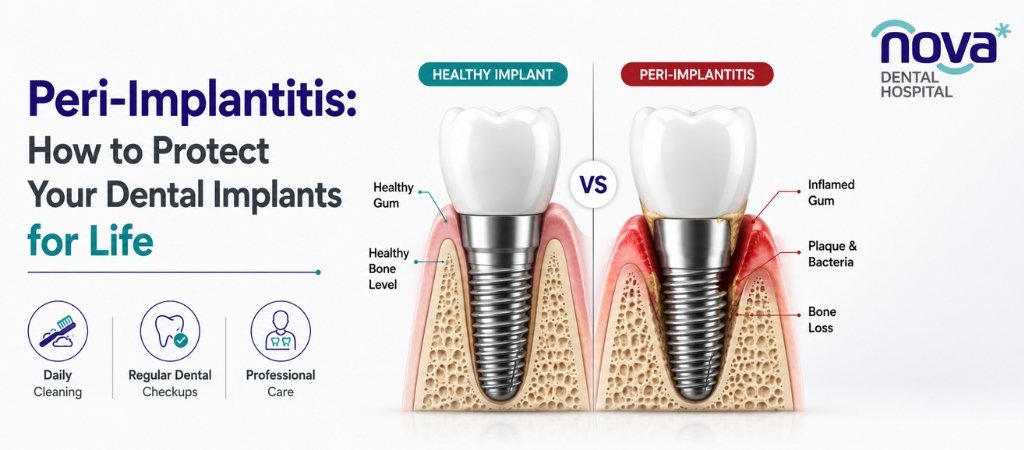
Peri-implantitis is a plaque-related inflammatory condition affecting the gum and bone tissue that surrounds and supports a dental implant. It is characterised by inflammation of the peri-implant mucosa together with progressive loss of the supporting bone. It is the more advanced stage of a two-part disease process:
- Peri-implant mucositis: inflammation limited to the soft gum tissue around the implant, with no bone loss. This stage is reversible with proper cleaning.
- Peri-implantitis: inflammation that has progressed into the bone, causing measurable bone loss around the implant. This stage requires active professional treatment and is not fully reversible, though it can usually be stabilised.
Research summarised across multiple clinical reviews shows peri-implant mucositis affects roughly a fifth to two-thirds of implant patients, while peri-implantitis itself affects an estimated one in ten to four in ten patients at the patient level, with figures varying by study population and diagnostic criteria. The wide range reflects differences in how studies define the condition — but the consistent message across the research is the same: peri-implant disease is common enough that every implant patient should take prevention seriously.
What Causes Peri-Implantitis?
Just like natural teeth, implants accumulate a sticky bacterial film called plaque. If this plaque is not removed, it hardens into calculus and triggers an inflammatory response in the surrounding tissue. Around an implant, this inflammation can spread to the bone faster than it typically does around a natural tooth, because the tissue attachment to an implant surface is structurally different and offers less natural resistance to bacterial spread.
Key Risk Factors
- A history of periodontitis (gum disease) on natural teeth
- Smoking or tobacco use
- Poorly controlled diabetes
- Inconsistent or incorrect oral hygiene
- Irregular professional maintenance visits
- Ill-fitting crowns or excess cement left around the implant
- Poor initial implant positioning or lack of adequate bone/gum support
| Expert Insight — On Risk Factors Patients often assume an implant is immune to gum disease because it isn’t a “real tooth.” In practice, a titanium or zirconia implant surface can accumulate plaque just as easily as enamel does, and because implants lack the same fibrous ligament attachment as natural teeth, infection can travel toward the bone more quickly if hygiene lapses. Treating implant hygiene with at least the same seriousness as natural tooth care is essential. |
Peri-Implant Mucositis vs Peri-Implantitis
| Feature | Peri-Implant Mucositis | Peri-Implantitis |
| Tissue involved | Gum (soft tissue) only | Gum and supporting bone |
| Bone loss | None | Progressive |
| Reversibility | Fully reversible | Can be stabilised, not fully reversed |
| Common signs | Redness, mild bleeding on brushing | Bleeding, swelling, pus, looseness, deeper pockets |
| Typical treatment | Professional cleaning + improved home care | Deep debridement, possible surgery |
Early Warning Signs to Watch For
Because peri-implantitis is often painless in its early stages, most people first notice one of these subtler signals rather than pain:
- Gums that bleed when brushing or flossing around the implant
- Redness, puffiness, or tenderness at the gumline
- A bad taste or odour localised near the implant
- Pus or discharge around the implant
- A feeling of looseness in the crown or implant
- Gum recession exposing more of the implant than before
A helpful way to think about it: pain is usually a late sign, not an early one. Bleeding and puffiness are the earlier, more useful warning signs — which is exactly why routine check-ups matter even when nothing seems wrong.
How Peri-Implantitis Is Diagnosed and Treated
Diagnosis combines a clinical gum examination (checking for bleeding, pocket depth, and pus) with an X-ray to assess the level of bone support around the implant. Treatment is matched to how advanced the condition is:
- Early / mucositis stage: professional cleaning of the implant surface plus a corrected home-care routine, reviewed at a follow-up visit.
- Moderate peri-implantitis: non-surgical mechanical or laser-assisted debridement to reduce the bacterial load around the implant threads, sometimes combined with local antimicrobial therapy.
- Advanced peri-implantitis: surgical access to clean the implant surface directly, often combined with bone grafting or tissue regeneration techniques to rebuild lost support.
- Severe, non-salvageable cases: implant removal, followed by site healing and evaluation for future re-implantation.
| Expert Insight — On Treatment Timing The stage at which peri-implantitis is caught changes the entire treatment conversation. A patient seen at the mucositis stage typically needs only cleaning and coaching on technique. The same condition caught two years later, after silent bone loss, may need surgery. This is the single strongest argument for not skipping recall visits, even when an implant feels completely normal. |
Prevention: How to Protect Your Dental Implant for Life
Prevention is overwhelmingly effective when it is consistent. The following routine reflects widely accepted preventive principles in implant dentistry:
- Brush twice daily with a soft or implant-safe brush, angling bristles gently along the gumline of the implant crown.
- Clean between the implant and neighbouring teeth daily using interdental brushes, implant-specific floss, or a water flosser.
- Avoid tobacco use, which is one of the strongest modifiable risk factors for implant bone loss.
- Keep diabetes and other systemic conditions well controlled, in coordination with a physician.
- Attend professional maintenance visits every 3 to 6 months, even if the implant feels completely fine.
- Ask your dentist to check implant crown fit periodically, since an ill-fitting crown can trap plaque.
- Report any bleeding, swelling, or looseness promptly rather than waiting for the next scheduled visit.
Common Mistakes Patients Make
- Assuming an implant cannot get “gum disease” because it isn’t a natural tooth.
- Skipping maintenance visits once the implant feels comfortable and problem-free.
- Using a hard-bristled brush or scrubbing aggressively, which can irritate rather than clean the gumline.
- Ignoring occasional bleeding as “normal,” when it is usually an early inflammation signal.
- Not flagging a change in bite or a slightly loose-feeling crown promptly.
Myths vs Facts
| Myth | Fact |
| Implants can’t get gum disease. | Implants can develop peri-implant mucositis and peri-implantitis, both plaque-related conditions. |
| No pain means everything is fine. | Peri-implantitis is frequently painless in early stages; bleeding and swelling are earlier signs. |
| Once placed, an implant needs no special care. | Implants need daily cleaning and periodic professional maintenance, similar to natural teeth. |
| Peri-implantitis always means losing the implant. | Many cases are stabilised successfully with timely non-surgical or surgical treatment. |
Questions Patients Forget to Ask
- “Can you check my implant’s bone level on X-ray at this visit, not just look at the gum?”
- “What cleaning tools are actually shaped to fit around my specific implant crown?”
- “How would I tell the difference between normal post-treatment sensitivity and a warning sign?”
- “How often should I really be coming in, given my personal risk factors?”
Practical Action Plan
- Book a check-up if it has been more than 6 months since your last implant review.
- Ask for a hands-on demonstration of correct interdental cleaning around your implant.
- Note any bleeding, odour, or looseness and mention it at your very next visit rather than waiting.
- If you smoke, discuss a cessation plan — it is one of the most controllable risk factors.
- Keep a fixed recall schedule (every 3–6 months) in your calendar rather than relying on memory.
| Nova Dental Expert Summary Box Peri-implantitis is common, largely preventable, and most manageable when caught early. The essentials are simple: clean around the implant daily with the right tools, don’t skip professional maintenance visits, manage risk factors like smoking and diabetes, and report bleeding or looseness promptly instead of waiting. Consistent, unglamorous daily habits protect an implant far more than any single treatment ever could. |
Key Takeaways
- Peri-implantitis is inflammation with bone loss around a dental implant, usually driven by uncontrolled plaque.
- It begins as reversible peri-implant mucositis before progressing to bone involvement.
- Bleeding, swelling, and bad taste are earlier signs than pain — don’t wait for pain.
- Smoking, diabetes, and past gum disease raise risk and deserve extra attention.
- Daily interdental cleaning plus 3–6 month professional visits is the core prevention strategy.
- Early-stage disease is easier and less invasive to treat than advanced disease.
- Regular check-ups allow silent bone loss to be caught on X-ray before symptoms are obvious.
How Nova Dental Hospital Can Help
Nova Dental Hospital supports implant patients across Gandhinagar and Ahmedabad with structured, family-focused preventive care. This includes personalised treatment planning around individual risk factors, regular growth and tissue monitoring for long-term implant health, early diagnosis through clinical and radiographic review, and guidance that fits real family routines — from a teenager’s first checkup to a senior citizen’s implant maintenance schedule. The focus throughout is educational and preventive, helping patients understand their own oral health rather than simply reacting to problems.
Frequently Asked Questions
1. What is peri-implantitis?
It is an inflammatory condition affecting the gum and bone around a dental implant, caused mainly by bacterial plaque, that leads to progressive bone loss if untreated.
2. Is peri-implantitis the same as peri-implant mucositis?
No. Mucositis is early, reversible gum-only inflammation. Peri-implantitis is more advanced and involves bone loss, which is harder to reverse.
3. What are the first signs of peri-implantitis?
Bleeding gums around the implant, redness, mild swelling, and occasionally a bad taste or odour are usually the earliest signs, often appearing before any pain.
4. Can peri-implantitis be treated without surgery?
Early and moderate cases are often managed with non-surgical or laser-assisted cleaning of the implant surface combined with improved home care. More advanced bone loss may need surgical treatment.
5. Can a dental implant be saved once it has peri-implantitis?
In many cases, yes — timely treatment can stabilise the condition and preserve the implant. Very advanced or non-responsive cases may eventually require implant removal.
6. What increases the risk of peri-implantitis?
Smoking, poorly controlled diabetes, a history of periodontitis, inconsistent oral hygiene, and irregular professional maintenance are the main recognised risk factors.
7. How often should I get my implant checked?
A professional maintenance visit every 3 to 6 months is generally recommended, though your dentist may adjust this based on your individual risk factors.
8. How do I clean a dental implant at home?
Brush twice daily with a soft brush angled at the gumline, and clean between the implant and neighbouring teeth daily with interdental brushes, implant-safe floss, or a water flosser.
9. Does peri-implantitis hurt?
Not usually in its early stages. Pain tends to appear later, which is why bleeding, swelling, and looseness are more reliable early warning signs to watch for.
10. Where can I get an implant check-up in Gandhinagar?
Nova Dental Hospital in Gandhinagar and Ahmedabad offers implant review and maintenance visits, including clinical and X-ray assessment of implant gum and bone health.

Related posts
Write a Comment
Recent Posts

Dry Socket After Tooth Extraction: Symptoms, Prevention & Treatment


