


Mini Dental Implants: Who Are They Right For?
Mini Dental Implants: Who Are They Right For?

Quick Answer
| Mini dental implants (MDIs) are narrower implants, roughly 1.8–3mm in diameter compared to 3.5–6mm for standard implants. They are best suited for patients with lower jawbone density, smaller dental arches, or those looking to stabilise loose dentures without bone grafting. They are usually not the first choice for replacing back molars that carry heavy chewing loads. |
Quick Summary
- Mini dental implants are 40–60% narrower than standard implants and are placed through a minimally invasive, often flapless procedure.
- They are frequently recommended for denture stabilisation, narrow jaw ridges, and patients who want to avoid bone grafting.
- Best candidates: adults with adequate (though thinner) bone, denture wearers, and patients seeking a shorter recovery.
- Less ideal for: molar replacement under heavy bite force, patients with severe bone loss, or those with untreated gum disease.
- Recovery is typically faster than standard implants, often 1–2 weeks for soft tissue healing.
- Cost is generally lower than standard implants, though long-term durability should be discussed with your dentist.
- A detailed jawbone and bite assessment at a dental hospital is essential before deciding.
Introduction
If you have been told your jawbone is too thin for a standard implant, or your lower denture keeps slipping while eating or speaking, you have likely come across the term “mini dental implants.” They are smaller, less invasive, and often positioned as a quicker alternative to conventional implants — but they are not right for every patient or every tooth. This guide explains, in plain language, who genuinely benefits from mini dental implants, who should consider other options, and what to expect at each stage, so you can have an informed conversation with your dentist.
What Are Mini Dental Implants?
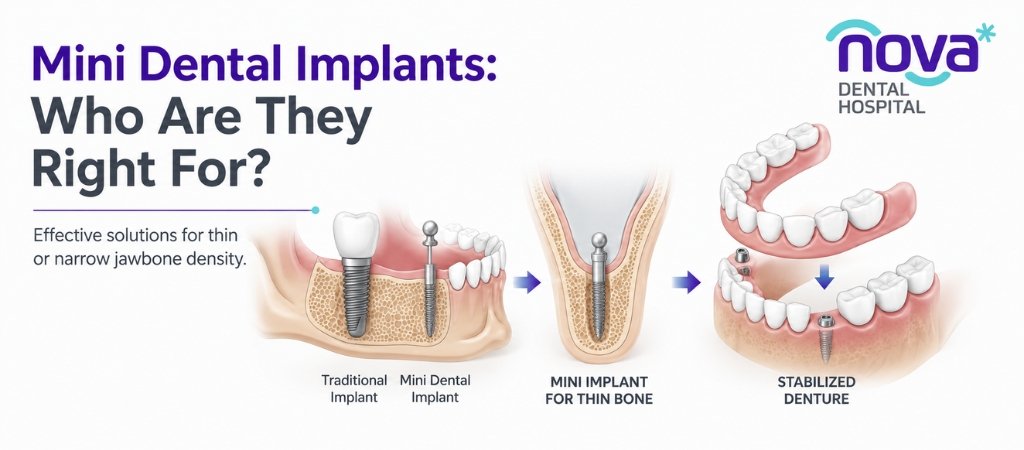
A mini dental implant is a single-piece titanium screw, narrower than a standard implant, topped with a small ball that snaps into a denture or supports a small crown. Because of their reduced width, they can often be placed directly into existing bone without the grafting procedures that wider implants sometimes require. The core idea is the same as any implant — the titanium post fuses with the jawbone through a process called osseointegration, creating a stable anchor for a replacement tooth or denture.
Mini Implants vs Standard Implants
| Factor | Mini Dental Implants | Standard Dental Implants |
| Diameter | 1.8mm – 3mm | 3.5mm – 6mm |
| Bone requirement | Works with thinner ridges | Needs adequate bone width/height |
| Procedure type | Often flapless, single-visit | May involve flap surgery, staged healing |
| Best use case | Denture stabilisation, narrow arches | Single teeth, molars, heavy bite areas |
| Typical recovery | Days to about 2 weeks | Several weeks to a few months |
| Long-term load capacity | Lower; best for lighter bite forces | Higher; suited to full chewing load |
Who Are Mini Dental Implants Right For?
Based on accepted clinical guidance, mini dental implants tend to work well for:
- Patients whose lower denture is loose or unstable and who want a same-day stabilisation solution.
- People with a naturally narrow jaw ridge, especially in the lower front jaw, where standard implants may not fit without bone grafting.
- Adults who want to avoid bone grafting due to cost, healing time, or personal preference.
- Patients replacing smaller teeth, such as lower incisors, where bite forces are comparatively lower.
- Older adults who prefer a shorter, less invasive procedure with quicker recovery.
- Patients who are otherwise healthy but have mild to moderate bone density loss not severe enough to need grafting.
Expert Insight: The Denture Stabilisation Scenario
Consider a patient in their sixties whose lower denture shifts every time they eat or laugh. A full standard implant procedure may involve grafting and months of healing. Four mini implants placed to anchor the denture can often stabilise it within a single visit, restoring confidence in chewing and speaking without a lengthy treatment plan. This is one of the most common and well-supported uses of mini implants.
Who Should Consider Standard Implants Instead?
Mini implants are not automatically the “easier” choice. Standard implants are usually preferable for:
- Replacing molars, which bear the greatest chewing force.
- Patients with significant bone loss who need grafting and a wider implant for long-term stability.
- Younger patients who need a restoration built to last several decades under full function.
- Cases where a single crown must closely match the strength and feel of a natural molar.
Expert Insight: Matching the Implant to the Job
A useful way to think about it: mini implants are excellent stabilisers and space-conscious solutions, while standard implants are structural replacements built for heavy daily use. A dentist assessing candidacy will look at bone width, bite force in that specific area of the mouth, and how the tooth will be used before recommending either option.
The Procedure: What to Expect
Mini dental implant placement typically begins with a 3D scan to measure bone width and map nerve position. In many cases, the implant is placed directly through the gum without cutting a surgical flap, using local anaesthesia. The single-piece design means the implant and its attachment are placed in one step, and a denture can often be adjusted to fit the same day. Total chair time is usually shorter than for standard implants, and many patients describe the experience as more comfortable than they expected.
Recovery Timeline
| Stage | Typical Timeframe | What to Expect |
| Initial healing | 3–5 days | Mild soreness, soft-food diet recommended |
| Soft tissue healing | 1–2 weeks | Gums settle around the implant collar |
| Denture adjustment check | 2–4 weeks | Fit and bite are reviewed and fine-tuned |
| Full osseointegration | 2–4 months | Bone fully bonds with the implant surface |
Benefits and Risks
Benefits commonly reported include a shorter procedure, lower upfront cost compared to standard implants, and suitability for patients who want to avoid grafting. Risks and limitations include a lower long-term load tolerance, and in some cases, a shorter overall lifespan if used in areas with heavy bite force or in patients with ongoing bone loss.
Expert Insight: Setting Realistic Expectations
Patients sometimes assume “mini” means “temporary.” In appropriate cases, such as denture stabilisation, mini implants can function well for many years with proper care. The key factor is matching the implant to the right clinical situation and maintaining regular dental check-ups to monitor bone health around the implant.
Common Mistakes to Avoid
- Choosing mini implants based on cost alone, without a bone and bite assessment.
- Assuming mini implants can replace molars under full chewing load without discussing suitability with a dentist.
- Skipping follow-up visits after placement, which are important for checking denture fit and gum health around the implant.
Myths vs Facts
| Myth | Fact |
| Mini implants are just a cheaper, weaker version of real implants. | They are a different implant category, purpose-built for specific situations like denture stabilisation, not a downgrade of standard implants. |
| Anyone can get mini implants regardless of bone condition. | Candidacy still depends on adequate bone density and healthy gums; a scan and exam are required. |
| Mini implants don’t need any maintenance. | Like any implant, they require regular brushing, denture care, and dental check-ups. |
Questions Patients Forget to Ask
- Is my jawbone density enough for a mini implant, or would I benefit more from a standard implant with grafting?
- How much chewing force will this specific implant need to handle in my mouth?
- What is the expected lifespan of a mini implant in my situation, and what would follow-up or replacement involve?
- How should I clean around the implant differently from my natural teeth or existing denture?
Practical Action Plan
- Book a consultation that includes a 3D scan to assess bone width and density in the area being treated.
- Ask your dentist to compare mini and standard implant suitability specifically for that tooth or denture location.
- Discuss your budget, timeline, and how much chewing load the site will bear before finalising a decision.
- Plan for a follow-up visit within the first month to check fit, healing, and any denture adjustments needed.
- Maintain routine dental check-ups every six months to monitor the implant and surrounding bone.
How Nova Dental Hospital Can Help
Deciding between mini and standard dental implants depends on individual bone structure, bite patterns, and long-term goals, which is why a thorough clinical assessment matters more than following a trend. At Nova Dental Hospital, treatment planning is built around personalised evaluation, including detailed imaging and growth or bone monitoring where relevant, so that families and individual patients receive guidance suited to their specific case rather than a one-size-fits-all recommendation. The focus throughout remains on family-focused, patient-first education, whether the concern is a loose denture, a missing tooth, or general preventive dentistry.
| Nova Dental Expert Summary Mini dental implants are a genuine, well-supported option — particularly for denture stabilisation and narrower jaw ridges — but they are not a universal replacement for standard implants. The right choice depends on bone density, the location of the missing tooth, and how much bite force that area needs to withstand. A proper assessment, not a fixed preference for “mini” or “standard,” should guide the final decision. |
Key Takeaways
- Mini dental implants are narrower, less invasive, and often used for denture stabilisation.
- They work best where bite force is lighter, such as the lower front jaw or under a denture.
- Standard implants remain preferable for molars and cases with significant bone loss.
- Recovery is generally faster, often within 1–2 weeks for initial healing.
- A 3D bone scan and clinical exam are essential before choosing either option.
- Regular follow-up care helps maintain long-term implant success.
Frequently Asked Questions
1. What are mini dental implants used for?
They are most commonly used to stabilise loose dentures and to replace smaller teeth in areas with narrower jawbone.
2. Are mini dental implants painful?
Most patients report mild discomfort similar to a tooth extraction, managed with local anaesthesia and standard aftercare.
3. How long do mini dental implants last?
With proper care and suitable placement, many patients experience good longevity, though outcomes depend on bone health and bite force at the site.
4. Can mini dental implants replace back teeth?
They are generally not the first recommendation for molars, since these teeth bear heavy chewing loads better suited to standard implants.
5. Do mini dental implants require bone grafting?
One of their key advantages is that many patients can avoid grafting, since the implant is narrower and needs less bone width.
6. How much do mini dental implants cost compared to standard implants?
They are typically more affordable than standard implants, though exact pricing depends on the number of implants and individual treatment needs.
7. Who should avoid mini dental implants?
Patients with severe bone loss, untreated gum disease, or a need to replace teeth under heavy chewing load may be better suited to standard implants.
8. How soon can I eat normally after getting mini dental implants?
A soft-food diet is usually recommended for the first few days, with a gradual return to normal eating as healing progresses.
9. Is a mini dental implant procedure the same day as consultation?
In many cases, placement can be done in a single visit after a bone assessment, though timelines vary by case.
10. Where can I get a mini dental implant assessment near Gandhinagar?
A dental hospital offering 3D imaging and implant planning can evaluate your bone structure and recommend the most suitable option for your situation.

Related posts
Write a Comment
Recent Posts


