Titanium vs Zirconia Implants: Which Material Is Right for You?
Titanium vs Zirconia Implants: Which Material Is Right for You?

Quick Answer
Titanium implants are the most researched and widely used option, with a 95-98% success rate over 10 years and a lower typical cost. Zirconia implants are a metal-free, tooth-coloured alternative best suited to patients with thin gums, front-tooth aesthetics, or a genuine titanium sensitivity. Neither material is universally “better” — the right choice depends on your bone quality, gum type, bite force, and personal priorities, which is why an in-person evaluation matters more than the material name alone.
Quick Summary
- Titanium has over 40 years of clinical use and remains the global standard for dental implants.
- Zirconia is a ceramic, metal-free implant material chosen mainly for aesthetics and rare metal allergies.
- Success rates are close for both (titanium ~95-98%, zirconia ~92-97%) when placed by an experienced clinician.
- Zirconia implants are usually 20-40% costlier in India due to material and technique.
- Titanium’s two-piece design offers more flexibility for angled or complex cases; zirconia is mostly one-piece.
- Gum biotype, bone density, and bite force matter more to long-term success than material choice alone.
- Nova Dental Hospital evaluates each patient individually before recommending a material.
Introduction
If you are exploring dental implants for a missing tooth, you have likely come across two material options: titanium and zirconia. Both are used to replace the tooth root and support a crown, but they differ in composition, appearance, cost, and clinical history. For a working professional in Ahmedabad worried about a visible grey line near a front tooth, or a senior citizen in Gandhinagar who wants the most proven option, the decision matters. This guide breaks down the science, the real-world trade-offs, and the questions worth asking before you choose.
What Are Dental Implants Made Of?
A dental implant has three parts: the implant post (embedded in the jawbone), the abutment (connector), and the crown (visible tooth). The post is the part where material choice matters most, since it must fuse with bone through a process called osseointegration.
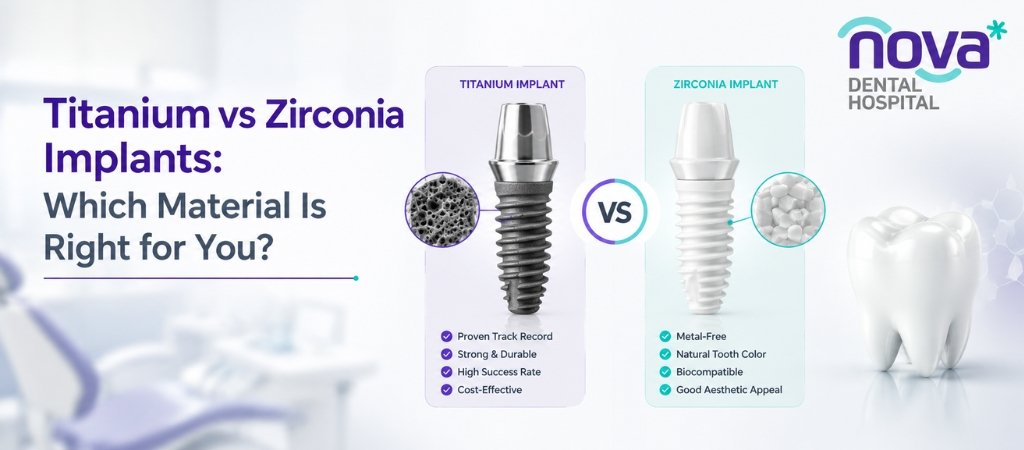
- Titanium implants: made from a medical-grade titanium alloy (Ti-6Al-4V), used in orthopaedic and dental implants worldwide since the 1960s.
- Zirconia implants: made from zirconium dioxide, a dense ceramic that is metal-free and naturally tooth-coloured.
Titanium Dental Implants: Benefits and Drawbacks
Titanium remains the default recommendation for most implant cases because of its long track record and mechanical reliability.
- Benefits: excellent bone integration, proven 10-year-plus success data, two-piece design that allows angle correction, wide range of sizes and systems, generally lower cost.
- Drawbacks: grey colour can show through very thin or receding gums, and a small number of patients report sensitivity, though confirmed allergy is uncommon.
Expert Insight
“In our experience treating patients across Gandhinagar and Ahmedabad, titanium remains the first recommendation for molars and premolars, where strength and long-term data matter more than visibility,” notes the implant team at Nova Dental Hospital.
Zirconia Dental Implants: Benefits and Drawbacks
Zirconia implants have grown in popularity over the last decade, particularly among patients who prioritise a completely metal-free mouth or a natural-looking gumline.
- Benefits: tooth-white colour that blends with the gum, metal-free (suitable for confirmed titanium sensitivity), high resistance to plaque accumulation on the surface.
- Drawbacks: shorter long-term research history, mostly one-piece design with fewer correction options during placement, typically higher cost, and slightly more brittle under very heavy bite forces.
Expert Insight
A common scenario: a 32-year-old patient with a thin gum biotype wanted an implant for a front tooth lost in an accident. Zirconia was recommended specifically because any future gum recession would be far less noticeable than with a metal post.
Titanium vs Zirconia: Side-by-Side Comparison
| Factor | Titanium Implants | Zirconia Implants |
| Material Type | Metal (titanium alloy) | Ceramic (zirconium dioxide, metal-free) |
| Track Record | 40+ years of clinical research | Growing evidence, roughly 15-20 years |
| Success Rate | About 95-98% at 10 years | About 92-97%, close but slightly less long-term data |
| Design | Usually two-piece (implant + separate abutment) | Mostly one-piece; fewer size and system options |
| Colour & Aesthetics | Grey metal can show through thin gums | Tooth-white, better for thin gum biotypes |
| Biocompatibility | Very high; rare metal sensitivity in some patients | Metal-free; preferred for confirmed titanium allergy |
| Strength | Slightly more flexible, absorbs bite force well | Very hard but can be more brittle under heavy load |
| Cost in India | Generally more affordable, wider price range | Usually 20-40% higher due to material and technique |
| Best Suited For | Most patients, back teeth, complex cases | Front teeth, thin gums, metal-sensitive patients |
Which Implant Material Suits Which Patient?
Rather than asking which material is “best,” it helps to ask which material fits your specific mouth and priorities.
- Back teeth or multiple missing teeth: titanium is usually preferred for its strength and flexible placement angles.
- Front tooth with thin or receding gums: zirconia often gives a more natural, tooth-coloured result.
- Confirmed metal allergy: zirconia is the safer, metal-free choice.
- Lower jawbone density or complex bite correction: titanium’s two-piece system offers more surgical flexibility.
- Budget-conscious treatment planning: titanium is typically the more economical option in India.
Expert Insight
“We map bone density on a CBCT scan before ever discussing material. A patient’s anatomy usually narrows the choice before personal preference even comes into play,” explains Nova Dental Hospital’s clinical team.
Common Mistakes Patients Make
- Choosing based on price alone: the cheaper option upfront can cost more later if it is not suited to the patient’s bone or bite.
- Assuming metal allergy without testing: many patients avoid titanium unnecessarily based on general “metal sensitivity” fears rather than a confirmed diagnosis.
- Ignoring gum biotype: patients with thin gums sometimes choose titanium for cost and later notice a greyish shadow near the crown.
- Skipping the CBCT scan: deciding on material before imaging the jawbone can lead to an unsuitable choice or the need for bone grafting later.
Myths vs Facts
| Myth | Fact |
| Zirconia implants are always better because they are newer. | Newer does not mean superior. Titanium has far more long-term clinical data, and both materials have similar success rates when placed correctly. |
| Titanium implants cause allergies in most patients. | True titanium allergy is rare. Most patients tolerate titanium implants without any reaction; testing is only needed if there is a known metal sensitivity history. |
| Zirconia implants never turn grey or show through the gum. | Zirconia is more aesthetic, but gum recession over time can still expose any implant material, so gum health matters regardless of choice. |
| Implant material alone determines how long the implant lasts. | Bone quality, oral hygiene, bite forces, and follow-up care influence longevity as much as, or more than, the material itself. |
Questions Patients Forget to Ask
- What does my gum biotype mean for how the implant will look over time?
- Will my bite force or teeth-grinding habit affect which material lasts longer?
- How many implants has this clinic placed using each material?
- What is the warranty or follow-up plan if the implant needs adjustment?
- How will the material choice affect the crown that sits on top?
Practical Action Plan
- Book a consultation and CBCT scan to assess bone density and gum type.
- Share your full medical history, including any known metal sensitivities.
- Ask for a written comparison of cost, timeline, and expected outcome for both materials.
- Discuss the location of the missing tooth (front vs back) and its aesthetic priority.
- Confirm the post-placement care and follow-up schedule before proceeding.
Nova Dental Expert Summary
Both titanium and zirconia are safe, well-studied implant materials when placed by a qualified clinician. Titanium suits the majority of cases, particularly back teeth and patients prioritising cost and proven longevity. Zirconia is a strong option for visible front teeth, thin gums, or confirmed metal sensitivity. The right decision comes from a clinical evaluation of bone, gum, and bite — not from material alone.
Key Takeaways
- Titanium has the longest clinical track record and generally lower cost.
- Zirconia offers a metal-free, tooth-coloured alternative for specific cases.
- Success rates for both materials are high (over 90%) when placed correctly.
- Gum biotype and bone density often matter more than material for final appearance.
- A CBCT scan should always precede the material decision.
- Confirmed metal allergy is the clearest reason to choose zirconia.
- Cost, location of the missing tooth, and bite strength all influence the right choice.
- A qualified implant consultation is the only reliable way to decide.
How Nova Dental Hospital Can Help
Choosing between titanium and zirconia implants is a clinical decision as much as a personal one. Nova Dental Hospital’s approach for every implant patient in Gandhinagar and Ahmedabad includes:
- Personalised Treatment Planning: a full evaluation of bone density, gum biotype, and bite before any material is suggested.
- Early Diagnosis & Imaging: CBCT scanning to map the jawbone and plan precise implant placement.
- Family-Focused Care: guidance for patients of all ages, from young adults to senior citizens considering implants.
- Preventive Follow-Up: structured review visits to monitor healing and long-term implant health.
Notice- This is educational information to help you prepare for a consultation, not a substitute for an in-person clinical assessment.
Frequently Asked Questions
Is zirconia stronger than titanium for dental implants?
Titanium is more flexible and absorbs bite force well, while zirconia is very hard but slightly more brittle under sudden heavy loads. For most patients, both perform well under normal biting forces.
Which implant material lasts longer, titanium or zirconia?
Titanium has more long-term data showing success rates of 95-98% over 10 years. Zirconia shows comparable results (92-97%) but has a shorter research history of about 15-20 years.
Are zirconia implants better for people with metal allergies?
Yes. Zirconia is completely metal-free, making it the recommended option for patients with a confirmed titanium or metal sensitivity.
Do titanium implants cause any health problems?
Titanium is considered highly biocompatible and safe. True allergic reactions are uncommon and are usually confirmed through specific testing rather than general sensitivity concerns.
Why are zirconia implants more expensive than titanium in India?
Zirconia requires specialised milling technology and is typically a single-piece design with fewer manufacturers, which raises material and technique costs compared to titanium.
Can zirconia implants be used for back teeth (molars)?
Yes, but titanium is more commonly recommended for molars because its two-piece design allows better angle correction and it handles heavier chewing forces with a longer proven history.
How do I know which implant material is right for me?
Your dentist will assess your jawbone density, gum thickness, bite pattern, and any allergy history through a clinical exam and CBCT scan before recommending a material.
Is the recovery time different for titanium vs zirconia implants?
Healing time is largely similar for both materials, generally 3-6 months for osseointegration, though individual healing depends more on bone quality than the implant material.
Do zirconia implants look more natural than titanium?
Zirconia’s white colour can look more natural in patients with thin gums, since it avoids the grey shadow that a titanium post can sometimes show through receding gum tissue.
Where can I get titanium or zirconia implants near Gandhinagar?
Nova Dental Hospital offers implant consultations in Gandhinagar and Ahmedabad, where a clinical evaluation helps determine which material suits your specific case.

Related posts
Write a Comment
Recent Posts