


Dental Bridges: Procedure, Cost, and How They Compare to Implants
Dental Bridges: Procedure, Cost, and How They Compare to Implants

Quick Answer
| A dental bridge is a fixed restoration that replaces one or more missing teeth by anchoring an artificial tooth, called a pontic, to crowns placed on the natural teeth (or implants) on either side of the gap. In India, a dental bridge typically costs between ₹8,000 and ₹35,000 per unit depending on material, while implants cost more upfront but can preserve jawbone density better over time. The right choice depends on your bone health, budget, and long-term goals, and is best confirmed after a clinical evaluation. |
Quick Summary
- A dental bridge replaces missing teeth using crowns on neighbouring teeth to support an artificial tooth in between.
- Common types include traditional, cantilever, Maryland, and implant-supported bridges.
- Average cost in India ranges from ₹8,000 to ₹35,000 per unit; implants cost more per tooth but may offer longer-term bone health benefits.
- A conventional bridge usually takes 2–3 visits over 2–3 weeks; implants involve a longer healing period of several months.
- Bridges rely on healthy abutment teeth; implants need adequate jawbone density and are placed surgically.
- Both options need daily cleaning; bridges require a floss threader or interdental brush under the pontic.
- A well-maintained bridge typically lasts 10–15 years, while implants can last 20 years or more with proper care.
- A personalised evaluation at a dental hospital is the most reliable way to decide between the two options.
Introduction
Losing a tooth changes more than your smile — it can affect chewing, speech, and the alignment of the teeth around the gap. Two of the most reliable ways to restore a missing tooth are dental bridges and dental implants. For many patients at Nova Dental Hospital in Gandhinagar and Ahmedabad, the first question is not just “what is a bridge?” but “is it the right choice for me compared to an implant?” This guide walks through how dental bridges work, what the procedure involves, realistic cost expectations in India, and an honest, side-by-side comparison with implants — so you can walk into your consultation with confidence rather than confusion.
What Is a Dental Bridge?
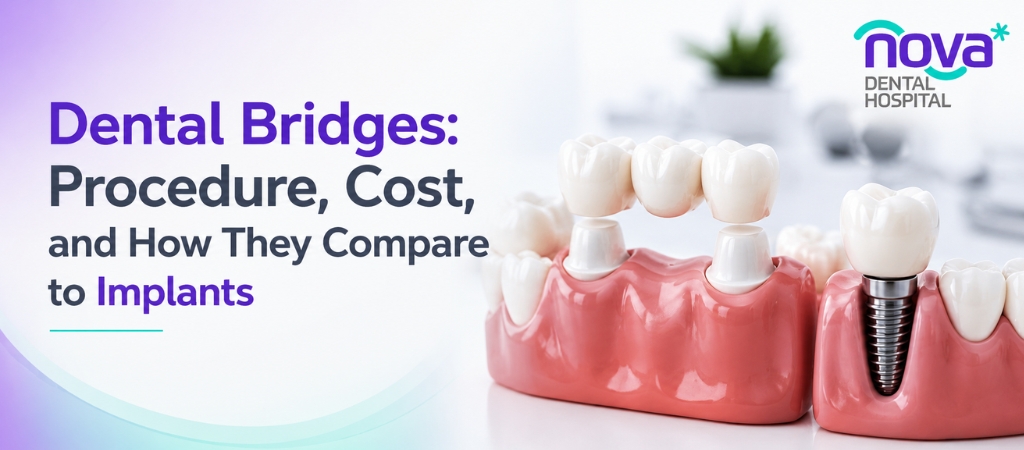
A dental bridge is a fixed prosthetic device used to “bridge” the gap created by one or more missing teeth. It consists of two main parts: the abutment crowns, which are placed over the natural teeth (or implants) on either side of the gap, and the pontic, the artificial tooth that fills the space. Unlike a removable denture, a bridge is cemented in place and functions much like natural teeth once it settles in.
| Expert Insight — Why Replacing a Missing Tooth Matters At Nova Dental Hospital, we regularly see patients delay treatment for a missing back tooth because it isn’t visible when they smile. In practice, an empty space allows neighbouring teeth to drift and the opposing tooth to over-erupt, which can affect the bite within a year. Replacing the tooth early, whether with a bridge or an implant, protects the rest of the mouth’s alignment. |
Types of Dental Bridges
Choosing the right type of bridge depends on the number of missing teeth, the condition of neighbouring teeth, and your budget.
- Traditional Bridge — the most common type, using a crown on each side of the gap to hold the pontic in place. Best when the adjacent teeth are healthy and can support crowns.
- Cantilever Bridge — anchored to a crown on only one side of the gap. Used when there is only one healthy tooth next to the missing space.
- Maryland Bridge — held in place with a metal or porcelain framework bonded to the back of neighbouring teeth rather than full crowns, preserving more natural tooth structure.
- Implant-Supported Bridge — the pontic is supported by dental implants instead of natural teeth, useful when several teeth in a row are missing.
The Dental Bridge Procedure: Step by Step
- Consultation and Assessment — the dentist examines the gap, checks the health of neighbouring teeth and gums, and may take an X-ray to assess bone support.
- Tooth Preparation — the abutment teeth are gently reshaped to make room for the crowns that will anchor the bridge.
- Impressions — a digital scan or physical impression is taken and sent to a dental lab to fabricate the custom bridge.
- Temporary Bridge — a temporary restoration is placed to protect the prepared teeth while the permanent bridge is being made, usually over 1–2 weeks.
- Fitting and Cementation — once ready, the permanent bridge is checked for fit and bite alignment, adjusted if needed, and cemented into place.
| Expert Insight — What to Expect After Placement It is common for a new bridge to feel slightly different for the first few days as the tongue and bite adjust. Mild sensitivity to hot or cold is normal initially. If discomfort continues beyond two weeks or the bite feels uneven, a follow-up adjustment visit is recommended rather than waiting it out. |
Cost of Dental Bridges in India
Bridge cost depends on the material used, the number of units required, and the complexity of the case. The table below gives an approximate range for planning purposes; exact pricing is confirmed after a clinical examination.
| Bridge Material | Approximate Cost Per Unit (INR) | Typical Lifespan |
| Metal-fused-to-ceramic (PFM) | ₹8,000 – ₹15,000 | 10–15 years |
| All-ceramic / Zirconia | ₹15,000 – ₹35,000 | 15+ years |
| Maryland (resin-bonded) | ₹8,000 – ₹18,000 | 5–10 years |
| Implant-supported bridge | ₹35,000 – ₹60,000+ per implant unit | 20+ years |
Dental Bridges vs Dental Implants
Both options restore function and appearance, but they work differently and suit different situations.
| Factor | Dental Bridge | Dental Implant |
| Procedure Time | 2–3 weeks, 2–3 visits | 3–6 months, including healing time |
| Impact on Neighbouring Teeth | Requires reshaping adjacent teeth | No alteration to neighbouring teeth |
| Jawbone Health | Does not prevent bone loss at the gap | Helps preserve jawbone density |
| Average Lifespan | 10–15 years | 20+ years with good care |
| Upfront Cost | Generally lower | Generally higher |
| Best Suited For | Healthy adjacent teeth, faster treatment need | Adequate bone density, long-term investment |
Neither option is universally “better” — a bridge may be the practical choice for a patient who wants a faster, more affordable fix and has strong neighbouring teeth, while an implant is often recommended for patients prioritising long-term bone health and durability. This is a decision best made jointly with your dentist after an examination.
Common Mistakes to Avoid
- Skipping the floss threader or interdental brush under the pontic, which allows plaque to build up and can lead to decay in the abutment teeth.
- Choosing the cheapest material without checking its expected lifespan, leading to earlier-than-expected replacement costs.
- Delaying treatment for a missing tooth, which allows neighbouring teeth to shift and can complicate the eventual bridge or implant procedure.
Myths vs Facts
| Myth | Fact |
| A dental bridge lasts a lifetime once fitted. | With good care, a bridge typically lasts 10–15 years before it may need replacement or repair. |
| Bridges don’t need special cleaning. | Bridges need daily cleaning under the pontic using a floss threader, water flosser, or interdental brush. |
| Implants are always the better option. | Implants have advantages for bone health, but bridges remain a suitable, faster, and more affordable option for many patients. |
Questions Patients Forget to Ask
- What material is recommended for my specific bite and budget?
- How will this affect the health of my neighbouring teeth in the long run?
- What is the realistic lifespan of the bridge I am choosing, and what happens when it needs replacement?
- Are there financing or staged payment options available?
Practical Action Plan
- Book a consultation to assess the gap, bone condition, and health of neighbouring teeth.
- Ask for a written comparison of bridge versus implant costs and timelines specific to your case.
- Choose a material based on lifespan and budget, not price alone.
- Follow the recommended cleaning routine from day one to protect the investment.
- Schedule a check-up six months after placement to confirm fit and gum health.
Nova Dental Expert Summary Box
| Nova Dental Expert Summary — Dr. Happy Patel, BDS A dental bridge remains a reliable, time-tested way to replace one or more missing teeth, particularly when neighbouring teeth are healthy and a faster treatment timeline is preferred. At Nova Dental Hospital, our approach is to evaluate bone health, bite alignment, and long-term goals before recommending a bridge, an implant, or a combination approach — because the right choice is always specific to the individual patient, not a one-size-fits-all answer. |
How Nova Dental Hospital Can Help
Choosing between a dental bridge and an implant is easier with a clear, personalised assessment. At Nova Dental Hospital in Gandhinagar, evaluations are led by Dr. Happy Patel, BDS, Owner and Director, who brings over 10 years of clinical experience in dental implants, cosmetic dentistry, painless root canal treatment, and full mouth rehabilitation. Every case — from a single missing tooth to a multi-unit restoration — is assessed for the health of neighbouring teeth, jawbone condition, and long-term goals before a bridge, an implant, or an alternative is recommended.
Patients from Gandhinagar, GIFT City, PDPU, Kudasan, and Ahmedabad choose Nova Dental Hospital for its emphasis on advanced diagnostic technology, strict sterilization and hygiene protocols, and treatment planning that keeps procedures as conservative and cost-effective as possible without compromising long-term outcomes.
Key Takeaways
- A dental bridge fills a gap using crowns on neighbouring teeth and an artificial tooth in between.
- Four main types exist: traditional, cantilever, Maryland, and implant-supported.
- Cost in India ranges roughly from ₹8,000 to ₹35,000 per unit depending on material.
- Bridges are faster to complete than implants but do not prevent jawbone loss at the site.
- Implants typically last longer but involve higher upfront cost and a longer healing period.
- Daily cleaning under the bridge is essential to prevent decay in the supporting teeth.
- A clinical evaluation is the only reliable way to decide between a bridge and an implant.
- Delaying tooth replacement can lead to shifting teeth and more complex treatment later.
Frequently Asked Questions
1. What is a dental bridge used for?
A dental bridge is used to replace one or more missing teeth by anchoring an artificial tooth to the crowns of neighbouring teeth or implants.
2. How long does a dental bridge last?
With good oral hygiene and regular dental check-ups, a dental bridge typically lasts between 10 and 15 years.
3. Is getting a dental bridge painful?
The procedure is performed under local anaesthesia, so discomfort during placement is minimal. Mild sensitivity for a few days afterward is normal.
4. How much does a dental bridge cost in India?
Costs generally range from ₹8,000 to ₹35,000 per unit depending on the material chosen, with implant-supported bridges costing more.
5. Is a dental bridge better than a dental implant?
Neither is universally better. Bridges are faster and often more affordable, while implants better preserve jawbone density over time. The best option depends on individual oral health.
6. Can a dental bridge be removed for cleaning?
No, a traditional dental bridge is fixed in place. Cleaning is done in place using floss threaders, water flossers, or interdental brushes.
7. What happens to the teeth next to the bridge?
The neighbouring teeth are reshaped to hold the crowns that anchor the bridge, so their long-term health should be monitored with regular check-ups.
8. How many visits does a dental bridge require?
Most patients need 2 to 3 visits over roughly 2 to 3 weeks, including preparation, a temporary bridge, and final fitting.
9. Can a dental bridge fail or need replacement?
Yes, bridges can eventually need replacement due to wear, decay in the supporting teeth, or damage to the pontic, which is why regular dental visits are important.
10. Is a Maryland bridge a good option for front teeth?
Maryland bridges are often used for front teeth because they preserve more of the natural tooth structure, though they may have a shorter lifespan than traditional bridges.
11. Does dental insurance cover bridges in India?
Coverage varies by insurer and policy; it is best to check directly with your provider, as many plans only partially cover prosthetic dental work.
12. Where can I get a dental bridge evaluation near Gandhinagar?
Nova Dental Hospital in Gandhinagar offers clinical evaluations to determine whether a bridge, an implant, or another restoration best suits your needs.

Related posts
Write a Comment
Recent Posts


