


Root Canal Retreatment: What Happens When the First Root Canal Doesn’t Heal
Root Canal Retreatment: What Happens When the First Root Canal Doesn’t Heal

Quick Answer
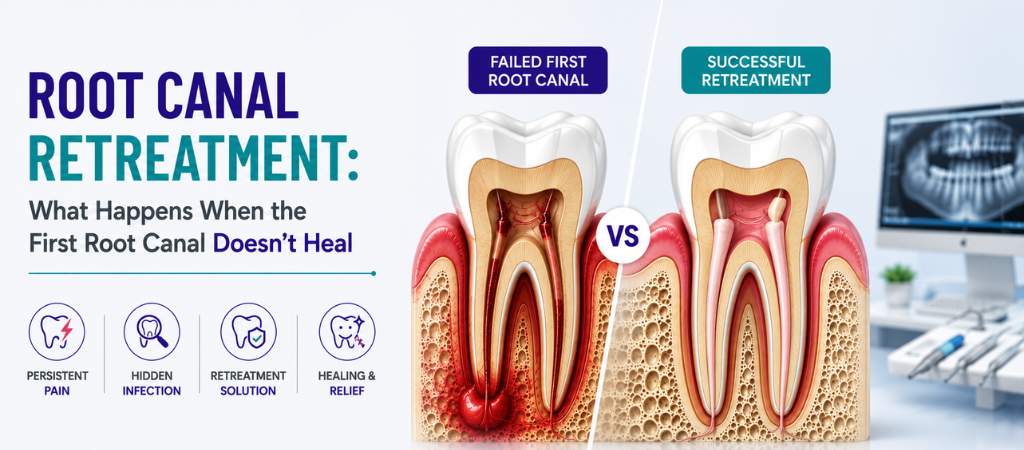
A root canal is said to have “failed” when bacteria re-enter the tooth or the infection was never fully resolved, causing pain, swelling, or a visible bump on the gum. Root canal retreatment reopens the tooth, removes the old filling material, cleans the canals thoroughly, and reseals them — offering a second chance to save the natural tooth before considering surgery or extraction.
Quick Summary
- A root canal can fail months or even years after treatment.
- Common causes: missed canals, cracks, new decay, or a delayed/leaking crown.
- Watch for pain, swelling, sensitivity, or a gum bump near the tooth.
- Retreatment reopens and recleans the tooth to try to save it.
- Success rates are good but slightly lower than first-time treatment.
- Alternatives exist if the tooth cannot be saved — apicoectomy or extraction with an implant.
- Early evaluation gives the best chance of saving the natural tooth.
Introduction
A root canal is meant to be a long-term solution, but occasionally a treated tooth starts causing trouble again — sometimes weeks later, sometimes years down the line. This can be confusing and worrying for patients who assumed the problem was already solved. The good news is that a failed root canal does not automatically mean losing the tooth. In many cases, root canal retreatment can clear the infection and preserve the natural tooth for years to come. This guide explains why root canals fail, what retreatment involves, and how to decide on the right next step.
Why Root Canal Treatments Sometimes Fail
Root canal treatment has a high success rate, but no medical or dental procedure is guaranteed forever. Failure usually falls into a few recognisable categories:
- Missed or unusually curved canals: Teeth, especially molars, can have extra or complex canals that are difficult to detect during the original treatment.
- New decay or a cracked tooth: Bacteria can re-enter through a new cavity, a fractured tooth structure, or a crack that develops under chewing pressure.
- Delayed or leaking crown: If a permanent crown is not placed soon after treatment, or if an existing restoration leaks, saliva and bacteria can seep back into the canal system.
- Complex canal anatomy: Some canals branch or curve in ways that make complete disinfection difficult even with careful technique.
Expert Insight: In our clinical experience, one of the most preventable causes of failure is a delay in getting the permanent crown placed after the root canal. An uncrowned tooth is more likely to fracture or allow bacterial leakage.
Signs Your Root Canal May Have Failed
Patients often notice symptoms gradually rather than all at once. Contact your dentist if you notice:
- Persistent or recurring pain in the treated tooth
- Swelling or tenderness in the gum near the tooth
- A small pimple-like bump on the gum (a sinus tract) that may drain fluid
- Discomfort when biting or chewing on that side
- Sensitivity that lingers longer than expected
Parent/Patient Scenario: A patient who had a root canal on a molar two years ago began noticing a dull ache whenever she chewed rice on that side. There was no visible swelling, so she assumed it was unrelated. An X-ray later showed a small area of reinfection at the root tip — a reminder that even mild, intermittent discomfort is worth investigating early.
What Happens During Root Canal Retreatment
Retreatment follows a structured process, generally completed over one or two appointments:
- Diagnosis: A clinical exam and X-ray (sometimes a 3D CBCT scan) identify the cause and extent of the problem.
- Reopening the tooth: The old crown or filling is accessed, and the previous root canal filling material (gutta-percha) is carefully removed.
- Re-cleaning the canals: The canals are re-shaped, disinfected, and checked for any missed or additional canals.
- Resealing: Once the infection is controlled, the canals are refilled and the access point is sealed.
- Restoration: A new crown or filling is placed to protect the tooth long-term.
Expert Insight: Retreatment is technically more demanding than a first root canal because the tooth structure has already been altered. This is one reason it is often carried out or supervised by an endodontist with specific training in complex cases.
Root Canal Retreatment vs. Other Options
| Option | What It Involves | Best Suited For |
| Root canal retreatment | Reopening and recleaning the existing root canal | Reinfection where the tooth structure is still sound |
| Apicoectomy (root-end surgery) | Minor surgery to remove infected tissue at the root tip | Cases where retreatment through the crown is not possible |
| Extraction + dental implant | Removing the tooth and replacing it with an implant | Teeth with severe fracture or repeated failure |
| Extraction + bridge | Removing the tooth and replacing it with a fixed bridge | When implant placement is not suitable |
Common Mistakes Patients Make
- Ignoring mild, intermittent pain instead of getting an early X-ray review.
- Delaying the permanent crown after the original root canal, leaving the tooth vulnerable to leakage.
- Assuming any discomfort after treatment automatically means extraction is the only option.
- Skipping follow-up checkups that could catch early signs of reinfection.
Myths vs. Facts
| Myth | Fact |
| A root canal that fails means the tooth must be extracted. | In many cases, retreatment can save the tooth without needing extraction. |
| Retreatment is more painful than the first root canal. | With modern local anaesthesia, most patients report similar comfort levels to the original procedure. |
| Root canals “fail” because the procedure doesn’t work. | Failure is usually due to reinfection, missed canals, or a delayed crown — not the treatment itself being ineffective. |
Questions Patients Forget to Ask
- What is the likely cause of my specific root canal failure?
- What are my realistic chances of success with retreatment versus other options?
- Will I need a CBCT scan to check for missed canals or cracks?
- How soon after retreatment should the permanent crown be placed?
- What symptoms should prompt me to come back sooner rather than later?
Practical Action Plan
- Book an evaluation as soon as you notice pain, swelling, or a gum bump near a previously treated tooth.
- Get an updated X-ray (and CBCT scan if recommended) to confirm the cause.
- Discuss retreatment, apicoectomy, and extraction-based options with your dentist before deciding.
- If retreatment is chosen, plan for the permanent restoration promptly afterward.
- Keep up with routine dental checkups to catch any recurrence early.
Nova Dental Expert Summary Box
At Nova Dental Hospital, our approach to a tooth that isn’t healing after root canal treatment is to first understand why — through careful diagnosis and imaging — before recommending a path forward. Retreatment is prioritised whenever the tooth structure allows it, since preserving a natural tooth is generally preferable to extraction. Every treatment plan is explained clearly so patients can make an informed decision about their care.
Key Takeaways
- A failed root canal usually results from reinfection, missed canals, a crack, or a delayed crown.
- Symptoms can be subtle — intermittent pain or a gum bump should not be ignored.
- Retreatment reopens, recleans, and reseals the tooth to try to resolve the infection.
- Success rates are good, though slightly lower than a first-time root canal.
- If retreatment isn’t suitable, apicoectomy or extraction with an implant/bridge are the alternatives.
- Early evaluation gives the best chance of saving your natural tooth.
Planning Dental Treatment During Your India Visit
For NRIs and overseas Indian families, root canal retreatment can often be planned around a visit to India, though timelines depend on healing and diagnosis. An initial online consultation and review of previous X-rays or dental records can help outline a realistic plan before travelling. Typically, retreatment itself may be completed in one to two visits, but adequate time should be kept for follow-up review before your return flight, since final restoration (such as a crown) is usually done after the tooth has settled. Carrying previous dental records and X-rays helps the treating dentist plan more efficiently. Booking an initial online consultation before arrival is a practical way to reduce uncertainty during a short trip.
NRI Patient Scenario: An NRI family visiting India for three weeks wanted to complete a root canal retreatment before returning abroad. After an online consultation and review of prior X-rays, an in-person diagnosis confirmed the tooth was suitable for retreatment. Treatment was completed over two visits, with the permanent crown scheduled toward the end of their stay and follow-up guidance provided for after their return overseas. This is illustrative — actual timelines vary by case and should be confirmed with a dentist directly.
How Nova Dental Hospital Can Help
Nova Dental Hospital, with locations in Gandhinagar and Ahmedabad, supports patients through personalised treatment planning, early diagnosis using diagnostic imaging, and family-focused, child-friendly care across general and specialist dentistry. For patients dealing with a tooth that isn’t healing as expected, the focus is on clear communication, evidence-based decision-making, and long-term oral health — not just resolving the immediate symptom.
FAQ Section
1. Why did my root canal fail?
Common reasons include missed or extra canals, new decay, a cracked tooth, or a delay in placing the permanent crown, which can allow bacteria to re-enter.
2. Can a root canal be redone?
Yes. Root canal retreatment reopens the tooth, removes the old filling material, recleans the canals, and reseals them, often saving the tooth without extraction.
3. Is root canal retreatment painful?
Retreatment is performed under local anaesthesia, and most patients describe the experience as similar to the original root canal, with mild soreness for a few days afterward.
4. How long does root canal retreatment take?
Most retreatments are completed in one to two appointments, though this depends on the tooth’s anatomy and the complexity of the original treatment.
5. What are the chances retreatment will work?
Reported success rates generally range from about 70–85%, depending on the cause of failure and whether the tooth structure remains sound.
6. What happens if retreatment also fails?
If retreatment does not resolve the issue, options include apicoectomy (minor surgery at the root tip) or extraction followed by a dental implant or bridge.
7. How much does root canal retreatment cost?
Cost depends on the tooth involved, imaging needed, and whether a new crown is required; your dentist can provide a personalised estimate after evaluation.
8. Can I complete retreatment during a short visit to India?
Often yes, though timelines depend on the individual case. Booking an online consultation before arrival helps with planning, and adequate follow-up time should be kept before travelling back.
9. How early should I book my appointment before travelling?
It’s advisable to reach out a few weeks in advance so previous records can be reviewed and an appointment plan outlined before you arrive.
10. Will I need follow-up after returning abroad?
In most cases, a follow-up check is recommended, which can sometimes be coordinated with a dentist near you along with guidance from the treating team in India.

Related posts

Write a Comment
Recent Posts


