


Do You Always Need a Crown After a Root Canal?
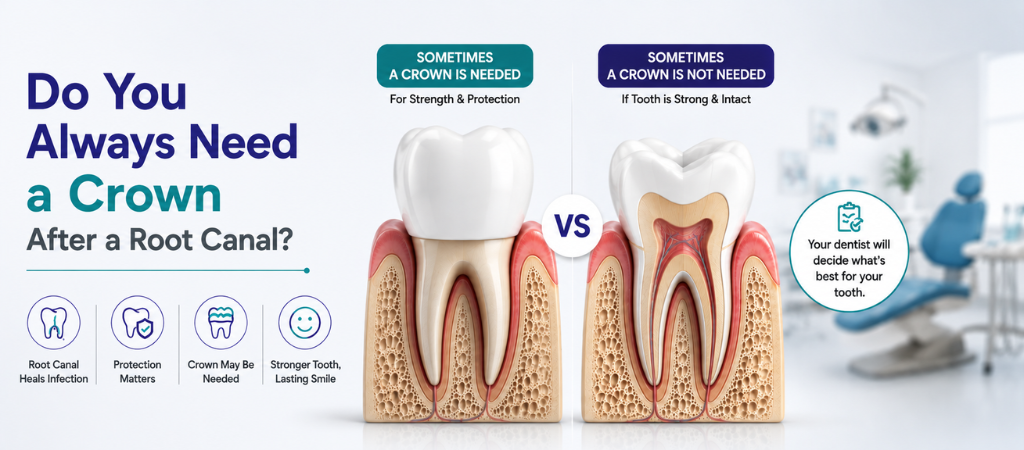
Do You Always Need a Crown After a Root Canal?

Quick Answer
| No — a crown is not always required after a root canal. Most back teeth (molars and premolars) need one because they bear heavy chewing pressure and lose significant structure during treatment. Front teeth (incisors and canines) with minimal damage can often be restored with just a filling. The right choice depends on how much natural tooth remains, the tooth’s location, and your bite pattern — your dentist will confirm this after examining the tooth. |
Quick Summary
- A crown is recommended in most cases, but it isn’t automatic for every root canal-treated tooth.
- Back teeth (molars, premolars) usually need a crown because they absorb the most chewing force.
- Front teeth (incisors, canines) with mild damage may only need a filling or core build-up.
- Root canal-treated teeth lose blood supply and become more brittle, raising fracture risk over time.
- Delaying a needed crown for too long increases the chance of cracks, reinfection, or tooth loss.
- Crowns are usually placed within a few weeks of completing the root canal.
- Material choices include porcelain, ceramic, and zirconia, chosen based on strength and appearance needs.
- Nova Dental Hospital evaluates each tooth individually rather than recommending crowns by default.
Introduction
If you’ve just finished a root canal treatment (RCT), there’s a good chance your dentist has mentioned a crown as the next step. This leaves many patients wondering: is a crown really necessary, or is it an added expense? The honest answer is that it depends on the tooth. A root canal removes infected or damaged pulp from inside the tooth, but it does not restore the tooth’s original strength. Whether that tooth needs a crown, a simple filling, or another type of restoration depends on its location in the mouth, how much healthy structure remains, and the forces it will face every day while chewing and biting. This guide walks through exactly how that decision is made, so you can have an informed conversation with your dentist rather than simply taking the recommendation on faith.
Why Root Canal-Treated Teeth Need Extra Support
During a root canal, the dentist removes the infected pulp — the soft tissue containing nerves and blood vessels — and cleans out the inner canals of the tooth before sealing it. This process, combined with the tooth decay or fracture that made the root canal necessary in the first place, removes a meaningful amount of the tooth’s internal structure. Once that structure is gone, the tooth continues to function for chewing and biting, but it becomes noticeably more brittle. A tooth in this condition is more prone to cracking, especially under the repeated pressure of daily chewing, and a crack that runs below the gumline can sometimes mean the tooth cannot be saved at all.
| Expert Insight A root canal-treated tooth is like a hollowed-out support beam — it can still carry weight, but it needs reinforcement to keep carrying that weight safely over years of use. The crown is that reinforcement, not a cosmetic add-on. |
When a Crown Is Usually Necessary
Certain factors consistently point toward needing a crown after root canal treatment:
- Back teeth (molars and premolars): these teeth absorb the majority of chewing and grinding force, so they almost always benefit from the full coverage a crown provides.
- Significant loss of tooth structure: if a large portion of the tooth was removed due to decay or during the root canal itself, a crown protects what remains from cracking.
- Existing large fillings: a tooth that already had a substantial filling before the root canal has less natural support and is a stronger candidate for a crown.
- Visible discoloration: teeth that darken after treatment, especially front teeth, may need a crown for appearance as much as protection.
- Root canal on a previously restored tooth: teeth that have been treated more than once are statistically more likely to need reinforcement.
When a Crown May Not Be Needed
Not every tooth requires a crown. Front teeth — incisors and canines — face far less chewing pressure than molars, so if the tooth still has strong walls and only a small access opening was made during the root canal, a well-placed filling or core build-up can be sufficient. In these situations, the dentist weighs the remaining tooth structure, bite alignment, and whether the tooth’s appearance is already acceptable without a crown.
| Real-Life Scenario A 34-year-old patient at Nova Dental Hospital needed root canal treatment on an upper incisor after a minor sports injury chipped the tooth. Because the damage was limited and most of the tooth structure remained intact, the dentist restored it with a composite filling rather than a crown, reviewing it again at the six-month follow-up to confirm it remained stable. |
Crown vs Filling vs Onlay: Quick Comparison
| Restoration | Best Suited For | Protection Level | Typical Longevity |
| Filling / Core Build-up | Front teeth, minor structural loss | Moderate | 5–7 years, tooth-dependent |
| Onlay | Premolars with moderate structural loss | Good | 7–10 years |
| Full Crown | Molars, premolars, extensive structural loss | High — full coverage | 10–15+ years with care |
What Happens If You Delay or Skip a Needed Crown
When a crown is genuinely needed but delayed, the unprotected tooth remains vulnerable every time you bite down. Over weeks or months, this raises the risk of the tooth cracking — sometimes in a way that cannot be repaired, leading to extraction. There is also a risk of bacteria re-entering the tooth through micro-cracks or a worn temporary filling, which can undo the benefit of the root canal itself. This doesn’t mean every patient must rush into a crown within days, but once a dentist has confirmed one is necessary, it’s best scheduled within a few weeks rather than left indefinitely.
Common Mistakes Patients Make
- Assuming a crown is optional cost-cutting: skipping a genuinely necessary crown often costs more later if the tooth fractures and needs extraction or an implant.
- Waiting too long after the root canal: leaving a tooth with only a temporary filling for months increases fracture and reinfection risk.
- Choosing a crown material based on price alone without discussing durability and bite-force suitability with the dentist.
- Not asking why a crown is or isn’t recommended for their specific tooth, and accepting a generic answer.
Myths vs Facts
| Myth | Fact |
| Every root canal needs a crown. | Only teeth with significant structural loss or high bite force typically need one; some front teeth do not. |
| A crown is just for appearance. | A crown’s primary role is structural protection; appearance is a secondary benefit. |
| You can wait as long as you like before getting the crown. | Delaying a needed crown raises fracture and reinfection risk; a few weeks is the usual recommended window. |
| A filling after root canal is always weaker than a crown. | For teeth with minimal structural loss, a well-placed filling can perform well long-term. |
Questions Patients Forget to Ask
- “How much of my natural tooth structure remains after the root canal?”
- “Would a filling be a safe option for my specific tooth, or is a crown strongly advised?”
- “What crown material would you recommend for this tooth, and why?”
- “What happens to my tooth’s warranty or long-term outlook if I choose a filling instead of a crown?”
- “How soon should the crown be placed, and what are the risks of waiting?”
Practical Action Plan
- Ask your dentist to show you which tooth was treated and how much structure remains.
- Get a clear recommendation on crown vs filling, along with the reasoning specific to your tooth.
- If a crown is advised, schedule it within the recommended window rather than delaying.
- Avoid chewing hard foods on the treated tooth until the permanent restoration is placed.
- Maintain routine check-ups so early signs of cracking or wear are caught before they become serious.
Nova Dental Expert Summary Box
| Nova Dental Hospital — Professional Guidance A crown is not an automatic step after every root canal — it is a decision based on the tooth’s location, remaining structure, and the forces it will face daily. At Nova Dental Hospital, each root canal-treated tooth is assessed individually using this criteria, with the treatment plan explained clearly so patients and families can make an informed choice rather than a default one. |
Key Takeaways
- A crown is not always mandatory after a root canal — it depends on the tooth.
- Molars and premolars usually need a crown due to high chewing pressure.
- Front teeth with minor damage may be restored with a filling instead.
- Root canal-treated teeth become more brittle and need timely protection.
- Delaying a genuinely needed crown increases fracture and reinfection risk.
- Crown material (porcelain, ceramic, zirconia) should match strength and appearance needs.
- A clear conversation with your dentist about remaining tooth structure guides the right decision.
How Nova Dental Hospital Can Help
Deciding between a crown and a filling after a root canal is easier with a dental team that explains its reasoning clearly. Nova Dental Hospital’s approach includes personalized treatment planning based on each patient’s remaining tooth structure and bite pattern, early diagnosis to catch structural weakness before it becomes a bigger problem, and family-focused care that extends from routine checkups through preventive dentistry for both children and adults. For families with children, growth monitoring and child-friendly care help ensure that any pediatric root canal treatment is followed by the right long-term restoration, whether that’s a stainless-steel crown on a baby tooth or ongoing monitoring as permanent teeth develop.
FAQ Section
1. Do you always need a crown after a root canal?
No. Crowns are strongly recommended for molars and premolars due to chewing pressure, but front teeth with minimal structural loss may only need a filling.
2. Why does a root canal-treated tooth need a crown?
Because the tooth loses internal structure and blood supply during treatment, making it more brittle and prone to cracking without reinforcement.
3. Can a front tooth skip a crown after root canal?
Often yes, if the damage was limited and most of the natural tooth structure remains intact; your dentist will confirm this after examination.
4. How soon should a crown be placed after root canal treatment?
Generally within a few weeks of completing the root canal, to reduce the risk of fracture or reinfection while the tooth is only temporarily restored.
5. What happens if I don’t get a crown when one is recommended?
The unprotected tooth remains vulnerable to cracking under normal chewing pressure, which can sometimes lead to extraction if the fracture is severe.
6. Is a crown more expensive than a filling after root canal?
Yes, a crown typically costs more than a filling, but it offers stronger, longer-lasting protection for teeth that need full coverage.
7. What crown materials are commonly used after root canal treatment?
Porcelain, ceramic, and zirconia are common choices, selected based on the tooth’s location, required strength, and aesthetic needs.
8. Do children need crowns after root canal treatment on baby teeth?
Pediatric root canal-treated baby teeth often need a stainless-steel crown, since baby teeth are smaller and more prone to breaking down before they naturally fall out.
9. Can I go straight from root canal to a permanent crown in one visit?
Some clinics offer same-day crowns, but many cases involve a temporary filling first while the permanent crown is custom-made.
10. How do I know if my dentist’s crown recommendation is necessary?
Ask specifically how much tooth structure remains and why a filling wouldn’t be sufficient for your particular tooth and bite pattern.

Related posts

Write a Comment
Recent Posts


