


CBCT Scan in Dentistry: The Complete Guide
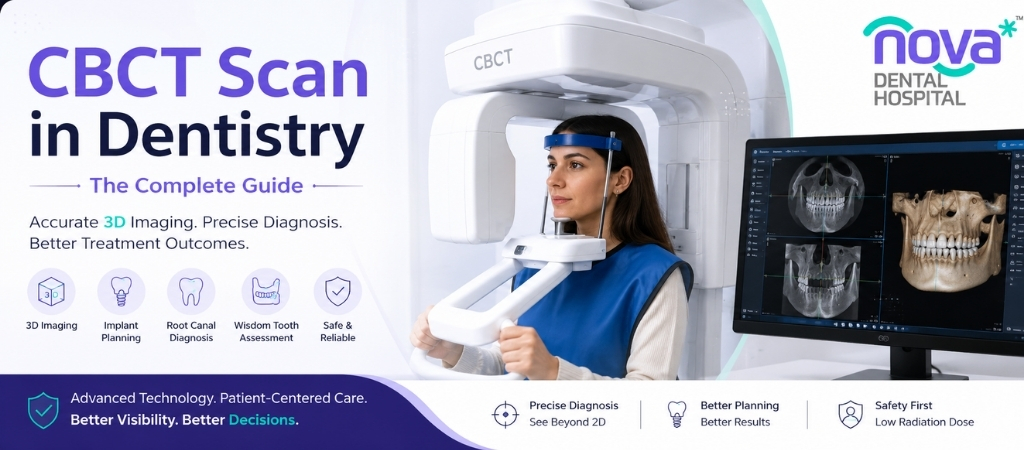
CBCT Scan in Dentistry: The Complete Guide

Quick Answer
A CBCT (Cone Beam Computed Tomography) scan is a specialised 3D dental X-ray that captures detailed images of teeth, jawbone, nerves, and surrounding tissue in a single rotation. Dentists use it for precise diagnosis before procedures such as implants, root canals, impacted tooth removal, and orthodontic planning, offering far more detail than a standard 2D X-ray while still using a comparatively low radiation dose.
Quick Summary
- CBCT creates a 3D image of teeth, jaws, nerves, and airway in one scan.
- It is commonly used for implant planning, complex root canals, wisdom tooth assessment, and orthodontics.
- Radiation exposure is generally lower than a medical CT scan, though higher than a routine dental X-ray.
- The scan itself takes about 10–40 seconds; the full appointment is usually under 15 minutes.
- CBCT helps dentists detect issues that 2D X-rays may miss, such as hidden infections or nerve proximity.
- Not every patient needs a CBCT scan — it is recommended case by case.
- Cost varies by region and scan area, and is usually a one-time diagnostic expense.
- Children and pregnant patients require special evaluation before a CBCT scan is advised.
Intro
Walking into a dental clinic and hearing the word “CBCT scan” can feel unfamiliar, even a little intimidating, especially for parents bringing in a child or patients preparing for a dental implant. In reality, a CBCT scan is one of the most valuable diagnostic tools in modern dentistry, allowing dental teams to see structures that a standard X-ray simply cannot capture. This guide explains what a CBCT scan is, when it is recommended, how safe it is, and what patients and parents should know before the procedure, so that the decision feels informed rather than confusing.
What Is a CBCT Scan?
Cone Beam Computed Tomography (CBCT) is an imaging technique that rotates a cone-shaped X-ray beam around the patient’s head to produce a three-dimensional image of the teeth, jawbone, nerve pathways, sinuses, and soft tissue. Unlike a traditional dental X-ray, which gives a flat, two-dimensional picture, CBCT builds a full volumetric model that a dentist can rotate and examine from any angle on a computer screen.
Expert Insight: A 2D X-ray can show that a problem exists, but a 3D CBCT scan often shows exactly where it is, how deep it goes, and what structures sit nearby — this difference changes treatment planning significantly.
Why Dentists Recommend a CBCT Scan
CBCT is not used for routine checkups; it is reserved for cases where precise, three-dimensional information directly affects treatment decisions. Common scenarios include:
- Dental implant planning, to assess bone height, width, and density before placement
- Locating impacted or unusually positioned wisdom teeth before extraction
- Diagnosing complex root canal cases, including hidden canals or fractures
- Evaluating jaw, joint, or airway conditions such as TMJ disorders or sleep-related breathing concerns
- Orthodontic assessment of impacted teeth, jaw growth, or surgical orthodontic planning
- Investigating cysts, tumours, or unexplained facial pain near the jaw
CBCT vs Traditional Dental X-Rays
| Factor | Traditional Dental X-Ray (Intraoral/OPG) | CBCT Scan |
| Image Type | 2D, flat image | 3D, rotatable volumetric image |
| Best Used For | Routine checkups, cavities, basic bone level | Implants, complex root canals, surgical planning |
| Detail Level | Limited depth perception | Precise measurement of bone, nerves, and structures |
| Radiation Dose | Very low | Low to moderate (higher than 2D, lower than medical CT) |
| Scan Time | A few seconds per image | 10–40 seconds for full volume |
Is a CBCT Scan Safe?
Patient safety is the most common concern raised before a CBCT scan, and it is a fair question to ask. CBCT does involve X-ray radiation, but the dose is generally lower than a conventional medical CT scan and is calibrated to the smallest area needed for diagnosis. Reputable dental practices follow the ALARA principle — As Low As Reasonably Achievable — selecting the smallest field of view that still answers the clinical question.
Expert Insight: Field-of-view selection matters as much as the scan itself. A small, targeted CBCT scan of one tooth area exposes the patient to far less radiation than a full-jaw scan, so dentists choose the scan size based on what is clinically necessary, not as a default.
Pregnant patients are typically advised to postpone non-urgent CBCT imaging, and children are scanned only when the diagnostic benefit clearly outweighs the exposure, often using paediatric-specific settings that further reduce dose.
What to Expect During the Scan
- The patient stands, sits, or lies down depending on the machine, while a cone-shaped scanner rotates around the head.
- No injections or contrast dye are needed for a standard dental CBCT scan.
- The scan itself takes roughly 10 to 40 seconds; the patient must stay still during this window.
- Images are processed digitally and are usually ready for the dentist to review within minutes.
- There is no recovery time — patients can resume normal activity immediately after the scan.
Common Mistakes Patients Make
- Assuming every dental procedure requires a CBCT scan, when in most routine cases standard X-rays are sufficient.
- Skipping a recommended CBCT scan before implant surgery, which increases the risk of inaccurate placement.
- Not informing the clinic about pregnancy or recent radiation exposure from other medical scans.
Myths vs Facts
| Myth | Fact |
| CBCT scans use the same radiation as a hospital CT scan | Dental CBCT typically delivers a significantly lower dose, especially with a small field of view |
| Every implant or root canal patient must get a CBCT scan | It is recommended case by case, based on complexity, not as a routine requirement |
| CBCT scans are painful | The scan is completely painless and non-invasive |
| Children should never undergo a CBCT scan | It can be used in children when clinically necessary, with dose-reduced paediatric settings |
Questions Patients Forget to Ask
- Why is a CBCT scan specifically needed for my case, instead of a regular X-ray?
- What field-of-view size will be used, and is it the smallest option for my diagnosis?
- How will the CBCT results change my treatment plan?
- Is there an additional cost beyond the consultation, and is it a one-time charge?
- Will the images be explained to me before treatment begins?
Practical Action Plan
- Ask your dentist directly why a CBCT scan is being recommended for your specific case.
- Share your full medical history, including pregnancy status or recent medical imaging.
- Request to see and have the 3D images explained before finalising treatment.
- Confirm the scan area (field of view) being used and why.
- Keep a copy of your CBCT images for any future second opinion or referral.
Nova Dental Expert Summary Box
Nova Dental Guidance: A CBCT scan is a precise, low-risk diagnostic step that helps avoid surprises during implant placement, root canal treatment, and complex extractions. At Nova Dental Hospital, imaging decisions are made individually for each patient, balancing diagnostic value with responsible radiation use, and results are explained clearly before any treatment plan is finalised.
How Nova Dental Hospital Can Help
Patients and families visiting Nova Dental Hospital in Gandhinagar and Ahmedabad benefit from a structured, patient-first approach to dental imaging and treatment planning. This includes:
- Child-friendly explanations for families considering imaging for younger patients
- Preventive dentistry guidance that reduces the need for complex future procedures
- Growth monitoring for paediatric and orthodontic patients over time
- Early diagnosis support using appropriate imaging tools, not unnecessary scans
- Personalised treatment planning based on each patient’s clinical picture
- Family-focused care that keeps parents and patients informed at every step
Key Takeaways
- CBCT is a 3D imaging technique used for precise dental diagnosis, not a routine checkup tool.
- It is most valuable for implants, complex root canals, impacted teeth, and surgical planning.
- Radiation dose is generally lower than medical CT and is minimised through field-of-view selection.
- The scan is quick, painless, and requires no recovery time.
- Pregnant patients and children require individual evaluation before a CBCT scan.
- Patients should always ask why a CBCT scan is being recommended for their case.
- Nova Dental Hospital evaluates imaging needs individually for every patient.
FAQ Section
Q. What is a CBCT scan in dentistry?
It is a 3D imaging technique that captures detailed images of teeth, jawbone, nerves, and surrounding structures in a single scan.
Q. How is CBCT different from a regular dental X-ray?
Regular X-rays produce flat 2D images, while CBCT produces a rotatable 3D volume that shows depth and structure detail.
Q. Is a CBCT scan painful?
No, it is completely painless and non-invasive, similar to a standard dental X-ray.
Q. How long does a CBCT scan take?
The scan itself typically takes 10 to 40 seconds, with the full appointment usually under 15 minutes.
Q. Is CBCT radiation safe?
Dental CBCT generally uses a lower radiation dose than a medical CT scan, and dentists select the smallest necessary scan area to limit exposure.
Q. When is a CBCT scan recommended?
It is commonly recommended before dental implants, complex root canals, wisdom tooth extraction, and certain orthodontic or surgical cases.
Q. Can children undergo a CBCT scan?
Yes, when clinically necessary, using paediatric dose-reduction settings and after careful evaluation.
Q. Should pregnant patients avoid CBCT scans?
Non-urgent CBCT imaging is typically postponed during pregnancy unless clinically essential.
Q. Does every implant patient need a CBCT scan?
Most implant cases benefit from CBCT for accurate bone assessment, though the dentist evaluates each case individually.
Q. How much does a CBCT scan cost?
Cost depends on the scan area and clinic; it is generally a one-time diagnostic expense discussed during consultation.
Q. Will my dentist explain the CBCT results to me?
Yes, a responsible dental team will review and explain the 3D images before finalising any treatment plan.
Q. Where can I get a CBCT scan near Gandhinagar?
Nova Dental Hospital offers CBCT-based diagnostic evaluation across its Gandhinagar and Ahmedabad locations.

Write a Comment
Recent Posts


Dry Socket After Tooth Extraction: Symptoms, Prevention & Treatment


