


When Should My Child First See a Dentist? A Complete Parent’s Guide
When Should My Child First See a Dentist? A Complete Parent’s Guide

The Question Most Parents Ask Too Late
The most common time a parent brings a child to the dentist for the first time is when something has already gone wrong — a toothache, visible decay, a tooth that has come in at an unusual angle, or a child who has been complaining of pain. By that point, the opportunity for the most impactful dental visit — the one that establishes a positive baseline and catches problems before they develop — has already passed.
This is not a criticism of parents. Most people received their own first dental visit whenever a problem arose, grew up with no particular guidance on when to start their children, and are simply repeating a pattern they inherited. The guidance has changed substantially over the past twenty years, and the current recommendation from paediatric dental organisations worldwide is considerably earlier than most parents expect.
This guide covers everything a parent needs to know: when to bring a child for their first dental visit and why timing matters, what the dentist is actually doing at each check-up at different ages, how to prepare a child — particularly an anxious one — for their first appointment, what common childhood dental problems look like and when they warrant concern, and how to build the habits that set a child up for a lifetime of good oral health.
🔑 Key Takeaways
- The recommended age for a child’s first dental visit is around the time the first tooth appears — typically between six and twelve months — or no later than the first birthday. Most parents wait until age three or four, which is too late for optimal preventive benefit.
- Baby teeth matter clinically and developmentally. They hold space for permanent teeth, guide jaw development, support speech and eating, and are susceptible to decay that can cause pain, infection, and premature loss with long-term consequences.
- The first dental visit is not a treatment appointment for most children — it is an assessment and familiarisation visit. Its primary purpose is to check development, give parents guidance on home care, and establish a positive association with the dental environment before any treatment is ever needed.
- Dental anxiety in children is largely shaped by experience. A child who has had several positive dental visits before any treatment is needed is significantly less likely to develop dental fear than one whose first experience involves an unexpected procedure.
- The most common childhood dental problem is early childhood caries — decay in the baby teeth, which can affect children as young as twelve to eighteen months. It is largely preventable with correct feeding practices and early oral hygiene habits.
- Children’s dental needs change significantly across the developmental stages: infancy, toddler, school age, and adolescence each have specific issues to monitor and specific guidance for parents.
Why Baby Teeth Matter — The Case Against Waiting
The most common reason parents delay their child’s first dental visit is a version of the same reasoning: they are only milk teeth — they will fall out anyway. This reasoning underestimates the clinical significance of the primary dentition in several ways.
Baby Teeth Hold Space for Permanent Teeth
Each baby tooth serves as a placeholder for the permanent tooth that will replace it. The permanent tooth beneath the gum is developing in a position guided by the root of the baby tooth above it. When a baby tooth is lost prematurely — through decay, infection, or trauma — the surrounding teeth begin to drift into the space, reducing or eliminating the room available for the permanent tooth to erupt correctly. Premature loss of baby teeth is one of the most common causes of crowding in the permanent dentition, often requiring orthodontic treatment that could have been avoided with appropriate care of the primary teeth.
Baby Teeth Support Jaw Development and Speech
The presence of the teeth — their height, their position, and the way they meet each other — contributes to the development of the jaw bones and the muscles of chewing and speech during the critical growth years. Children who lose back teeth early may develop altered chewing patterns that affect jaw growth. Children who lose front teeth early may develop speech patterns that require speech therapy. These consequences are not inevitable, but they are real and documented.
Baby Teeth Can Cause Significant Pain and Infection
Decay in baby teeth is not benign. Early childhood caries — decay in the primary dentition — can progress rapidly because the enamel of baby teeth is thinner than that of permanent teeth and the pulp chambers are proportionally larger. A small cavity in a baby tooth can reach the nerve within months. A dental abscess in a child is genuinely painful and, if untreated, can spread to surrounding bone and affect the developing permanent tooth beneath it. The idea that it is ‘just a baby tooth’ does not account for the pain, the infection risk, or the potential impact on the permanent dentition below.
Early Habits Shape Lifetime Oral Health
The oral health behaviours established in early childhood — brushing habits, diet patterns, frequency of dental visits — tend to persist. A child who grows up with dental check-ups as a routine, unremarkable part of life is significantly more likely to maintain that pattern as an adult. A child whose first dental experience is negative — an unexpected procedure, an anxious environment, pain — is more likely to develop the dental anxiety that leads to avoidance in adulthood. The first dental visit is, in part, an investment in a lifetime of appropriate dental care.
When to Bring Your Child for Their First Dental Visit
The current recommendation from the Indian Academy of Pediatric Dentistry and international paediatric dental organisations is that a child should have their first dental visit when the first tooth erupts, or by the first birthday — whichever comes first. In practical terms, this means the first visit should happen between six and twelve months of age for most children.
This recommendation surprises most parents, who typically assume the first dental visit is appropriate at around age three — when the full set of primary teeth is present and the child can communicate more easily. The three-year timing is not wrong as a checkpoint, but it misses the preventive value of the earlier visit.
Why the First Birthday Is the Right Target
The first birthday visit — sometimes called the ‘First Dental Birthday’ — serves several specific purposes that are not achievable at a later age. It allows the dentist to check the eruption pattern and health of the first teeth before any decay has had time to establish. It gives parents direct guidance on bottle and breastfeeding practices that are the primary driver of early childhood caries. It establishes the dental environment as a familiar, non-threatening place well before any treatment is ever needed. And it gives the dentist a baseline for monitoring development from the earliest stage.
If You Have Missed the First Birthday Visit
If your child is already past one year and has not yet had a dental check-up, the right answer is to book one now — not to wait for the next convenient milestone. The earlier any developing problem is identified, the simpler and less invasive the management. A three-year-old with no dental history is not a clinical emergency, but beginning now is better than waiting until school age.
The Developmental Milestone Guide: What the Dentist Checks at Each Age
Children’s dental needs change substantially across the years from infancy to adolescence. The following table gives parents a map of what to expect at check-ups across the key developmental stages and what the dentist is specifically looking for at each.
| Age | Dental Development | What the Dentist Checks | Key Parental Guidance |
| 0–6 months (pre-eruption) | No teeth present; gum tissue only | Gum health; oral mucosa; check for natal teeth (teeth present at birth) | Begin cleaning gums with a clean damp cloth after feeds; no sugary drinks in bottles |
| 6–12 months (first tooth) | First lower central incisors typically erupt around 6–8 months | Health of first teeth; eruption pattern; early signs of nursing caries; jaw development | First dental visit at this stage. Introduce finger brush or soft infant brush. No juice in bottles. |
| 12–24 months | Multiple teeth erupting; all four first molars typically present by 18 months | Caries risk assessment; bite development; check for bottle use patterns; fluoride assessment | Switch from bottle to cup by 12–18 months. Brush twice daily with smear of fluoride toothpaste. |
| 2–3 years | Full primary dentition (20 teeth) typically complete by 30 months | All primary teeth present and healthy; spacing between teeth (space needed for permanent teeth); bite assessment | Supervise brushing. Limit sugary snacks. Assess thumb-sucking or dummy habits. |
| 4–6 years | Permanent teeth beginning to develop; first permanent molars typically erupt around age 6 | Spacing and arch development; any early crowding; health of primary teeth; first permanent molar eruption | Fissure sealants on first permanent molars recommended. Continue twice-daily supervised brushing. |
| 6–9 years (mixed dentition) | Active shedding of primary teeth; permanent teeth erupting in sequence | Eruption sequence and timing; crowding assessment; root resorption of primary teeth; bite development | Normal variation in eruption timing is wide — check with dentist if concerned. Orthodontic assessment if indicated. |
| 10–12 years | Most permanent teeth erupted; second molars beginning to erupt | Second molar eruption; orthodontic review; wisdom tooth development beginning to appear on X-ray | Fissure sealants on second permanent molars. Continue regular six-monthly checks. |
| 12–18 years (adolescence) | Full permanent dentition (except wisdom teeth); orthodontic treatment common | Wisdom tooth development and position; orthodontic progress; gum health (puberty gingivitis common); caries risk | Wisdom tooth X-ray assessment from around 16–17 years. Maintain strict oral hygiene during orthodontic treatment. |
What Actually Happens at the First Dental Visit
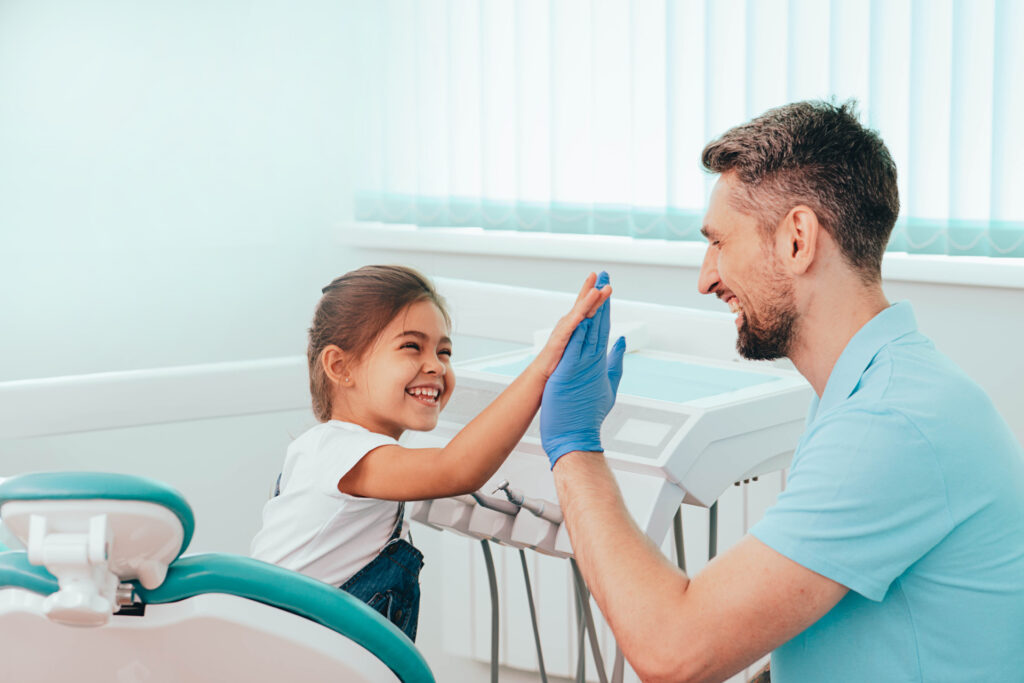
The first dental visit for a young child is nothing like the dental appointments that parents themselves typically associate with dentistry. There is no drilling, no fillings, and in most cases no discomfort of any kind. It is primarily a familiarisation and assessment appointment, structured around making the child comfortable in the dental environment and giving the parent useful clinical guidance.
The Environment
A paediatric dental environment is designed to be child-friendly — with smaller equipment, appropriate lighting, and a clinical approach that is paced to the child’s comfort and cooperation rather than to adult treatment timelines. The dental chair can be adjusted so that a very young child sits in the parent’s lap, with the parent seated in the chair holding the child — this keeps the child close to a trusted adult and allows the dentist to examine the mouth briefly and comfortably.
What the Dentist Does
For an infant or toddler, the clinical examination is brief and gentle. The dentist examines the teeth and gums using a small mirror and a light — looking for any signs of early decay, checking the eruption pattern, assessing the bite, and looking for any developmental concerns. The examination rarely takes more than a few minutes. No instruments that produce noise or sensation are used unless a specific clinical concern requires it.
The majority of the appointment time is spent in conversation with the parent. The dentist discusses feeding practices — whether the child is breastfed or bottle-fed, whether they fall asleep with a bottle, what they drink during the day — because feeding patterns are the primary driver of early childhood caries and giving parents accurate guidance at this stage is one of the highest-impact interventions available in paediatric dentistry. The dentist also covers home hygiene technique — how to brush an infant or toddler’s teeth correctly, which toothpaste to use and how much, and when to introduce flossing.
The Clinical Findings
For most children at their first visit, the clinical findings are reassuring — the teeth are developing normally, there are no signs of decay, and the parent leaves with a clear picture of what is normal and what to watch for. Occasionally, the first visit identifies an early concern — a small lesion of early caries, an unusual eruption pattern, or a habit (thumb-sucking, dummy use) that is beginning to affect jaw development. In all of these cases, early identification is the best possible outcome — the management at this stage is always simpler than at a later stage.
How to Prepare an Anxious Child for the Dental Visit
Dental anxiety in children is not innate — it is learned. Children who have never been to a dentist do not arrive with pre-formed anxiety about the experience; they arrive curious. The anxiety, when it develops, is typically the result of negative past experiences (their own or a sibling’s), parental anxiety that has been communicated (often unintentionally), or media representations of dentistry that focus on discomfort.
The most effective strategy for preventing dental anxiety in children is to make the early visits genuinely positive — low-stimulus, unhurried, and oriented around the child feeling safe rather than getting through the clinical examination as efficiently as possible. The following practical guidance for parents is evidence-based and drawn from paediatric dental behaviour management literature.
Before the Visit
- Do not use the dentist as a threat: Phrases like ‘if you don’t brush your teeth, the dentist will pull them out’ create negative associations before the child has ever met a dentist. Avoid all framing that positions the dentist as a consequence or punisher.
- Use positive, neutral language: Describe the dentist as someone who counts and cleans teeth and makes sure they are strong and healthy. Avoid words like ‘drill’, ‘needle’, ‘injection’, or ‘hurt’ — introduce the dentist’s own vocabulary (the ‘tooth counter’, the ‘tooth cleaner’) rather than adult clinical terms.
- Read picture books about dental visits: There are several well-known children’s books that introduce the dental visit positively and normalise the experience before the appointment. Reading these in the days before the visit helps children form a positive mental model.
- Do not rehearse extensive details: A brief, matter-of-fact description (‘We are going to see a dentist who will look at your teeth and count them’) is better than a lengthy explanation that may inadvertently raise anxiety through over-preparation.
On the Day
- Keep your own anxiety contained: Children are highly sensitive to parental emotional states. If you are anxious about dental visits yourself, take care not to communicate that anxiety through your tone, body language, or the words you choose on the day of the appointment.
- Choose an appointment time that suits the child: For toddlers, mid-morning appointments after a nap and a meal tend to be best — the child is rested and not hungry. Late afternoon appointments after a long day are rarely the best timing for very young children.
- Bring a comfort item: A favourite toy, blanket, or comfort object can be brought into the appointment. Having something familiar in an unfamiliar environment reduces anxiety for many young children.
- Praise, do not bribe: Praise the child for specific positive behaviours (‘You were so brave opening your mouth wide’) rather than offering rewards contingent on the appointment going well — conditional rewards can inadvertently signal that the experience is expected to be unpleasant.
At Nova Dental Hospital
Nova Dental Hospital’s paediatric dentistry appointments are structured around the child’s pace and comfort — the clinical examination is never rushed, behaviour management techniques are used throughout, and the approach is to build a positive association with the dental environment over multiple visits rather than to maximise what is achieved in a single appointment. A child who leaves the dental clinic having had a pleasant experience — where they were treated with patience and appropriate communication — is one who will return willingly for the next visit.
Common Childhood Dental Problems — What to Watch For
Early Childhood Caries (Nursing Caries / Baby Bottle Tooth Decay)
Early childhood caries is the most common chronic disease in childhood globally and the most prevalent paediatric dental problem in India. It can begin as soon as the first teeth erupt — typically presenting as white spot lesions (early demineralisation) on the upper front teeth, progressing to brown or black cavitation if untreated. The primary risk factor is prolonged contact between the teeth and fermentable carbohydrates — most commonly in the form of milk or juice in a bottle that the child falls asleep with, or prolonged on-demand breastfeeding through the night after teeth have erupted.
Prevention is straightforward: no bottle of milk or juice at bedtime after the first teeth appear; wiping the gums and teeth after night feeds; establishing a brushing routine from the first tooth. Treatment, when decay has established, ranges from preventive remineralisation for very early lesions through to composite fillings, stainless steel crowns, or in severe cases, extractions under general anaesthesia for very young children with extensive decay.
Thumb Sucking and Dummy (Pacifier) Habits
Non-nutritive sucking habits — thumb sucking, dummy use — are normal and developmentally appropriate in infancy and toddlerhood. The majority of children stop these habits naturally between two and four years of age, with no lasting dental consequence. Prolonged habit persistence beyond the age of four to five begins to affect jaw development — typically producing an open bite (where the front teeth do not meet when the back teeth close), a narrow upper arch, or excessive forward positioning of the upper front teeth.
The clinical guidance is that habits that resolve by four years do not require intervention. Habits persisting beyond four to five years, or habits that are producing visible bite changes, warrant assessment and, where appropriate, habit-breaking appliances or behavioural strategies. Forcibly removing a dummy or thumb from a child before they are developmentally ready typically causes more psychological distress than dental benefit.
Delayed or Early Eruption
There is significant normal variation in the timing of tooth eruption — both primary and permanent — and most deviations from average timing are clinically insignificant. The average eruption of the first primary tooth is six to eight months, but a range of four to fourteen months is entirely normal. The first permanent molar typically erupts around age six, but a range of five to seven years is normal. A tooth that is six months outside the expected range warrants an X-ray to confirm the tooth is present and developing normally; a tooth that is twelve months or more delayed warrants more thorough investigation.
Early loss of primary teeth — from decay, trauma, or early natural shedding — should prompt assessment of the space available for the permanent successor. Space maintainers — small appliances that hold the space open until the permanent tooth is ready to erupt — are sometimes recommended after premature primary tooth loss in positions where the adjacent teeth are at risk of drifting.
Tooth Grinding in Children
Bruxism — teeth grinding — is common in children and is almost universally outgrown without dental consequences. As discussed in our blog on bruxism, headaches, and jaw pain, grinding in adults requires protective management because of the cumulative wear on the permanent dentition. In children, the primary dentition has sufficient enamel bulk to absorb typical childhood grinding, and night guards are not routinely recommended because the jaw is actively growing and a fixed appliance would quickly become ill-fitting. If a child is grinding loudly and consistently, it is worth mentioning at the dental check-up, but in the vast majority of cases watchful waiting is appropriate.
Dental Trauma
Dental injuries are extremely common in childhood — particularly between the ages of eighteen months and three years, when toddlers are developing locomotion and frequently fall, and between seven and ten years, when physical activity and contact sports increase the risk. Injuries range from displacement of baby teeth (which may resolve spontaneously or require removal) through to crown fractures of permanent teeth (which require prompt assessment and treatment to protect the pulp).
Any dental trauma in a child should be assessed by a dentist promptly — even if the tooth appears undamaged and the child is not in pain. The impact on the underlying permanent tooth development may not be immediately visible, and a clinical and radiographic assessment is the only way to establish whether intervention is needed. Parents should keep the clinic’s number accessible for exactly these situations.
⚠️ Signs That Warrant Prompt Dental Assessment in Children
- White, brown, or black spots or cavities visible on any tooth — particularly the upper front teeth in young children
- A tooth that has been knocked, displaced, or fractured — even if the child is not in pain
- Swelling of the gum near any tooth, or a tooth that appears darker than adjacent teeth
- A child complaining of tooth pain or pain when eating — particularly if they are avoiding food or eating on one side
- Persistent thumb-sucking or dummy use after the age of four, particularly if the bite is visibly changing
- A permanent tooth erupting in an unusual position, or a primary tooth that should have been shed a year ago still present
- Bleeding gums during brushing — particularly if it is persistent rather than occasional
Home Care by Age: What Parents Should Be Doing
Infants (0 to 12 Months)
Before the first tooth appears, clean the gums after feeds with a clean, damp cloth or a silicone finger brush — this removes milk residue from the gum tissue and establishes the routine of mouth cleaning from birth. Once the first tooth appears, begin brushing twice daily with a soft infant toothbrush and a smear of fluoride toothpaste (the size of a grain of rice). No sugary drinks in bottles; water or milk only.
Toddlers (12 to 36 Months)
Brush twice daily — after breakfast and before bed — with a smear of fluoride toothpaste on a small-headed soft brush. The parent should be doing the brushing, not supervising the child doing it themselves. Toddlers lack the manual dexterity for effective self-brushing. Transition from bottle to cup by eighteen months. No juice or sweet drinks between meals — water between meals is the only safe drink for teeth.
Preschool Age (3 to 6 Years)
Continue twice-daily brushing, with the parent brushing after the child has had a go themselves. Introduce a pea-sized amount of fluoride toothpaste. Begin introducing flossing where teeth are in contact. Reinforce the association between sugary snacks and tooth decay — not as a threat, but as a matter-of-fact explanation (‘the sugar feeds the bacteria that make holes in teeth’).
School Age (6 to 12 Years)
Children can take increasing responsibility for their own brushing from around six to seven years, but parents should continue to check and supervise until at least age nine or ten — most children do not have the manual dexterity for consistent, thorough brushing before this age. Electric toothbrushes are particularly helpful for this age group. Fissure sealants on the first permanent molars (around age six) and second permanent molars (around age twelve) are a highly effective preventive measure.
Adolescents (12 to 18 Years)
Maintain twice-daily brushing and daily interdental cleaning. Adolescence is a period of heightened caries risk — dietary habits (snacking, sugary drinks) and oral hygiene compliance often decline. Puberty-related gum inflammation (puberty gingivitis) is common and can produce bleeding gums that resolve with improved hygiene. For adolescents in orthodontic treatment, meticulous cleaning around brackets and wires is essential — plaque accumulation under fixed braces is a significant caries risk.
✅ Fluoride Toothpaste — Getting the Amount Right
- 0 to 2 years: Smear of fluoride toothpaste (the size of a grain of rice). Fluoride at this stage is preventive; the smear amount minimises ingestion risk.
- 2 to 6 years: Pea-sized amount of fluoride toothpaste (1,000 ppm fluoride).
- 6 years and above: Pea-sized to standard amount of adult fluoride toothpaste (1,450 ppm fluoride). Older children should spit but not rinse — leaving a small amount of fluoride on the teeth maximises the preventive effect.
- Do not use non-fluoride ‘natural’ toothpastes for children — fluoride is the single most evidence-based preventive agent for dental caries and there is no clinically validated alternative.
Frequently Asked Questions
FAQ 1: My child’s teeth have gaps between them. Is that normal?
Yes — spacing between primary teeth is not only normal but desirable. The permanent teeth are larger than the primary teeth they replace, and spacing between the baby teeth creates the room that the permanent teeth need to erupt without crowding. A child with tightly packed primary teeth with no spacing between them is actually more likely to have crowding in the permanent dentition than one with generous spacing. Spacing is cause for reassurance, not concern.
FAQ 2: My child refuses to let me brush their teeth. What should I do?
Resistance to toothbrushing is extremely common in toddlers and pre-schoolers and is a normal expression of autonomy rather than anything specific about tooth-brushing. Practical strategies that help: let the child choose their toothbrush (character themes, preferred colours); allow them to brush first themselves before you finish; use a song or a timer to make two minutes manageable; make it a routine that follows a predictable sequence (bath, pyjamas, teeth, story) so resistance is less likely; stay matter-of-fact rather than making it a battle. Seeking support from the paediatric dentist at check-up appointments is also worthwhile — children often accept tooth-brushing coaching from a dentist more readily than from a parent.
FAQ 3: Does my child need fluoride treatments at the dental check-up?
Professional fluoride application — typically a fluoride varnish painted onto the teeth at check-up appointments — is recommended for children at elevated caries risk: those with a history of early childhood caries, those with dietary risk factors (frequent sugary snack or drink consumption), or those in areas with non-fluoridated water supplies. For children with good home fluoride toothpaste use, low sugar intake, and no decay history, the additional benefit of in-clinic fluoride application is modest. The dentist will assess the individual child’s caries risk at each check-up and recommend fluoride treatment where it adds meaningful preventive value. Book a paediatric dental check-up at Nova Dental Hospital for an individual assessment.
FAQ 4: My child’s permanent tooth is coming in behind the baby tooth. Should I be worried?
This is called an ‘ectopic eruption’ or, informally, ‘shark teeth’ — a very common finding in children aged five to seven years when the lower permanent incisors erupt behind the primary teeth rather than pushing them out. In most cases, the primary teeth loosen and fall out on their own within a few weeks of the permanent tooth becoming visible, and the permanent tooth moves forward into position with tongue pressure over subsequent months. If the primary tooth remains firmly in place after the permanent tooth is clearly visible and has been present for four to six weeks, a dental assessment is warranted — the primary tooth may need to be extracted to allow the permanent tooth to move into position.
FAQ 5: How often should my child see the dentist?
The standard recommendation is every six months for most children. Children at elevated caries risk — those with a history of decay, high sugar intake, or difficult home hygiene — may benefit from more frequent check-ups (every three to four months). Children with established good oral health, effective home hygiene, and low sugar exposure may be assessed annually at some age ranges. The recall interval is determined by the individual child’s risk profile at each check-up, not by a fixed schedule that applies to all children equally. At Nova Dental Hospital, the paediatric team reviews recall frequency at every appointment and adjusts the schedule to what is clinically appropriate for that child. You are welcome to read parent reviews on our Google Business Profile.
🔑 Key Takeaways
- The first dental visit should happen when the first tooth erupts — ideally by the first birthday. Most parents wait too long, missing the most impactful preventive window.
- Baby teeth are not expendable. They guide permanent tooth eruption, support jaw development and speech, and can cause serious pain and infection if affected by decay.
- The first dental visit for a young child is a familiarisation and assessment appointment, not a treatment appointment. It is primarily about checking development and giving parents guidance.
- Dental anxiety is shaped by experience, not by inherent fear of dentistry. Positive early visits, neutral parental language, and a child-paced clinical approach all contribute to a child who attends dental appointments willingly throughout life.
- The most common childhood dental problem is early childhood caries — preventable with correct feeding practices, fluoride toothpaste from the first tooth, and regular check-ups.
- Home care should be parent-led until at least age nine or ten. Children develop sufficient manual dexterity for effective independent brushing later than most parents assume.
Conclusion: Start Early, Keep It Positive, and the Rest Follows
The child who grows up with dental check-ups as a normal, unremarkable part of life — who has never had an unexpected procedure at the dentist, who has always left the clinic feeling fine, and whose dental problems have consistently been caught and addressed before they became painful — is the adult who maintains their dental health for life. That outcome starts with the first dental visit, and the first dental visit starts earlier than most parents realise.
If your child has not yet had their first dental check-up — whatever their age — the right time to book it is now. And if you are expecting a first child or have an infant at home, bookmark this guide for when the first tooth appears. The first birthday is not too early.
Nova Dental Hospital’s paediatric dentistry appointments are structured for children of all ages — from infants through to adolescents — with a child-first approach that prioritises comfort, communication, and building a positive relationship with dental care before any treatment is ever needed. Book a paediatric check-up for your child today.

Related posts
Write a Comment
Recent Posts


