


What Is Full Mouth Rehabilitation and Who Is It Actually For?
What Is Full Mouth Rehabilitation and Who Is It Actually For?

The Moment When Treating One Tooth at a Time Stops Being Enough
Most dental treatment is episodic. A tooth hurts, it is treated. A filling fails, it is replaced. A crown is recommended, it is placed. Each problem is addressed as it arises — independently, sequentially, without necessarily considering the relationship between individual problems or the state of the mouth as a whole.
For many patients, this approach works well. Their dental problems are isolated, their overall oral health is stable, and treating each issue as it appears is both appropriate and efficient. But for a significant number of patients — particularly those who have had years of accumulating dental problems, significant tooth wear, multiple missing teeth, a heavily restored dentition with failing restorations, or severe gum disease — treating one tooth at a time does not address the underlying situation. Each new problem is, in part, a consequence of the broader state of the mouth: the shifting bite, the compromised support, the loss of vertical dimension, the cascading failures of an occlusion that no longer distributes force evenly.
This is the clinical territory that full mouth rehabilitation addresses. It is not a specific procedure — it is a treatment philosophy and a planning approach: assessing the entire mouth as an integrated system, identifying all the problems and their interrelationships, and developing a sequenced treatment plan that addresses everything in a logical order, restoring both function and aesthetics to the dentition as a whole.
This guide explains what full mouth rehabilitation involves, who it is appropriate for, what the planning process looks like, what treatments are typically included, how long it takes, and what to expect along the way.
🔑 Key Takeaways
- Full mouth rehabilitation is not a single procedure — it is a coordinated, sequenced treatment plan that addresses multiple dental problems across the whole mouth as an integrated system rather than as isolated individual issues.
- It is appropriate for patients with severe tooth wear, multiple missing teeth, widespread decay or failing restorations, bite collapse from tooth loss, and congenital or trauma-related conditions affecting most of the dentition.
- The planning process is the most important phase. Before any treatment begins, a thorough clinical assessment, diagnostic records, and in many cases a diagnostic wax-up and trial restoration establish the proposed outcome and the treatment sequence.
- Full mouth rehabilitation almost always involves multiple treatment types — periodontal treatment, root canals, extractions, implants, crowns, bridgework — coordinated in a specific sequence that builds the foundation before the final restorations are placed.
- Treatment timelines range from several months for straightforward cases to one to two years for comprehensive cases involving implant placement and osseointegration periods.
- The outcome is not cosmetic in isolation — it is functional and structural. Patients who have completed full mouth rehabilitation typically report significant improvements in chewing, comfort, confidence, and quality of life.
What Full Mouth Rehabilitation Actually Means
The term full mouth rehabilitation (also called full mouth reconstruction or full mouth restoration) describes a comprehensive restorative treatment plan that addresses the teeth, gums, jaw joints, and bite across the entire dentition — upper and lower arches — with the goal of restoring optimal function, health, and aesthetics.
It is distinguished from simpler restorative treatment by its scope — it involves most or all of the teeth — and by its integrated planning approach. Rather than treating each problem independently, a full mouth rehabilitation plan considers the relationship between all the components: how the bite closes, how the jaw joints are loaded, how the vertical dimension of the face is maintained, how the remaining teeth are distributed and loaded, and how each planned restoration interacts with every other planned restoration.
The distinction between a smile makeover and a full mouth rehabilitation is worth clarifying. A smile makeover is primarily aesthetic — veneers, whitening, composite bonding — addressing the appearance of the teeth without necessarily any functional or structural component. A full mouth rehabilitation is primarily functional and structural, with aesthetics as an important secondary objective. In practice, the two overlap in comprehensive cases — a patient who needs all their teeth restored because of severe wear will also want the result to look good — but the clinical driver is function and health, not aesthetics alone.
Who Full Mouth Rehabilitation Is For: The Four Main Patient Groups
Full mouth rehabilitation is not an exotic or unusual treatment. It is the appropriate clinical response to a set of conditions that present relatively commonly in adult dental practice — particularly in patients who have had limited dental care for extended periods, or who have a systemic condition or habit that has systematically damaged the dentition over time. The four main clinical presentations that lead to a full mouth rehabilitation plan are:
1. Severe Tooth Wear — Bruxism, Erosion, or Attrition
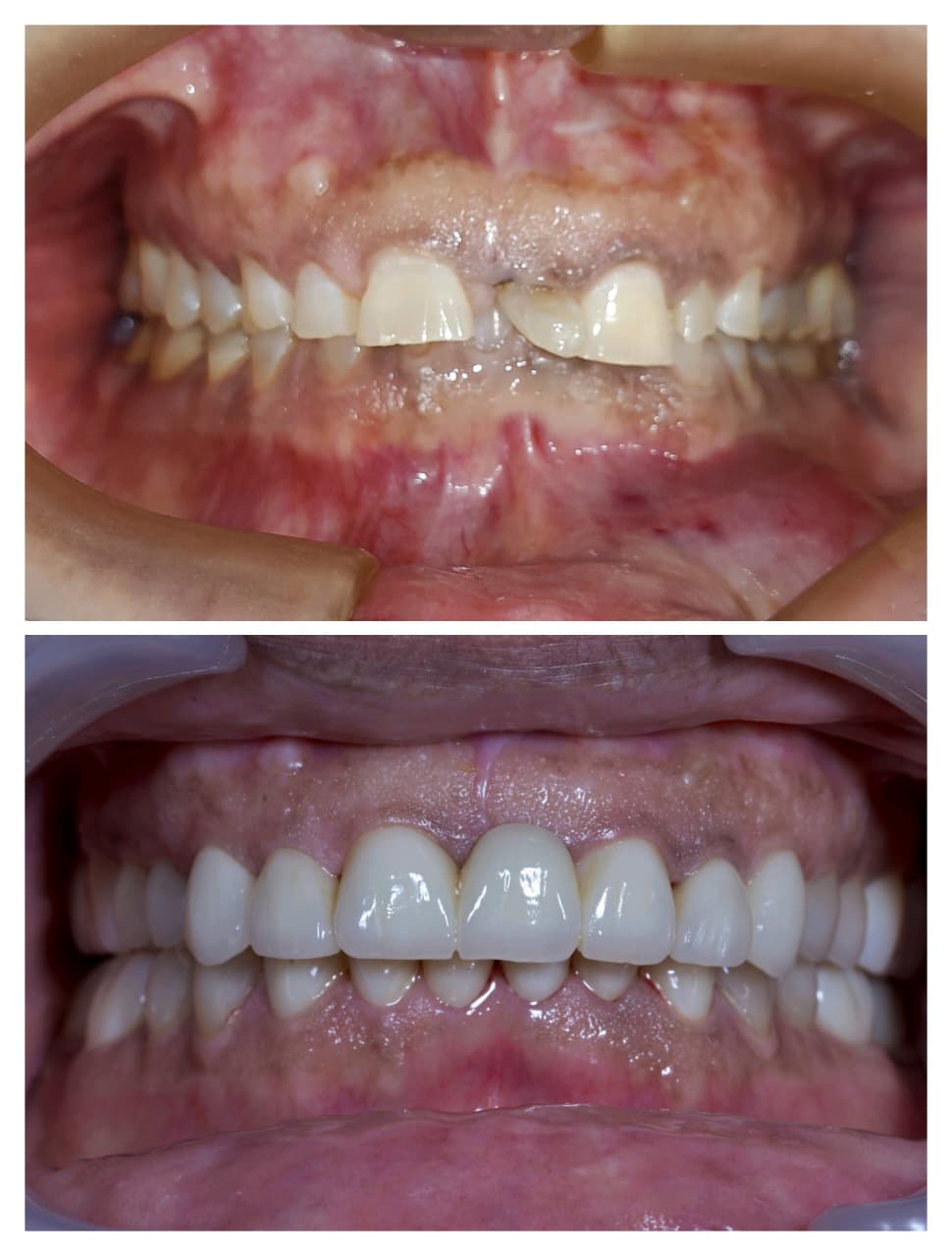
Patients who have ground their teeth for years — with or without being aware of it — present with teeth that are visibly shorter, flatter, and more sensitive than they should be. The enamel has been worn away from the biting surfaces, the incisal edges of the front teeth are chipped and irregular, and in advanced cases the teeth have lost significant vertical height — the lower face looks shorter, the patient’s smile shows less tooth, and the bite has collapsed to a level where restoring individual teeth is not possible without first re-establishing the correct vertical dimension.
This is one of the most common presentations for full mouth rehabilitation. As discussed in our blog on bruxism, headaches, and jaw pain, the forces generated during sleep grinding far exceed those of normal chewing — and sustained over years, they produce the kind of wear that cannot be addressed by treating individual teeth. The rehabilitation plan must restore the correct vertical dimension across the whole arch before individual restorations are placed, and a night guard must be incorporated into the ongoing management to protect the new restorations.
2. Multiple Missing Teeth With Bite Collapse
Patients who have lost multiple teeth over time — through extractions that were not replaced, through tooth loss from gum disease, or through a combination — present with a dentition that has progressively collapsed. Adjacent teeth tilt into gaps, opposing teeth over-erupt into spaces, the bite shifts to distribute load onto the remaining teeth (often overloading them), and the vertical dimension reduces as the supporting tooth structure is lost.
By the time a patient with multiple long-standing missing teeth seeks rehabilitation, the problems are rarely limited to the gaps themselves. The teeth adjacent to and opposing the gaps have moved, the gum and bone in the gap areas has resorbed, and the remaining teeth may show signs of excessive wear, cracking, or periodontal involvement from the altered load distribution. Restoring this situation requires a plan that accounts for all of these consequences — not just the placement of implants or bridgework in the spaces. As explored in our blog on implants versus dentures versus bridges, the choice between replacement options for each gap is made in the context of the whole rehabilitation plan, not in isolation.
3. Widespread Decay or Failing Restorations
Patients who have had significant dental problems for years — through neglect, through financial constraints that prevented treatment, through systemic conditions that affected dental health, or through a combination — may present with decay affecting most of their teeth, failing or missing fillings, teeth that have broken down around old restorations, and a mouth that has deteriorated to a point where each individual problem is compounded by the others.
These patients often feel significant embarrassment about the state of their teeth — and often have not sought dental care for years precisely because the embarrassment and anxiety about the likely extent of treatment required has been a barrier. A full mouth rehabilitation plan for this group begins with a systematic assessment of every tooth, prioritises what needs to be done urgently (infections, pain, extractions of non-restorable teeth), and then plans the restorative phase in a sequence that rebuilds the mouth systematically.
4. Trauma or Congenital Conditions
Significant facial trauma — from road accidents, sports injuries, or other causes — can result in multiple fractured, avulsed, or structurally compromised teeth that require comprehensive reconstruction. Similarly, congenital conditions such as amelogenesis imperfecta (a condition affecting enamel formation) or dentinogenesis imperfecta, ectodermal dysplasia, or cleft palate may result in multiple missing or severely malformed teeth that require a planned rehabilitation from early adulthood.
For trauma patients in particular, the rehabilitation plan must also account for any jaw joint involvement, any bone loss in the traumatised areas, and the integration of implants in sites where immediate or early placement may have been done as part of the acute trauma management.
| Patient Profile | Primary Problem | Key Rehabilitation Components | Typical Complexity |
| Severe bruxism / tooth wear | Loss of vertical dimension; worn, shortened teeth | Bite reconstruction to restore VDO; crowns across most or all teeth; night guard | High — vertical dimension change requires careful planning |
| Multiple missing teeth / bite collapse | Gaps, tilting, over-eruption; lost bone; compromised bite | Orthodontic uprighting or extractions; implants or bridges; crowns on compromised adjacent teeth | High — each missing tooth has downstream effects |
| Widespread decay / failing restorations | Multiple carious teeth; broken-down restorations; pain; infection | Periodontal treatment; RCTs; extractions of non-restorable teeth; fillings; crowns; possible implants | Variable — depends on what can be saved |
| Trauma | Fractured, avulsed, or displaced teeth; possible bone loss | Implants; crowns; bridgework; TMJ assessment; bone grafting if needed | Variable — depends on severity and time since trauma |
| Congenital conditions | Missing, malformed, or soft teeth across much of the dentition | Phased treatment from adolescence; implants after growth complete; crowns; overdentures | High — lifelong management, often multidisciplinary |
The Planning Process: Why It Is the Most Important Phase
Full mouth rehabilitation begins not with drills and impressions but with a comprehensive diagnostic phase that can take one or more dedicated appointments before any treatment is planned. Skipping or abbreviating this phase is one of the most common causes of suboptimal rehabilitation outcomes — treating each tooth as it presents without a plan for the whole means that later restorations may conflict with earlier ones, or that the sequence of treatment has to be undone and redone.
Clinical Examination and Records
The assessment begins with a thorough clinical examination — periodontal probing of every tooth, assessment of all existing restorations, tooth mobility, bite relationship, jaw joint assessment (for clicking, pain, or limited opening), and a facial assessment noting vertical dimension, lip support, and smile aesthetics. Full clinical photographs — both facial and intraoral — are taken as a baseline record and as a reference for laboratory communication. An OPG panoramic X-ray and periapical X-rays of all teeth are taken to assess bone levels, root lengths, the condition of the periapical tissues, and the presence of any pathology.
CBCT 3D Imaging for Complex Cases
For cases involving implant placement, severe bone loss, impacted teeth, or significant jaw joint involvement, a CBCT 3D scan provides the three-dimensional bone and root anatomy that two-dimensional X-rays cannot. At Nova Dental Hospital, CBCT imaging is available in-house — meaning the same team that plans and delivers the treatment has immediate access to the detailed anatomical data needed for surgical accuracy. In implant-based rehabilitation cases, the CBCT scan allows virtual implant planning and, where appropriate, the fabrication of a surgical guide for precise implant placement.
Study Models and Articulator Mounting
Impressions or digital scans of both arches are taken and used to produce plaster study models, which are mounted on an articulator — a mechanical device that reproduces the jaw joint movements and bite relationship. The articulator allows the clinician to study the bite in detail, identify the discrepancies in occlusion, and plan the restorations without the patient present. This is a critical step in cases requiring vertical dimension changes, as the articulator allows the proposed new bite to be established and evaluated before any teeth are prepared.
Diagnostic Wax-Up
A diagnostic wax-up — wax additions built onto the study models to simulate the proposed restorations — allows the clinician and, importantly, the patient to visualise the planned result in three dimensions before any treatment begins. The wax-up establishes the proposed tooth shapes, sizes, and bite relationship and serves as the reference for laboratory fabrication of the final restorations. For cases with significant aesthetic components, a trial smile or mock-up — temporary composite applied over the existing teeth to simulate the wax-up — allows the patient to preview the result in their own mouth before committing to preparation.
The Treatment Plan Document
Every full mouth rehabilitation plan should be presented to the patient as a written treatment plan that covers every proposed procedure, the sequence in which it will be carried out, the expected timeline for each phase, and the full cost with a breakdown by treatment component. This document is the foundation of informed consent — the patient should understand every element of the plan before any treatment begins. At Nova Dental Hospital, the treatment plan is presented at a dedicated consultation appointment, with time for the patient to review it, ask questions, and seek any second opinions before proceeding.
The Treatment Sequence: What Happens in What Order
The sequence of treatment in a full mouth rehabilitation is not arbitrary — it follows a clinical logic that builds the foundation of health before placing the final restorations. Placing crowns or veneers before underlying gum disease or decay is addressed is the most common error in poorly planned restorative treatment, and it leads to restoration failure and further disease beneath or around the new work.
Phase 1 — Disease Control
The first phase addresses all active disease: periodontal treatment for gum disease (scaling and root planing as covered in our blog on why deep cleaning is recommended), treatment or extraction of teeth with untreatable decay or infection, root canal treatment for teeth with pulpal involvement that are worth saving, and any necessary surgical procedures. No restorative work is placed until the disease is controlled and the mouth is stable. This phase may take weeks to several months depending on the extent of disease present.
Phase 2 — Foundation and Provisional Restorations
Once the mouth is disease-free and stable, the structural foundation for the rehabilitation is established. Where implants are planned, they are placed at this stage and allowed to osseointegrate — a process of three to six months during which the titanium fixture bonds to the bone. Where the vertical dimension needs to be restored (in severe wear cases), provisional restorations are placed at the new planned bite height and worn for a period to confirm that the patient’s jaw joints and muscles are comfortable at the new position before the definitive restorations are made.
Provisional restorations — temporary crowns, bridges, or veneers — serve a dual clinical purpose: they protect the prepared teeth and maintain aesthetics and function during the treatment period, and they allow both the clinician and the patient to evaluate and adjust the planned tooth shapes, sizes, and bite before the permanent restorations are fabricated.
Phase 3 — Definitive Restorations
Once the provisional restorations have been evaluated and approved — typically after a period of one to three months — the definitive restorations are fabricated. In a comprehensive full mouth rehabilitation, this involves detailed laboratory work: full-coverage crowns on prepared teeth, implant crowns on integrated fixtures, bridges where spans require them, and in some cases veneers on teeth that do not require full coverage. The definitive restorations are fabricated to the exact specifications established during the provisional phase and cemented or bonded at dedicated fit appointments.
Phase 4 — Review and Maintenance
Following completion of the definitive restorations, a review appointment assesses the bite, the fit of the restorations, the health of the gum tissue around each restoration, and the patient’s comfort. Occlusal adjustments are made where needed. The patient is placed on a maintenance recall schedule — typically every four to six months for a full mouth rehabilitation patient — to monitor the restorations, the periodontal status, and the bite long-term. For bruxism patients, a night guard is fabricated and its use is monitored at every maintenance appointment.
| Phase | What Happens | Approximate Duration |
| Phase 1: Disease Control | Periodontal treatment; root canals; extractions of non-restorable teeth; any surgical procedures | 4–12 weeks (longer if severe periodontitis) |
| Phase 2: Foundation | Implant placement and osseointegration; provisional restorations at new VDO; evaluation period | 3–6 months (driven by implant healing) |
| Phase 3: Definitive Restorations | Laboratory crowns, implant crowns, bridges, veneers; fit appointments; occlusal refinement | 4–12 weeks (laboratory turnaround + fit appointments) |
| Phase 4: Review and Maintenance | Post-treatment review; bite assessment; recall schedule established; night guard for bruxism patients | Ongoing — first review at 4–6 weeks post-completion |
What Treatments Are Typically Included
Full mouth rehabilitation draws on the full range of dental treatments — often coordinated across multiple specialties. The specific combination depends entirely on the individual patient’s clinical situation. The following are the most commonly involved treatment types:
- Periodontal treatment: Scaling and root planing for any active gum disease; periodontal surgery for advanced cases; gum contouring where gum levels need adjustment for aesthetics or crown lengthening.
- Root canal treatment: Teeth with pulpal disease that are worth saving are root canal-treated and built up with a post and core before being crowned. Teeth with untreatable root involvement are extracted.
- Extractions: Teeth that cannot be saved — due to vertical root fracture, non-restorable decay, severe bone loss, or unfavourable root anatomy — are extracted, with the extraction sites planned in advance as future implant or bridge sites.
- Bone grafting: Where implants are planned in sites with insufficient bone volume — either from prior resorption or from the extraction itself — bone grafting is performed to augment the site before or at the time of implant placement.
- Dental implants: For missing teeth, implants are the preferred restoration where bone volume and medical status permit. In full arch cases, implant-supported fixed bridges (All-on-4 or All-on-6) may replace an entire arch on four to six implants.
- Crowns: Heavily restored teeth, root canal-treated teeth, severely worn teeth, and implant fixtures all receive full-coverage crowns fabricated from zirconia or lithium disilicate.
- Bridges: Where implants are not appropriate for specific sites, fixed bridgework spans the gap using adjacent teeth as abutments.
- Veneers: For teeth that do not require full coverage but benefit from surface change — colour, shape, or minor alignment — veneers may be incorporated into the rehabilitation plan alongside crowns.
- Orthodontic treatment: In some cases, orthodontic tooth movement before the restorative phase simplifies or improves the final restoration — uprighting tilted teeth adjacent to gaps, creating space for restorations, or improving the occlusal relationship before crowns are placed.
How Long Does Full Mouth Rehabilitation Take?
The timeline for a full mouth rehabilitation is one of the first questions patients ask, and it varies widely depending on the complexity of the case, the treatments involved, and whether implants are part of the plan.
At the simpler end — a patient with severe wear affecting most teeth, no missing teeth, and no significant gum disease — the rehabilitation may involve provisional restorations followed by definitive crowns across the upper and lower arches, with a total treatment timeline of four to six months. At the more complex end — a patient with multiple missing teeth requiring bone grafting, implant placement, osseointegration, and then crowns and bridges — the timeline may extend to twelve to eighteen months, with the majority of the time accounted for by the osseointegration period during which the patient is wearing provisional restorations.
The most important thing patients should understand about the timeline is that it is not a period of discomfort and disruption throughout. For most of the treatment period, the patient is wearing well-made provisional restorations that function adequately and look reasonable — they are not going without teeth or significantly impaired. The wait for osseointegration, in particular, is a biological process that happens while the patient goes about their normal life.
💡 Realistic Expectations for Full Mouth Rehabilitation
- The diagnostic and planning phase takes longer than most patients expect — and it should. A well-planned rehabilitation is significantly less likely to require revision or supplementary treatment than a rushed one.
- Provisional restorations are a normal part of a comprehensive plan, not a sign that things are being delayed. They serve an important clinical purpose and are not just placeholders.
- The final restorations, once placed, require maintenance — regular check-ups, professional cleaning, and for bruxism patients, consistent night guard wear. The maintenance phase is as important as the active treatment phase.
- Significant improvement in function, comfort, and aesthetics is typically reported by patients well before the final restorations are placed — often from the provisional phase onwards.
- The investment in full mouth rehabilitation, spread over the treatment timeline, is the last significant dental investment most patients need to make for ten to twenty years — provided the result is maintained.
Frequently Asked Questions
FAQ 1: Is full mouth rehabilitation the same as a smile makeover?
Not exactly — though the two overlap in comprehensive cases. A smile makeover is primarily aesthetic — veneers, whitening, composite bonding — to improve the appearance of the teeth in an otherwise healthy mouth. Full mouth rehabilitation is primarily restorative and functional — addressing teeth that are structurally compromised, missing, severely worn, or diseased. Aesthetics is an important objective of a full mouth rehabilitation, but the clinical driver is function and health. For patients whose teeth are both functionally and aesthetically compromised, the two approaches converge — a cosmetic dentistry consultation can establish which approach is appropriate.
FAQ 2: How do I know if I need full mouth rehabilitation or just a few fillings and crowns?
The distinction comes down to whether the problems in your mouth are isolated or systemic. If you have two or three teeth that need attention and the rest of the mouth is healthy, targeted treatment of those specific teeth is appropriate. If multiple teeth have problems that are interrelated — bite collapse from missing teeth affecting how remaining teeth are loaded, severe wear that has affected most of the dentition, gum disease that has compromised the bone around many teeth — the problems cannot be effectively addressed in isolation. A thorough clinical assessment at Nova Dental Hospital gives you a clear picture of whether your situation calls for a comprehensive plan or targeted treatment.
FAQ 3: Will I be without teeth at any point during the treatment?
No — a properly planned rehabilitation ensures that you have provisional restorations covering prepared or treated teeth at every stage of treatment. You will not leave an appointment with an exposed preparation or a visible gap that was not there at the start. The provisionals may not have the aesthetic precision of the final restorations, but they are functional and presentable, and they maintain your bite and appearance throughout the treatment period.
FAQ 4: What happens if some of my teeth cannot be saved?
Extractions of non-restorable teeth are a normal component of many full mouth rehabilitation plans. The key is that extractions are planned in advance — identified during the diagnostic phase — rather than discovered mid-treatment. Each extraction site is evaluated for future treatment: whether an implant is appropriate, whether bone grafting will be needed, and whether the site will be part of a bridge span. A tooth that needs to be removed is not a setback in a well-planned rehabilitation — it is a step in the plan. For guidance on replacement options, our blog on implants versus dentures versus bridges covers the decision framework in detail.
FAQ 5: How do I get started with full mouth rehabilitation at Nova Dental Hospital?
The starting point is a comprehensive assessment appointment — not a regular check-up, but a dedicated diagnostic visit that includes a full periodontal assessment, clinical photographs, radiographs, and time to discuss your concerns and goals. From this appointment, a clinical picture of your mouth is established and the basis of a treatment plan is developed. For cases involving implants or complex bone assessment, a CBCT 3D scan is typically part of the diagnostic records. You are welcome to read about patient experiences with full mouth treatment at Nova Dental Hospital on our Google profile.
🔑 Key Takeaways
- Full mouth rehabilitation is the appropriate treatment response when dental problems affect most of the dentition in an interrelated way — not when individual teeth can be treated independently without consequence for the rest of the mouth.
- The four main patient groups who benefit from full mouth rehabilitation are: severe bruxism with bite collapse, multiple missing teeth with cascade effects, widespread decay or failing restorations, and trauma or congenital conditions.
- The planning phase — clinical assessment, CBCT imaging, articulator mounting, diagnostic wax-up, and a written treatment plan — is the most important phase. The quality of the plan determines the quality of the outcome.
- Treatment follows a logical sequence: disease control first, foundation and provisionals second, definitive restorations third. Restorative work placed before disease is controlled fails.
- Patients are never left without teeth during treatment — provisional restorations maintain function and appearance throughout the active treatment period.
- The timeline ranges from four to six months for straightforward wear cases to twelve to eighteen months for complex cases involving implants. The majority of this time is recovery and osseointegration — not active treatment appointments.
Conclusion: Full Mouth Rehabilitation Is About Restoring a System, Not Just Repairing Individual Teeth
The mouth is not a collection of independent parts. The teeth, the gums, the bone, the jaw joints, and the bite all function as an integrated system — and when that system is compromised at multiple points, the consequences of those individual failures compound each other. Full mouth rehabilitation is the clinical discipline of addressing those compounded failures as a system rather than as isolated problems, and restoring the function and aesthetics of the whole mouth in a sequenced, planned way.
For patients who have been living with compromised dental health for years — whether from wear, from missing teeth, from decay, or from any other cause — the prospect of comprehensive treatment can feel overwhelming. The reality, for most patients who complete a well-planned rehabilitation, is that it is the most significant improvement to their quality of life they have made in years. Eating comfortably, smiling confidently, and not thinking about their teeth are outcomes that isolated fillings and crowns cannot deliver when the underlying situation requires a comprehensive approach.
At Nova Dental Hospital, full mouth rehabilitation planning begins with a comprehensive diagnostic assessment — clinical examination, radiographs, CBCT imaging where indicated, study models, and a written treatment plan with full cost breakdown — before any treatment is scheduled. If you are at a point where piecemeal treatment is no longer working and you want to understand what a comprehensive approach would involve for your specific situation, a consultation is the right starting point.

Related posts
Write a Comment
Recent Posts


