Fissure Sealants for Children: What They Are, When to Get Them, and Why They Matter
Fissure Sealants for Children: What They Are, When to Get Them, and Why They Matter

The Treatment That Prevents Most Back-Tooth Cavities — Before They Start
When parents bring their child for a dental check-up and the dentist recommends fissure sealants, the most common response is a question: what is that? Fissure sealants are one of the most evidence-based and cost-effective preventive treatments in all of dentistry, yet they remain largely unknown among parents who have not specifically encountered them in a clinical setting.
This guide explains what fissure sealants are, why the grooves of the back teeth are so uniquely vulnerable to decay, exactly which teeth benefit and at what ages, what the application procedure involves, how long sealants last, and what the evidence says about their effectiveness. For any parent whose child has recently had the first permanent molars erupt — or who is approaching that milestone — this is one of the most clinically relevant things to understand about protecting their child’s teeth.
Nova Dental Hospital’s paediatric dentistry team in Gandhinagar recommends fissure sealants as a routine preventive measure at two specific developmental milestones — and the reason why will become clear once the biology of the grooved tooth surface is explained.
🔑 Key Takeaways
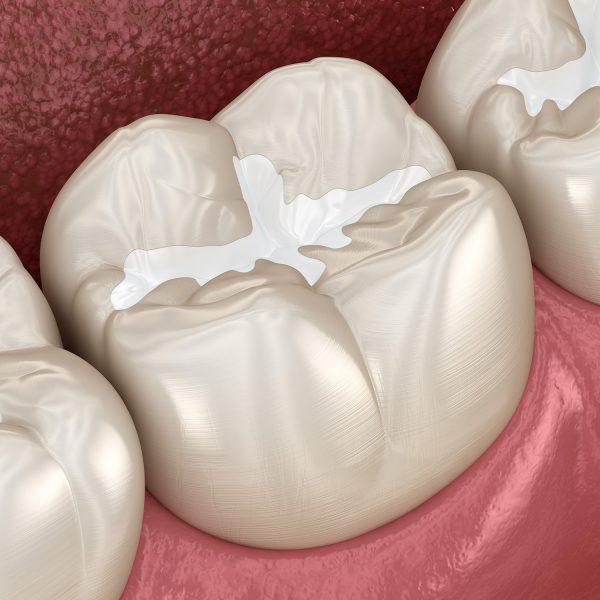
- Fissure sealants are thin, plastic coatings applied to the deep grooves (fissures) of the back teeth — the biting surfaces of the molars — to seal out the bacteria and food that cause decay in those grooves.
- The grooves of the back teeth are deeper and narrower than a toothbrush bristle. They cannot be effectively cleaned by brushing alone, making them the most vulnerable site for childhood and adolescent decay.
- The two most clinically important times for fissure sealants are: when the first permanent molars erupt (around age 6) and when the second permanent molars erupt (around age 12). Sealing these teeth shortly after they erupt, before decay has had time to establish, is the highest-value application.
- The procedure is entirely painless — no drilling, no injection, no discomfort. A liquid resin is applied to the tooth surface, flows into the grooves, and is set hard with a curing light. The whole procedure takes a few minutes per tooth.
- Studies consistently show that fissure sealants reduce the risk of cavities in sealed teeth by 70 to 80 percent compared to unsealed teeth. The cost of the sealant is a fraction of the cost of a filling — and far less than the cost of a crown or root canal.
- Sealants are not a substitute for brushing, fluoride toothpaste, or dietary management — they specifically protect the groove surfaces that those measures cannot adequately reach.
The Problem With Grooved Teeth — Why the Back Teeth Are So Vulnerable
To understand why fissure sealants are necessary, it helps to understand the specific anatomy of a molar tooth — because the vulnerability is structural, not behavioural, and it exists regardless of how well a child brushes.
The Fissure Anatomy of a Molar
The biting surface of a molar tooth is not flat. It is covered in a complex pattern of peaks (cusps) and valleys — deep, narrow grooves called fissures — that give the tooth its chewing efficiency by trapping food for grinding. These grooves range in depth from shallow surface markings to deep, narrow channels that can extend to within a fraction of a millimetre of the dentine beneath the enamel.
The critical measurement is the width of the groove at its base versus the width of a toothbrush bristle. Most fissures narrow significantly as they deepen, reaching a width at the base that is substantially narrower than even the finest toothbrush bristle. A bristle can remove the plaque from the entrance to the groove but cannot reach the base. The bacteria and food debris that accumulate at the base of the fissure are, for practical purposes, unreachable by any amount of brushing — regardless of technique, brush type, or duration.
What Happens in an Unprotected Fissure
In an unprotected fissure, the sequence of events that leads to a cavity is predictable. Food debris and bacteria accumulate at the base of the groove. The bacteria metabolise the carbohydrates in the food to produce acid. The acid begins dissolving the enamel at the base of the groove — in a location where the enamel is thinnest and where the dentine beneath is closest to the surface. Because the groove is narrow and the decay is at its base, it may progress significantly before any visual sign of a cavity is apparent from above.
This is why dentists find active decay in the grooves of apparently normal-looking back teeth. The groove entrance may look dark or slightly stained — but the cavity beneath is already substantial because the decay progresses downward into the dentine before widening at the surface. By the time a parent notices something wrong, a filling — or worse, a crown — is already necessary.
Why Newly Erupted Molars Are Particularly Vulnerable
A tooth that has just erupted is the most susceptible it will ever be to decay. When a permanent tooth first breaks through the gum, its enamel is not yet fully mineralised — it continues to mature and harden during the months and years after eruption, a process called post-eruptive enamel maturation. During this period of incomplete mineralisation, the enamel is more soluble in acid and less resistant to decay than fully matured enamel.
The combination of immature enamel and deep, cleansing-resistant grooves in a newly erupted molar makes the first year or two after eruption the highest-risk period for fissure decay. Sealing the grooves before decay establishes — rather than after — is the only way to protect this window. A sealant placed on a fully mature, cavity-free molar tooth is a very different clinical situation from one placed after a small dark lesion has developed in the groove.
Which Teeth Benefit From Fissure Sealants — and When
The First Permanent Molars — Around Age 6
The first permanent molars erupt at approximately age 6, behind the baby teeth, without replacing any of them. Because they appear at the back of the mouth and are not replacing a baby tooth that was lost, many parents do not realise they have erupted — children sometimes describe them as ‘new teeth at the back’ without parents being aware of their significance.
These teeth are the most important teeth in the mouth for long-term dental function — they anchor the bite, bear the highest chewing loads, and are the foundation against which the rest of the permanent dentition is organised. They are also the teeth most commonly found to have cavities in adolescents and young adults, because they have been present since age 6 and their grooves have had years to accumulate decay.
The optimal time for fissure sealant placement on the first permanent molars is as soon as they have erupted sufficiently for the sealant to be applied without the gum tissue still covering part of the biting surface — typically between 6 and 7 years of age. Sealing them at this age protects the most vulnerable window of newly erupted, immature enamel.
The Second Permanent Molars — Around Age 12
The second permanent molars erupt behind the first molars at approximately age 12. They have the same structural vulnerability — deep fissures, newly erupted immature enamel — and the same clinical recommendation: seal them shortly after they erupt.
Adolescence is also a period of elevated cavity risk for other reasons: dietary habits (sugary drinks, snacks), oral hygiene compliance that often decreases from childhood standards, and the social pressures that lead to more frequent snacking. Protecting the second molars’ groove surfaces with sealants at the time of eruption is particularly valuable in this context.
The Upper Premolars and First Premolars
Premolars — the teeth that erupt between the canines and the molars — also have groove surfaces that can benefit from sealants in some children. The fissures of premolars are typically less deep and complex than those of molars, and the clinical benefit of sealing them is more case-specific. The dentist will assess the fissure morphology at each check-up and recommend sealants on premolars where the groove anatomy makes them particularly vulnerable.
Baby Teeth
Fissure sealants can be placed on the second primary molars (baby back teeth) in children at high decay risk — those with a history of early childhood caries or significant risk factors. The evidence for primary molar sealants is somewhat less robust than for permanent molars, and their application is reserved for children where the additional protection is clinically warranted rather than as a universal preventive measure.
| Tooth | Eruption Age | Sealant Recommendation | Notes |
| First permanent molars | Around age 6 | Strongly recommended — highest priority | Most important teeth in the mouth; highest long-term decay risk if unsealed |
| Second permanent molars | Around age 12 | Strongly recommended | Erupts during high-risk adolescent period |
| Premolars (selected cases) | Ages 10–12 | Case-specific — dentist assesses fissure depth | Not universally recommended; depends on individual groove anatomy |
| Second primary molars (baby teeth) | Present from age 2–3 | For high-risk children only | Reserved for children with elevated caries risk; shorter lifespan of baby teeth |
What the Fissure Sealant Procedure Involves
For most children, fissure sealant application is one of the most straightforward and least stressful dental procedures they will encounter. There is no drilling, no injection, and no discomfort. The procedure takes a few minutes per tooth and requires only that the child can keep their mouth open for a short period.
Step by Step
- Cleaning the tooth surface: The biting surface of the tooth is cleaned thoroughly — a small brush or air-abrasion device removes any plaque or debris from the grooves. The surface is rinsed and dried.
- Etching: A mildly acidic etching gel is applied to the tooth surface for approximately 15 to 30 seconds. This microscopically roughens the enamel surface, creating a better mechanical bond for the sealant material. The gel is rinsed off and the tooth is dried completely — moisture at this stage would compromise the bond.
- Sealant application: The liquid sealant resin is applied to the groove surface using a small brush or applicator. The material is thin enough to flow into the depths of the fissures under capillary action, filling the groove from base to entrance.
- Curing: A blue LED curing light is held over the tooth for approximately 20 to 40 seconds, setting the resin hard through a photopolymerisation reaction.
- Bite check: The child bites together and the dentist checks that the sealant does not interfere with the bite. Any high spots are gently reduced with a fine bur — a procedure that takes seconds and does not require anaesthesia because the adjustment is to the sealant material, not the tooth.
The entire procedure for one tooth typically takes 3 to 5 minutes. Four teeth — both first permanent molars on each side — can be sealed in a single appointment of approximately 20 to 30 minutes. Most children find the procedure entirely comfortable, and it is an excellent first clinical procedure for building a positive association with the dental environment.
What It Feels Like
The etching gel may produce a mildly acidic taste but no pain or discomfort. The sealant material itself is odourless and tasteless once set. The curing light produces no heat or sensation. The child may feel the sealant material as a slightly different texture on the biting surface for a day or two after application — this settles as the bite adjusts.
How Long Do Fissure Sealants Last?
A well-placed fissure sealant on a cooperative patient with a dry field can last 5 to 10 years — covering the highest-risk period of childhood and adolescence when the enamel is maturing and decay risk is at its peak. Clinical studies report retention rates of approximately 85 to 90 percent at one year and 60 to 70 percent at five years, with the remaining teeth showing either partial retention (where the sealant has chipped at the edges but the groove centres remain sealed) or complete retention.
At every dental check-up, the sealants are examined — visually and with a probe — to confirm that the groove centres remain sealed. Areas where the sealant has chipped or worn away are reapplied at the same appointment if needed. Reapplication requires no more preparation than the original application — it is simply a question of cleaning the surface, etching, and resealing.
What Compromises Sealant Retention
- Moisture contamination during application: The most common cause of early sealant failure. If saliva contacts the etched enamel surface before the sealant is applied, the bond is compromised. Isolation of the tooth during the procedure is the most important technical factor in sealant longevity.
- Incomplete eruption at the time of sealing: If the tooth is not fully erupted and the gum still covers part of the biting surface, full isolation is not possible. The dentist may advise waiting a few months for full eruption before sealing.
- Chewing on very hard foods: Hard biting forces can chip sealant material at the edges — a reason to avoid biting on very hard objects, which is good advice for dental health generally.
- Material quality and technique: Light-cured resin sealants applied with good technique outlast older glass ionomer sealants and chemically cured materials. The quality of the application significantly affects retention.
The Evidence: What Research Says About Fissure Sealants
Fissure sealants are among the most extensively studied preventive dental interventions, and the evidence base supporting them is robust. Key findings from the literature:
- 70 to 80 percent reduction in occlusal (biting surface) caries: Meta-analyses of randomised controlled trials consistently show that sealed teeth develop significantly fewer cavities in the fissure surfaces than unsealed control teeth.
- Cost-effectiveness: Economic analyses show that the cost of a fissure sealant is significantly lower than the cost of a filling in the same tooth — and substantially lower than the cost of a crown or root canal that may result from a large cavity that was not intercepted. Across a child’s dental life, preventive sealants represent a net cost saving compared to treatment of the decay they prevent.
- Safety: Fissure sealants are among the most extensively safety-tested materials in dentistry. Concerns about BPA content in some early sealant materials have been addressed by reformulation — modern dental sealants use materials with negligible BPA exposure that is orders of magnitude below any level of clinical concern. The Cochrane Review and systematic reviews from leading dental organisations all consider fissure sealants safe and effective.
- Guidelines: The American Academy of Pediatric Dentistry, the European Academy of Paediatric Dentistry, and the Indian Academy of Pediatric Dentistry all recommend fissure sealants on newly erupted permanent molars as a standard preventive measure in children and adolescents at moderate to high caries risk.
💡 Frequently Misunderstood Facts About Fissure Sealants
- ‘My child brushes well — do they still need sealants?’ Sealants protect grooves that brushing cannot reach regardless of technique. Good brushing and sealants are complementary, not alternatives.
- ‘Can’t decay develop beneath the sealant?’ If the sealant is placed over a tooth with no existing decay and the sealant remains intact, no. Studies show that intact sealants effectively prevent further decay progression even when placed over early non-cavitated lesions. The bacteria beneath an intact sealant cannot access food or oxygen and do not progress.
- ‘Are sealants permanent?’ No — they are a medium-term preventive measure lasting 5 to 10 years typically, with monitoring and reapplication as needed. This is the period of highest risk; the permanent enamel continues to mature and becomes more resistant to decay over time.
- ‘My child had sealants on baby teeth — do the permanent teeth need them too?’ Sealants on baby teeth and on permanent teeth are separate clinical decisions. The permanent first and second molars need to be assessed and sealed at the appropriate eruption ages regardless of what was done to the primary teeth.
Fissure Sealants vs. Fluoride — Are They the Same Thing?
Fissure sealants and fluoride are both preventive interventions for tooth decay, but they work by entirely different mechanisms and they are not interchangeable.
Fluoride — whether from toothpaste, professional varnish, or fluoridated water — works by strengthening the enamel across all tooth surfaces, making it more resistant to acid dissolution. It protects all surfaces — smooth surfaces, interproximal surfaces, and groove surfaces — but its protection of groove surfaces is limited because it does not physically occlude the grooves where bacteria accumulate.
Fissure sealants work by physically blocking the groove — filling it with a hard resin that eliminates the space where bacteria and food debris can accumulate. They do not strengthen the enamel; they simply eliminate the microenvironment in which decay initiates in the groove.
The two interventions are complementary and both are important. A child who uses fluoride toothpaste twice daily and has fissure sealants on their permanent molars has significantly better cavity protection than one who uses only fluoride or only sealants. Neither replaces the other, and neither replaces appropriate dietary management and regular paediatric dental check-ups.
Frequently Asked Questions
FAQ 1: At what age should my child get fissure sealants?
The two most important ages are around 6 years (when the first permanent molars erupt) and around 12 years (when the second permanent molars erupt). The exact timing within these age ranges depends on how far the teeth have erupted — the dentist will assess at the check-up and recommend sealant placement when the tooth is fully enough erupted to allow isolation and application without gum tissue covering the biting surface. If your child is around these ages and has not been assessed for fissure sealants, book a paediatric dental check-up at Nova Dental Hospital.
FAQ 2: Do fissure sealants hurt?
No — fissure sealant application is entirely painless. There is no injection, no drilling, and no discomfort during the procedure. The etching gel may produce a slightly unusual taste but no pain. The curing light produces no heat or sensation. Most children find it to be one of the simplest and most comfortable dental appointments they have. The procedure is an excellent first clinical treatment for building a child’s confidence in the dental environment.
FAQ 3: Can my child get a cavity even after getting fissure sealants?
Yes — but significantly less likely in the sealed grooves. Fissure sealants protect the biting surface grooves of the treated teeth specifically. They do not protect the surfaces between teeth (interproximal surfaces) or the smooth surfaces of the teeth. Cavities can still develop between unsealed teeth or on smooth surfaces that are affected by frequent sugar exposure or poor brushing. Sealants are part of a comprehensive preventive approach — not a substitute for fluoride toothpaste, interdental cleaning, and dietary management. Regular check-ups with the paediatric dentist in Gandhinagar continue to be important after sealants are placed.
FAQ 4: How do I know if my child’s sealants are still intact?
The sealants are checked at every dental check-up — visually and with a probe. The dentist looks for any areas where the sealant has chipped, worn, or lifted at the margins, and applies fresh sealant material to any areas that need it. From the parent’s perspective, the sealed grooves may appear slightly white or opaque compared to the natural tooth — this is normal. If a sealant has chipped significantly and the groove is partially open, the tooth should be assessed sooner rather than waiting for the next scheduled check-up, as a partially intact sealant can sometimes trap decay beneath a compromised margin.
FAQ 5: Are fissure sealants worth it?
Yes — the evidence is clear and the cost-benefit analysis is straightforward. The cost of a fissure sealant is significantly less than the cost of a filling in the same tooth, and substantially less than the cost of a crown or root canal that may result from a large cavity that was not intercepted. Across a child’s dental life, the sealants pay for themselves many times over in prevented treatment. Beyond cost, the prevented cavity means no drilling, no injection, no discomfort for the child — which is equally significant from a patient experience and anxiety prevention perspective. Book a paediatric check-up and ask the team whether your child’s permanent molars are ready to be sealed. You are also welcome to read parent reviews on our Google Business Profile.
🔑 Key Takeaways
- Fissure sealants protect the deep groove surfaces of back teeth that brushing cannot reach — the primary site for childhood and adolescent cavities — by physically sealing the groove with a thin resin coating.
- The two critical treatment windows are age 6 (first permanent molars) and age 12 (second permanent molars). Sealing these teeth shortly after eruption, while the enamel is still maturing, provides the greatest preventive benefit.
- The procedure is painless — no drilling, no injection, no discomfort. It is one of the most child-friendly procedures in paediatric dentistry.
- Well-placed sealants reduce the risk of cavities in sealed groove surfaces by 70 to 80 percent compared to unsealed teeth. The evidence base is robust and the cost-effectiveness is well established.
- Sealants and fluoride are complementary — not interchangeable. Both are part of a comprehensive preventive approach alongside dietary management and regular check-ups.
- Sealants require monitoring at every check-up and reapplication where they have chipped or worn. Regular paediatric dental visits are essential to maintain their effectiveness.
Conclusion: The Best Time to Seal a Tooth Is Before It Has a Cavity
Fissure sealants represent one of the clearest examples in all of dentistry of a treatment where the cost-benefit calculation is unambiguous. Applying a painless, quick, inexpensive coating to the grooves of a newly erupted permanent molar — before any decay has had the opportunity to establish — prevents a significant proportion of the fillings, crowns, and root canals that would otherwise follow over that tooth’s lifetime.
The reason most parents have not heard of fissure sealants is simply that they are not widely discussed outside the dental clinic. The parents who do know about them are usually those whose dentist has recommended them at the appropriate time — which is why attending regular check-ups with a paediatric dentist in Gandhinagar who monitors eruption milestones and makes timely preventive recommendations is so important.
If your child is approaching age 6 or age 12 — or is already past those ages without having had sealants assessed — book a check-up at Nova Dental Hospital. The paediatric dentistry team will assess whether the permanent molars are ready for sealing and carry out the procedure at the same appointment if appropriate. It takes less time than most parents expect and protects teeth for years.

Related posts
Write a Comment
Recent Posts