


Your Child’s First Filling: What to Expect and How to Prepare Them
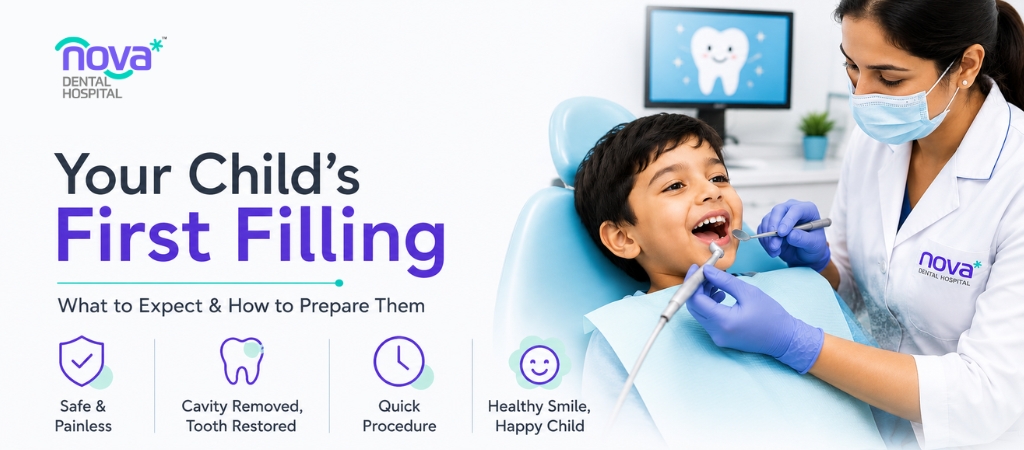
Your Child’s First Filling: What to Expect and How to Prepare Them

Quick AnswerA child’s first dental filling is a straightforward, low-risk procedure that typically takes 30–60 minutes. The dentist numbs the area with local anaesthesia so your child feels little to no pain. The decayed portion of the tooth is removed and replaced with a safe tooth-coloured or stainless-steel filling. With calm preparation and the right dentist, most children handle their first filling well and leave with no fear of future visits. |
Quick Summary — Key Facts at a Glance
| 5 Things Every Parent Should Know Before the Appointment
✓ Milk teeth can and should be filled — untreated cavities cause pain, infection, and affect permanent teeth. ✓ Local anaesthesia is standard; the procedure itself is virtually painless. ✓ Tooth-coloured composite fillings are the most common choice for children today. ✓ The appointment takes 30–60 minutes depending on the cavity size. ✓ Proper preparation at home — reading books, role-playing, staying calm — is the single biggest factor in a positive experience. ✓ Avoid bribing with sweets; reward with non-food treats like a sticker or park visit. ✓ Post-filling numbness lasts 1–3 hours; watch that your child does not bite their cheek. |
Introduction
Getting the call that your child has a cavity can feel overwhelming, especially when you picture a dental drill and a frightened child in a big chair. The good news is that children’s dental fillings today are far gentler, faster, and more child-friendly than most parents imagine. The procedure has evolved significantly, and with a skilled pediatric dentist, the experience can actually build your child’s confidence rather than create lasting dental anxiety.
This guide will walk you through exactly what happens during a first filling, why it matters for milk teeth, how to prepare your child at home, and what to watch for afterward. If you are searching for a trusted pediatric dentist in Gandhinagar, understanding the process will help you ask the right questions and make the best decision for your child’s oral health.
Why Does My Child Need a Filling for a Baby Tooth?
One of the most common questions parents ask is: “Why should we fill a milk tooth if it will fall out anyway?” This is a very understandable concern, but leaving a cavity untreated in a baby tooth carries several serious risks that affect both your child’s comfort and their long-term oral health.
| Expert Insight #1 — Why Baby Tooth Cavities Should Never Be Ignored Baby teeth are not just placeholders. They guide the eruption path of permanent teeth, help children speak clearly, and allow proper chewing. A severely decayed or prematurely lost baby tooth can lead to crowding, misalignment, and even damage to the developing permanent tooth beneath it. |
What happens if a cavity is left untreated:
- The decay spreads deeper, reaching the nerve and causing significant pain.
- Infection can spread to the jaw and affect the permanent tooth bud underneath.
- Premature tooth loss leads to shifting of surrounding teeth.
- The child may develop habits like chewing only on one side, affecting jaw development.
- A severe infection may require tooth extraction under sedation — a far more complex procedure than a simple filling.
In short, filling a baby tooth is not about saving that specific tooth. It is about protecting your child’s overall oral development and avoiding pain and more extensive treatment later.
What Happens During a Child’s First Filling? A Step-by-Step Guide
Understanding each step removes the fear of the unknown — for both parent and child. Here is exactly what to expect during a pediatric filling appointment at a child-friendly dental hospital.
| Step | What Happens |
| 1. Examination & X-ray | The dentist reviews the cavity using a digital X-ray to assess depth and confirm the filling plan. |
| 2. Topical numbing gel | A flavoured gel is applied to the gum to numb the surface before the injection — most children do not feel the needle. |
| 3. Local anaesthesia | A small injection numbs the tooth and surrounding area completely. Your child may feel pressure but not pain. |
| 4. Isolation | A rubber dam or cotton roll keeps the area dry and prevents children from swallowing debris. |
| 5. Decay removal | The dentist uses a gentle drill or air abrasion to remove the decayed tooth material only. |
| 6. Filling placement | The cleaned cavity is filled with composite resin (tooth-coloured) or stainless-steel crown for larger cavities. |
| 7. Bite check & polish | The filling is shaped and polished so it feels natural when your child bites. |
| 8. Post-care instructions | The dentist advises on eating restrictions and home care for the first few hours. |
The entire appointment takes 30 to 60 minutes for a single filling. Larger or multiple cavities may require additional visits or sedation for younger or more anxious children.
Types of Fillings Used for Children
Not all fillings are the same, and the choice depends on the tooth location, the size of the cavity, and your child’s age. Here is a quick comparison of the most common options available at pediatric dental clinics in India.
| Filling Type | Best For | Appearance | Durability |
| Composite Resin | Front & back teeth, moderate cavities | Tooth-coloured | 5–10 years |
| Stainless Steel Crown | Large back tooth cavities, broken teeth | Silver | Until natural loss |
| Glass Ionomer | Small cavities, root surfaces | Off-white | 3–5 years |
| Amalgam (rare) | Deep back tooth cavities (less common now) | Silver | 10–15 years |
| Expert Insight #2 — Composite vs Stainless Steel Crown For front teeth, tooth-coloured composite fillings are always preferred for aesthetics. For large back-tooth cavities in young children, a stainless-steel crown (SSC) is often the most durable and cost-effective solution. It covers the entire tooth and protects it until it naturally falls out. Do not be alarmed if your pediatric dentist recommends an SSC — it is a well-established, safe treatment backed by decades of clinical evidence. |
How to Prepare Your Child for Their First Filling
Preparation at home is just as important as what happens in the dental chair. Children take emotional cues from their parents. A calm, informed parent raises a calm, cooperative child at the dentist.
A Week Before the Appointment
- Read picture books about dentist visits (“The Berenstain Bears Visit the Dentist” is a classic favourite).
- Watch short, age-appropriate videos of children having dental checkups — keep it positive.
- Role-play “dentist” at home with a toy mirror and toothbrush.
- Answer questions honestly but simply: “The dentist will clean your tooth and put special medicine in it so it does not hurt.”
The Night Before
- Keep bedtime routines normal — avoid building extra excitement or anxiety around the visit.
- Avoid the phrase “it won’t hurt” as it places the focus on pain. Instead say, “You will feel the dentist working but it will be quick.”
- Pick a comfort item — a favourite small toy or blanket — to bring along.
The Morning of the Appointment
- Feed your child a light meal (check with your dentist if sedation is involved — fasting may be required).
- Dress your child comfortably.
- Arrive 10 minutes early so your child can get comfortable with the environment.
- Stay calm yourself. Children read parental anxiety in seconds.
| Common Mistake #1 — Promising “It Won’t Hurt At All” Well-meaning parents often over-promise. If the child feels any pressure or hears the drill, they feel deceived and trust breaks down. Instead, say: “You might feel something, but the dentist will make sure your tooth is comfortable. You can squeeze my hand any time.” Honest, calm reassurance builds far more trust than false promises. |
Managing Dental Anxiety in Children
Dental anxiety is one of the most common childhood challenges. Studies suggest that approximately 20–30% of children experience some level of fear around dental visits. The good news is that it is highly manageable with the right approach.
Techniques dentists use to reduce anxiety:
- Tell-Show-Do: The dentist describes each step, demonstrates it on a model, then does it — no surprises.
- Nitrous Oxide (Laughing Gas): A safe, short-acting sedative inhaled through a small mask. The child remains awake but relaxed.
- Distraction techniques: Ceiling-mounted TV screens, music headphones, or interactive lighting.
- Positive reinforcement: Sticker charts and praise, never negative language about procedures.
- Parental presence: In most pediatric clinics, parents can stay in the room for young children.
| Expert Insight #3 — The Relationship Between the First Visit and Lifetime Dental Health Research consistently shows that a positive first dental experience — including the first filling — is one of the strongest predictors of a child maintaining regular dental care into adulthood. A child who leaves the dental clinic feeling safe and proud is far more likely to keep healthy oral hygiene habits for life. This is why the environment, the dentist’s communication style, and parental preparation matter so much. |
After the Filling: What to Expect and How to Care for Your Child
Immediately after the appointment:
- Numbness lasts 1–3 hours. Watch carefully — children often accidentally bite or chew their numb lip or cheek, causing injury.
- Avoid hot foods or drinks until feeling returns.
- Soft foods are recommended for the first few hours (dal, curd, soft roti).
- Mild sensitivity to cold or pressure is normal for 1–3 days.
- If pain is significant after 48 hours, contact your dentist.
Long-Term Care After a Filling:
- Continue regular brushing twice daily with fluoride toothpaste.
- Limit sugary snacks and juice, especially between meals.
- Schedule a follow-up visit in 6 months.
- Fillings in baby teeth do not need special maintenance — just regular oral hygiene.
| Common Mistake #2 — Skipping Follow-Up Visits After a Filling Many parents assume that once a tooth is filled, the job is done. However, filled teeth can develop new cavities, especially around the edges of the filling. Regular 6-monthly checkups at a dental hospital in Gandhinagar or Ahmedabad allow the dentist to catch any issues early before they require more complex treatment. |
Myths vs Facts: Children’s Dental Fillings
| MYTH | FACT |
| Baby teeth don’t need fillings — they’ll fall out anyway. | Untreated baby tooth cavities cause pain, infection, and can permanently damage the developing permanent tooth underneath. |
| Dental fillings are very painful for children. | With modern local anaesthesia and numbing gels, children feel pressure but not pain during a filling. Most children handle it well. |
| Silver (amalgam) fillings are the only option for kids. | Tooth-coloured composite and glass ionomer fillings are widely used and very effective for children, even on back teeth. |
| My child is too young for a filling. | Children can receive fillings as soon as a cavity is diagnosed — even at age 2–3 with appropriate technique and sometimes sedation. |
| Filling a tooth weakens it. | The opposite is true. Removing decay and restoring the tooth with filling material protects remaining tooth structure. |
| Common Mistake #3 — Using Fear of the Dentist as a Behavioural Threat Never say phrases like “If you don’t brush, the dentist will drill all your teeth” or “The dentist will give you an injection if you misbehave.” These statements create deep-rooted dental phobia that can last decades. Instead, frame dentist visits as a team effort: “We go to the dentist to keep your smile strong and healthy.” |
Questions Parents Often Forget to Ask the Dentist
Walk into your appointment prepared. These questions will help you get the most out of your child’s dental visit.
- Which type of filling do you recommend for my child’s tooth, and why?
- Is sedation necessary, and what type do you use for children?
- Should we treat all cavities in one visit or spread them across visits?
- How many more teeth need attention, and what is the priority?
- Is there anything in my child’s diet or brushing habit I should change?
- What are the signs that the filling has failed or the cavity has returned?
- At what age should I bring my child for their first dental X-ray?
Practical Action Plan for Parents
| When | Action |
| Right now | Book a dental checkup at a pediatric dentist in Gandhinagar even if there’s no visible problem. Early diagnosis saves your child from complex treatment. |
| This week | Start a simple brushing routine — 2 minutes, twice daily — with a soft-bristled toothbrush and pea-sized fluoride toothpaste. |
| Before the appointment | Read a dentist story book together. Role-play the visit. Answer questions calmly and honestly. |
| Day of appointment | Bring a comfort item. Arrive early. Stay calm and positive. Avoid the word ‘pain’ or ‘hurt’. |
| After the filling | Monitor for numbness and soft-food diet for a few hours. Praise your child generously. Book the 6-month follow-up before leaving the clinic. |
| Ongoing | Limit sugary snacks. Ensure daily brushing and flossing. Attend 6-monthly dental checkups consistently. |
How Nova Dental Hospital Can Help
| Nova Dental Expert Summary
At Nova Dental Hospital, Gandhinagar, our pediatric dental team is trained specifically to work with children and anxious young patients. Our child-friendly environment, gentle techniques, and experienced dentists are designed to make your child’s first filling — and every visit after — a positive experience.
What we offer for young patients: ✓ Child-friendly treatment rooms with a calm, welcoming atmosphere ✓ Preventive dentistry — fluoride treatment, pit and fissure sealants to prevent cavities ✓ Early dental growth monitoring to catch bite or alignment issues ✓ Pain-free techniques including topical numbing and Tell-Show-Do communication ✓ Tooth-coloured composite fillings for a natural appearance ✓ Dental anxiety management including nitrous oxide when appropriate ✓ Personalised treatment planning built around your child’s specific needs ✓ Family-focused care — we support parents through every step
Whether you are looking for a children’s dentist in Gandhinagar for a routine checkup or your child’s first filling, our team at Nova Dental Hospital is here to guide you every step of the way. We serve families across Gandhinagar and Ahmedabad, providing evidence-based, compassionate pediatric dental care. |
Key Takeaways
| 10 Things to Remember About Your Child’s First Filling
1. Baby teeth cavities must be treated — they affect permanent teeth, speech, and jaw development. 2. Modern fillings are virtually painless thanks to local anaesthesia and numbing gels. 3. The procedure takes 30–60 minutes and children recover quickly. 4. Tooth-coloured composite fillings are safe, effective, and aesthetically superior. 5. Home preparation — books, role-play, calm conversation — is the most powerful tool against dental anxiety. 6. Never use the dentist as a threat; never promise there will be no sensation at all. 7. Post-filling numbness lasts 1–3 hours — watch for self-injury like lip or cheek biting. 8. Mild sensitivity after filling is normal; persistent pain beyond 48 hours needs review. 9. A positive first filling experience is a lifetime investment in your child’s oral health confidence. 10. Book 6-monthly checkups to monitor fillings and catch new cavities early. |
Frequently Asked Questions (FAQ)
1. Can milk teeth be filled?
Yes, absolutely. Baby teeth can and should be filled when decay is present. Untreated cavities in milk teeth cause pain, infection, and can damage the permanent tooth developing beneath them. The earlier a cavity is treated, the simpler the procedure.
2. Does a filling hurt for a child?
With proper local anaesthesia, the filling procedure itself is not painful. Your child may feel pressure, vibration, or hear the sounds of the dental instruments, but pain is well-controlled. Most children report that the anticipation is far worse than the actual experience.
3. How long does a children’s dental filling take?
A single filling typically takes 30 to 45 minutes. Multiple fillings or larger cavities may take longer. Your dentist will give you a realistic time estimate before the appointment.
4. At what age can children get dental fillings?
There is no minimum age for a dental filling. Children as young as 2–3 years can receive fillings. For very young or anxious children, the dentist may recommend conscious sedation or nitrous oxide to ensure a cooperative and safe experience.
5. Is it safe to do a dental filling for a child under general anaesthesia?
General anaesthesia (GA) for dental treatment is used only when absolutely necessary — typically for very young children with extensive decay who cannot cooperate with conventional treatment. It is performed in a hospital setting with a medical anaesthesiologist. For most children, local anaesthesia or nitrous oxide is sufficient.
6. What type of filling is best for children?
Tooth-coloured composite resin fillings are the most popular choice for children as they blend naturally with the tooth. Stainless-steel crowns are recommended for large back-tooth cavities or when the cavity involves most of the tooth structure. Your pediatric dentist will recommend the most appropriate option based on the specific situation.
7. How do I calm my child before their dental filling?
Read dentist-themed picture books together, role-play the visit at home, use simple honest language to explain the appointment, bring a comfort item, and arrive early. Stay calm yourself — children absorb parental anxiety very quickly. Praise your child at every step, regardless of how the visit goes.
8. What should my child eat before a filling appointment?
A normal light meal is fine for most filling appointments. If sedation or nitrous oxide is involved, your dentist may give specific fasting instructions. Always confirm this when booking the appointment.
9. How long after a filling can my child eat normally?
For composite fillings, your child can eat once the anaesthesia wears off — typically 1–3 hours. For amalgam fillings (increasingly rare in children), harder foods should be avoided for 24 hours. Soft, lukewarm foods are recommended immediately after the procedure.
10. What are signs that a child’s filling has failed or fallen out?
Signs include sensitivity to sweets, cold, or pressure at the filled tooth; visible rough or sharp edges in the mouth; the tooth looks different; or your child reports that the tooth feels different when biting. Contact your dentist promptly if any of these signs appear.
11. How often should children visit the dentist after getting a filling?
Every 6 months is the standard recommendation. Children who have had cavities before are at higher risk of developing new ones and benefit from more frequent monitoring.
12. Is there a family dentist in Gandhinagar who treats children?
Yes. Nova Dental Hospital in Gandhinagar offers comprehensive pediatric and family dental services, including first fillings, preventive care, orthodontic assessments, and routine checkups for children of all ages.

Related posts



Write a Comment
Recent Posts


