


Wisdom Teeth in Gandhinagar: When to Remove vs. When It’s Safe to Watch and Wait
Wisdom Teeth in Gandhinagar: When to Remove vs. When It’s Safe to Watch and Wait

Quick Answer
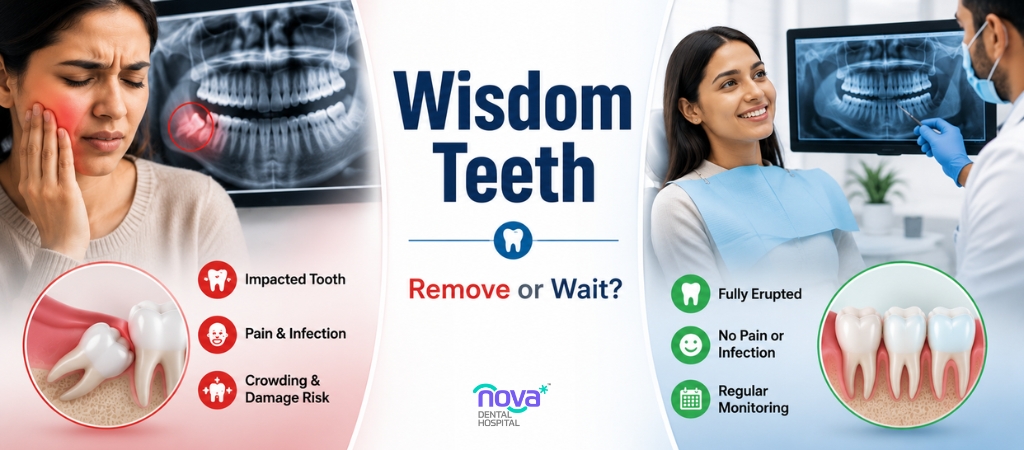
Most wisdom teeth need to come out when they’re impacted, repeatedly infected, decayed, or crowding nearby teeth. If your wisdom tooth has fully erupted, sits upright, causes no pain, and is easy to clean, watch-and-wait with regular X-ray monitoring is often a reasonable choice. The right decision depends on what your dentist sees on imaging and your symptom history — not on a blanket rule that applies to everyone.
Introduction
Few dental topics create as much conflicting advice as wisdom teeth. One relative says “get them out before they cause trouble,” another says “leave them alone unless they hurt.” Both can be right — for different teeth.
Wisdom teeth, or third molars, are the last teeth to erupt, usually appearing at the back of the jaw between the late teens and mid-twenties. Because they arrive after the jaw has mostly finished growing, many people simply don’t have enough room for them to come in straight. That’s when problems start.
At Nova Dental Hospital in Gandhinagar, the decision to remove or monitor a wisdom tooth is never made by age alone. It comes from a panoramic X-ray or CBCT scan, a review of symptom history, and an honest look at how much risk that specific tooth carries if left in place. This guide walks through exactly how that decision gets made, so you can ask the right questions at your own appointment.
What Are Wisdom Teeth and Why Do They Cause Problems?
Wisdom teeth are the third and final set of molars, one in each corner of the mouth. Trouble arises from impaction — when a wisdom tooth doesn’t have enough space to erupt fully and ends up angled against the tooth in front of it, buried under gum or bone, or only partly breaking through the surface.
Dentists classify impaction by direction: mesioangular (tilted forward, the most common and usually the easiest to remove), distoangular, horizontal, and vertical impaction. The angle matters because it affects both the risk the tooth poses to neighboring teeth and the complexity of removal if extraction is needed.
Signs Your Wisdom Tooth May Need to Be Removed
- Repeated swelling, tenderness, or bad taste at the back of the jaw (pericoronitis)
- Decay in the wisdom tooth or the second molar next to it
- A cyst or fluid-filled sac visible around the crown on X-ray
- Visible crowding or pressure pushing against the second molar
- Partial eruption that traps food and is impossible to clean properly
- Jaw stiffness or difficulty opening fully, linked to the area
- Pain radiating to the ear or jaw joint with no other identifiable cause
| Expert Insight One episode of mild gum tenderness around a wisdom tooth isn’t automatically a red flag. What matters more is the pattern — pericoronitis that returns two or more times in a year is a strong, reliable signal that the tooth’s position is the underlying problem, not a one-off infection that antibiotics alone will fix permanently. |
When It’s Safe to Watch and Wait
Monitoring is a reasonable choice when a wisdom tooth meets several of these conditions:
- Fully erupted and standing upright, in line with the bite
- No decay in the tooth itself or the molar beside it
- No cyst, lesion, or bone loss visible on X-ray
- No pressure on or movement of neighboring teeth
- Easy enough to reach with a toothbrush and floss
- No history of repeated infection or pain
Watch-and-wait isn’t the same as doing nothing. It means scheduled dental visits with periodic X-rays so any change in position, decay risk, or bone level gets caught early — not just whenever symptoms flare up.
| Expert Insight In teenagers and young adults, root development isn’t finished, and the angle of a wisdom tooth on an X-ray today can shift somewhat as the root fully forms. In adults over roughly 25, root and bone position are largely settled, so a clear, symptom-free X-ray carries more long-term reassurance than the same image would in a 17-year-old. |
Removal vs. Watch-and-Wait: Side-by-Side Comparison
| Factor | Favors Removal | Favors Watch-and-Wait |
| Position on X-ray | Impacted or angled against another tooth/bone | Fully erupted and upright, in line with the bite |
| Infection history | Recurrent pericoronitis or abscess | No history of gum infection |
| Decay | Cavity in the wisdom tooth or adjacent molar | No decay present |
| Cyst / pathology | Cyst, lesion, or bone loss visible | Clear bone, no abnormal findings |
| Crowding | Pressure on or movement of neighboring teeth | No crowding or pressure |
| Hygiene access | Hard to reach, traps food | Easy to brush and floss |
| Symptoms | Pain, swelling, bad taste, jaw stiffness | No symptoms |
| Age / root development | Younger patients with confirmed impaction (often easier surgery) | Older patients with stable, clear imaging |
What Happens If You Leave an Impacted Wisdom Tooth Untreated?
Not every impacted wisdom tooth causes immediate pain, which is part of why some patients put off a decision for years. Left untreated, an impacted tooth can lead to a cyst forming around the crown, slow resorption of the root of the second molar, spreading infection if pericoronitis becomes chronic, or progressive crowding that complicates orthodontic treatment. These outcomes aren’t guaranteed, and they develop gradually — but they’re the reason dentists recommend tracking, rather than ignoring, a wisdom tooth that shows early warning signs on X-ray.
| Expert Insight Patients often picture wisdom tooth surgery as more difficult than it actually is for a healthy young adult with a straightforward impaction. In practice, a planned extraction done before infection sets in is usually faster to recover from than the same extraction performed during an active abscess, when swelling and inflammation make both the procedure and the healing harder. |
The Wisdom Tooth Removal Procedure: What to Expect
A typical removal at Nova Dental Hospital follows a predictable sequence: a clinical exam and OPG or CBCT imaging to map the tooth’s position relative to nerves and the second molar; local anesthesia, sometimes combined with mild sedation for anxious patients or more complex impactions; the extraction itself, which may be a simple elevation for fully erupted teeth or a surgical procedure with a small gum flap for impacted ones; and stitches that are either dissolvable or removed after about a week.
Recovery generally follows this pattern: swelling and discomfort peak in the first 1–3 days, noticeable improvement by days 4–7, soft tissue healing within about two weeks, and full bone fill-in over several months. Most people return to normal activity within a few days, with some dietary modifications recommended during the first week.
Common Mistakes Patients Make
- Waiting for an emergency. Postponing a clearly impacted, symptomatic tooth until severe pain or facial swelling sets in turns a planned outpatient procedure into a more complicated, harder-to-recover-from emergency extraction.
- Assuming all four must go together. Each tooth is assessed individually — a problematic lower tooth may need removal while a healthy, well-positioned upper tooth on the same side is left untouched.
- Skipping imaging. Deciding based on how a tooth “feels” rather than what an X-ray or CBCT shows means missing silent issues like cyst formation or pressure on the second molar that cause no pain until they’re advanced.
- Forgetting the follow-up. Choosing to watch a wisdom tooth and then not returning for the recommended check-up defeats the purpose of monitoring — the whole strategy depends on catching changes early.
Myths vs. Facts
| Myth | Fact |
| Removing wisdom teeth always damages facial nerves. | Nerve injury is uncommon, and CBCT imaging beforehand helps the surgeon plan around nerve position safely. |
| Every wisdom tooth must be removed as soon as it appears. | Well-positioned, symptom-free wisdom teeth can often be safely monitored rather than removed automatically. |
| Watching and waiting means doing nothing. | It means scheduled monitoring with periodic X-rays, not ignoring the tooth until it hurts. |
| Wisdom tooth removal always requires hospitalization. | Most extractions are outpatient procedures done under local anesthesia or mild sedation. |
| Pain is the only sign a wisdom tooth needs attention. | A tooth can damage the molar beside it or develop a cyst with no pain at all. |
Questions Patients Forget to Ask
- Will this wisdom tooth affect the health of the molar next to it over time?
- What exactly does my X-ray or CBCT show about the depth and angle of impaction?
- If we’re choosing to monitor, how often should it be rechecked?
- Does the type of impaction I have change how complex the removal would be?
- Could removing — or keeping — this tooth affect my bite or any orthodontic treatment?
Practical Action Plan
- Get a panoramic X-ray or CBCT scan if you haven’t had one in the last one to two years.
- Track your own symptom pattern — frequency of pain, swelling, or bad taste — before your appointment.
- Ask your dentist to name the specific impaction type and risk level for your tooth, not just a yes-or-no answer.
- If monitoring is recommended, schedule the next check at a fixed 6–12 month interval rather than waiting for symptoms.
- If removal is recommended, schedule it while you’re healthy — not during an active infection — and plan a few recovery days around it.
- Follow aftercare instructions exactly, especially around rinsing and diet, to reduce the risk of dry socket.
Nova Dental Expert Summary
| Nova Dental Hospital — Expert Guidance At Nova Dental Hospital, wisdom tooth decisions in Gandhinagar and Ahmedabad are based on imaging and individual risk factors — not a one-size-fits-all rule. On-site panoramic X-ray and CBCT imaging let our dental team map impaction angle and proximity to nerves before recommending removal or monitoring, with the goal of avoiding emergency extractions through routine, preventive dental checkups and family-focused, personalized treatment planning. |
Key Takeaways
- Wisdom tooth removal isn’t automatic — it depends on position, symptoms, and imaging findings.
- Recurrent infection, decay, cysts, or crowding generally point toward removal.
- Fully erupted, symptom-free, well-positioned wisdom teeth can often be safely monitored.
- X-ray or CBCT imaging — not guesswork — should drive the decision.
- Planned removal in a healthy patient is usually easier than emergency extraction during an infection.
- Straightforward extraction recovery typically takes about a week.
- A “watched” wisdom tooth still needs scheduled dental visits, not just visits when it hurts.
- Ask your dentist for the specific impaction type and risk classification, not a generic answer.
Frequently Asked Questions
1. At what age do wisdom teeth usually need to be removed?
Most wisdom tooth issues appear between ages 17 and 25, when these teeth typically erupt. There’s no fixed age for removal — the decision depends on whether the tooth is impacted, infected, or crowding nearby teeth, not on a calendar age.
2. Can an impacted wisdom tooth fix itself over time?
No. Once a wisdom tooth is impacted against bone, gum, or another tooth, that position generally doesn’t correct on its own. In teenagers, the angle can shift slightly as the root finishes forming, but a tooth that’s significantly impacted in an adult will stay that way.
3. Is wisdom tooth removal painful?
The procedure itself is performed under local anesthesia, so you shouldn’t feel pain during removal. Some soreness and swelling in the days afterward is normal and manageable with prescribed pain relief and a soft diet.
4. How long is recovery after wisdom tooth extraction?
A simple extraction typically heals enough for normal activity within 3–7 days, with soft tissue closing over about two weeks. Surgical removal of a deeply impacted tooth may take a bit longer to feel fully comfortable.
5. Can I keep a wisdom tooth that isn’t causing pain?
Often, yes — if it’s fully erupted, well-positioned, free of decay, and easy to keep clean. Absence of pain alone isn’t proof a tooth is healthy, though, which is why periodic X-rays matter even for symptom-free teeth.
6. What is pericoronitis and why does it matter?
Pericoronitis is inflammation and infection of the gum tissue around a partially erupted wisdom tooth. A single mild episode can sometimes resolve with cleaning and antibiotics, but recurring episodes usually indicate the tooth’s position itself is the problem, which points toward removal.
7. Do I need to remove all four wisdom teeth at once?
Not necessarily. Each wisdom tooth is evaluated individually based on its own position and condition. It’s common to remove one or two problematic teeth while monitoring others that are healthy and well-positioned.
8. What’s the difference between a simple and a surgical wisdom tooth extraction?
A simple extraction is used for a fully erupted tooth and involves loosening and lifting it out. A surgical extraction is needed for impacted teeth and may involve a small gum incision and, occasionally, removing the tooth in sections.
9. Can a wisdom tooth damage the tooth next to it without causing pain?
Yes. Pressure from an impacted wisdom tooth can gradually affect the root of the second molar, and decay or cyst formation can progress with little to no discomfort until it’s caught on an X-ray.
10. How often should a “watched” wisdom tooth be checked?
A reasonable interval is every 6 to 12 months, with a periodic X-ray to confirm the tooth’s position and surrounding bone haven’t changed.
11. What is dry socket, and how can I avoid it?
Dry socket happens when the blood clot protecting the extraction site is dislodged too early, exposing bone and nerve endings. Avoiding smoking, straws, and vigorous rinsing in the first few days significantly lowers the risk.
12. Does Nova Dental Hospital perform wisdom tooth removal in Gandhinagar and Ahmedabad?
Yes. Nova Dental Hospital evaluates wisdom teeth using on-site imaging and provides both monitoring plans and extraction procedures for patients in Gandhinagar, Ahmedabad, and the surrounding area.
13. Where should I go for a wisdom tooth evaluation near Gandhinagar?
A dental hospital with on-site panoramic X-ray or CBCT imaging is best, since an accurate evaluation depends on seeing the tooth’s exact position and depth, not just a visual exam.

Related posts
Write a Comment
Recent Posts


Dry Socket After Tooth Extraction: Symptoms, Prevention & Treatment


1 Comment
Dry Socket After Tooth Extraction: Symptoms & Treatment
[…] difficulty: more difficult or prolonged extractions, such as impacted wisdom teeth, carry a higher risk simply due to greater tissue […]