


Periodontal Surgery Explained: Flap Surgery, Pocket Reduction & What to Expect
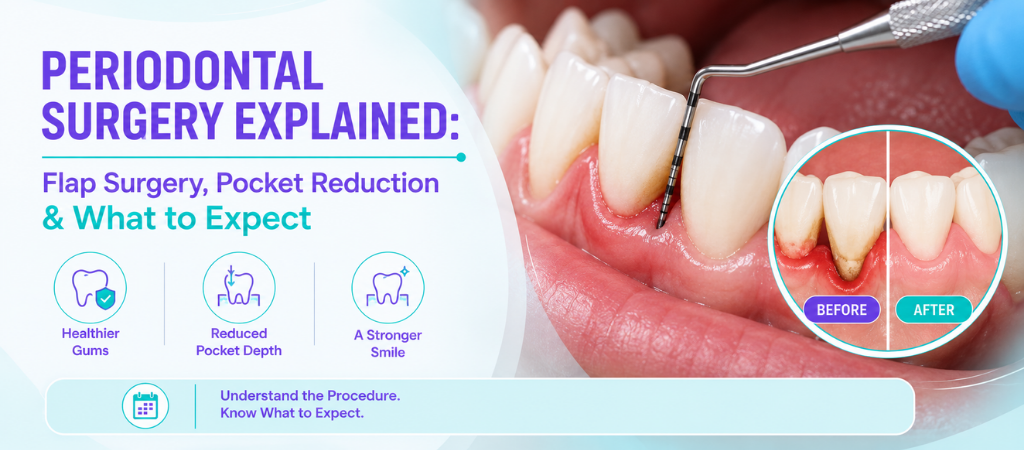
Periodontal Surgery Explained: Flap Surgery, Pocket Reduction & What to Expect

Quick Answer
Periodontal surgery is a treatment for advanced gum disease (periodontitis) that non-surgical cleaning could not fully resolve. Flap surgery lifts the gum tissue to clean deep infection around the roots, while pocket reduction surgery reshapes bone and gum to make pockets shallower and easier to keep clean. Most patients heal within one to two weeks, with full tissue settling over a few months.
Quick Summary
- Periodontal surgery treats gum disease that has progressed beyond what deep cleaning (scaling and root planing) can fix.
- Flap surgery temporarily lifts the gums to clean bacteria and tartar from tooth roots and bone.
- Pocket reduction surgery reshapes the bone/gum so pockets become shallow enough to clean at home.
- The procedure is done under local anaesthesia and typically takes 45–90 minutes per area treated.
- Mild swelling and tenderness for 3–5 days is normal; most people return to work within a day or two.
- Left untreated, deep pockets can lead to bone loss and eventual tooth loss.
- Good oral hygiene and regular periodontal maintenance visits are essential after healing.
- Not every gum problem needs surgery — many early-stage cases respond to non-surgical care.
Introduction
Bleeding gums, bad breath that won’t go away, or gums that seem to be pulling away from the teeth are often dismissed as minor problems. In reality, they can be early signs of periodontitis — a gum infection that, left unmanaged, damages the bone that holds teeth in place. When a dentist mentions “flap surgery” or “pocket reduction surgery,” it is natural for patients and parents to feel anxious. This guide explains, in plain language, what each procedure involves, why it may be recommended, what recovery looks like, and how to decide whether surgery is the right next step.
What Is Periodontal Surgery?
Periodontal surgery refers to a group of procedures used to treat gum disease once it has advanced beyond the point where non-surgical treatment — such as scaling and root planing, commonly called deep cleaning — can fully control it. The goal is always the same: remove infection, reduce pocket depth around the tooth, and create a gum-and-bone environment that a patient can realistically keep clean at home.
Expert Insight: A periodontal pocket deeper than 5–6 mm is very difficult to clean with a toothbrush or floss alone, no matter how diligent the patient is. Surgery is often less about “fixing damage” and more about making daily hygiene achievable again.
Flap Surgery (Periodontal Flap Surgery)
In flap surgery, the periodontist gently separates the gum tissue from the tooth and bone, creating a small “flap” that can be folded back. This gives direct access to the tooth roots and underlying bone, allowing thorough removal of plaque, tartar, and infected tissue that lie below the gumline — areas a regular cleaning cannot reach. Once the area is cleaned and, if needed, the bone surface is smoothed, the gum is repositioned and secured with sutures.
- Typical duration: 45–90 minutes per quadrant of the mouth
- Anaesthesia: Local anaesthesia; the patient stays awake and comfortable
- Stitches: Usually removed after 7–10 days
Pocket Reduction Surgery
Pocket reduction surgery (also called osseous surgery) goes a step further when the bone itself has an irregular shape due to long-standing infection. After lifting the gum flap, the periodontist may gently reshape the bone to remove small craters or ledges where bacteria collect, then reposition the gum snugly against the tooth so that the pocket is shallower. Shallower pockets mean easier home cleaning and a lower risk of future infection.
Common Mistake: Assuming pocket reduction surgery is only about cutting away gum tissue. In most cases, the priority is reshaping the underlying bone; gum tissue is preserved as much as possible to avoid unnecessary recession.
Healthy Gums vs Gum Disease: Pocket Depth Benchmarks
Periodontists measure the space between tooth and gum with a small probe. This single number is often the clearest way to know whether surgery is even being considered:
| Pocket Depth | What It Usually Means |
| 1–3 mm, no bleeding | Healthy gums; routine 6-month checkups are enough |
| 4–5 mm | Early gum disease; usually managed with deep cleaning and better home care |
| 5 mm and above, with bone loss on X-ray | Non-surgical care alone is often not enough; flap or pocket reduction surgery is discussed |
Flap Surgery vs Pocket Reduction Surgery: Comparison
| Aspect | Flap Surgery | Pocket Reduction Surgery |
| Primary Goal | Access roots to remove deep infection | Reshape bone/gum to reduce pocket depth long-term |
| Bone Reshaping | Rarely, only if needed | Usually involved |
| Best For | Moderate pockets with root surface infection | Deeper pockets with irregular bone loss |
| Recovery Time | 5–7 days initial healing | 7–14 days initial healing |
| Follow-up | Suture removal, review at 2 weeks | Suture removal, review at 2–3 weeks |
Who Typically Needs This Surgery?
- Pocket depths consistently above 5–6 mm despite deep cleaning
- Gums that bleed easily and remain inflamed after non-surgical treatment
- Visible bone loss on dental X-rays
- Loose or shifting teeth linked to gum disease
- Difficulty accessing certain tooth surfaces for cleaning due to pocket shape
Gum Disease and Overall Health
Periodontal infection does not always stay confined to the mouth. Ongoing gum inflammation has been studied for its links to heart disease, uncontrolled diabetes, and respiratory conditions, since bacteria and inflammatory markers from infected gum pockets can enter the bloodstream. This is one more reason deep pockets are addressed proactively rather than left to “see how it goes,” especially for patients who are already managing diabetes or cardiac conditions.
Is There an Alternative to Traditional Flap Surgery?
Some clinics offer laser-assisted flap surgery as a less invasive alternative to the traditional scalpel-and-suture approach. A laser is used to remove infected tissue and bacteria from the pocket, which can mean less bleeding and a shorter chair-side visit for suitable cases. It does not replace the need for surgery when bone reshaping is required, but it is worth asking about during a periodontal consultation if a patient is anxious about traditional surgery.
Cost of Periodontal Surgery in India
Cost varies by city, the periodontist’s experience, the number of areas (quadrants) treated, and whether bone grafting or laser assistance is used. As a general guide in India:
- Conventional flap surgery: approximately ₹5,000–₹25,000 per quadrant
- Full-mouth flap surgery: approximately ₹20,000–₹60,000
- Laser-assisted flap surgery: typically priced higher than conventional surgery due to the technology used
- Additional cost if bone grafting or guided tissue regeneration is required
These are general Indian market ranges for orientation only; an accurate quote depends on a clinical evaluation of pocket depth and bone condition at Nova Dental Hospital.
Expert Insight: Why Surgery Isn’t the First Step
Reputable periodontal care follows a step-by-step approach. Non-surgical treatment — deep cleaning combined with improved home care — is always tried first and reassessed after 4–6 weeks. Surgery is considered only when pockets remain too deep to clean or when bone architecture needs correction. This staged approach protects patients from surgery they may not need.
What to Expect: Before, During, and After
Before Surgery
- A full periodontal charting and X-rays to map pocket depth and bone levels
- Review of medical history and medications (especially blood thinners and diabetes control)
- A final round of deep cleaning to reduce inflammation before surgery
During Surgery
- Local anaesthesia is administered to numb the treatment area
- The gum flap is lifted and the roots/bone are cleaned or reshaped
- The gum is repositioned and secured with sutures
After Surgery
- Mild swelling and tenderness for 3–5 days, manageable with prescribed medication
- Soft-food diet for about one to two weeks; avoiding the treated side while chewing
- Gentle rinsing with a prescribed antiseptic mouthwash instead of brushing that area initially
- Avoid drinking through a straw, as suction can disturb the healing gum
- Avoid touching or probing the surgical site with your tongue or finger
- Avoid alcohol and smoking until the periodontist confirms healing is on track
- Suture removal appointment 7–14 days later
- Initial healing settles over 2–4 weeks; full bone and tissue remodelling continues for 3–6 months
Myths vs Facts
| Myth | Fact |
| Gum surgery means you are losing your teeth. | The goal of periodontal surgery is to save teeth by controlling infection before bone loss becomes severe. |
| Surgery is extremely painful. | With local anaesthesia and modern pain management, most patients report only mild soreness afterward, similar to a tooth extraction. |
| Once you have surgery, gum disease is completely cured forever. | Surgery treats existing damage; long-term success depends on ongoing home care and periodontal maintenance visits. |
| Only older adults need periodontal surgery. | Aggressive forms of gum disease can affect younger adults too, especially with poor oral hygiene or smoking. |
Common Mistakes Patients Make
- Delaying treatment because gums “only bleed a little” — early pockets are easier to treat non-surgically.
- Skipping the prescribed post-surgery mouth rinse, which raises infection risk.
- Returning to normal brushing too soon on the healing site instead of following the dentist’s timeline.
- Stopping periodontal maintenance visits once gums feel fine, allowing pockets to redevelop.
Risks and Considerations
- Temporary tooth sensitivity to hot or cold
- Some visible gum recession as swelling resolves, which can make teeth look slightly longer
- Rare risk of infection if aftercare instructions are not followed
- Smoking significantly slows healing and reduces long-term success
Questions Patients Forget to Ask
- Will this procedure be done in one visit or staged across multiple areas of the mouth?
- What happens if I choose to wait or skip surgery?
- How will my bite or gum appearance change afterward?
- How often will I need maintenance cleanings after healing?
- Are there non-surgical options still worth trying first in my case?
Practical Action Plan
- Schedule a periodontal evaluation including pocket-depth charting and X-rays.
- Complete any recommended non-surgical deep cleaning and reassess after 4–6 weeks.
- If pockets remain deep, discuss whether flap surgery or pocket reduction surgery fits your specific bone pattern.
- Plan for a few days of soft food and reduced activity around the procedure date.
- Book periodontal maintenance visits every 3–4 months after healing, or as advised.
Nova Dental Hospital Expert Summary
Periodontal surgery is a targeted, well-established treatment — not a last resort reserved for severe cases only. When pockets stay deep despite good non-surgical care, timely flap or pocket reduction surgery can prevent further bone loss and help preserve natural teeth for the long term. The right approach always depends on individual pocket depth, bone pattern, and overall oral health, which is why a thorough evaluation matters more than the surgery name itself.
How Nova Dental Hospital Can Help
Nova Dental Hospital, with locations in Gandhinagar and Ahmedabad, approaches gum health as part of overall family dental care. Evaluation begins with careful pocket-depth charting and imaging to understand whether non-surgical or surgical treatment fits a patient’s specific situation. Where surgery is appropriate, personalised treatment planning considers the patient’s medical history, bone pattern, and long-term maintenance needs, with clear explanations at every step so patients and families can make informed, unhurried decisions.
- Thorough periodontal evaluation before recommending any treatment path
- Personalised treatment planning based on individual pocket depth and bone pattern
- Family-focused care for patients across age groups, from teenagers to senior citizens
- Guidance on maintenance routines to support long-term gum health after healing
Key Takeaways
- Periodontal surgery treats gum disease that hasn’t responded to deep cleaning alone.
- Flap surgery focuses on cleaning root surfaces; pocket reduction surgery also reshapes bone.
- Both are done under local anaesthesia with manageable recovery of about one to two weeks.
- Mild sensitivity and some gum-height change are normal and expected.
- Non-surgical treatment is always tried first when appropriate.
- Long-term success depends on home care and regular maintenance visits.
- Smoking and uncontrolled diabetes can slow healing and should be discussed with your dentist beforehand.
- Early evaluation of bleeding or receding gums can often prevent the need for surgery altogether.
Frequently Asked Questions
Is periodontal surgery painful?
Most patients feel only mild discomfort managed with prescribed medication, since the area is fully numbed with local anaesthesia during the procedure.
How long does recovery take after gum surgery?
Initial healing takes about 5–14 days depending on the procedure, with complete gum tissue settling over 2–3 months.
What is the difference between flap surgery and pocket reduction surgery?
Flap surgery mainly cleans infection from tooth roots, while pocket reduction surgery also reshapes the underlying bone to make pockets permanently shallower.
Can gum disease be treated without surgery?
Early to moderate gum disease often responds well to non-surgical deep cleaning and improved home hygiene; surgery is considered only when pockets remain deep afterward.
Will my teeth look different after periodontal surgery?
Some gum-height change is possible as swelling resolves, which can make teeth appear slightly longer; this is discussed with the patient beforehand.
How much does periodontal surgery cost in Gandhinagar?
In India, conventional flap surgery generally ranges from ₹5,000–₹25,000 per quadrant, with full-mouth cases higher; a periodontal evaluation at Nova Dental Hospital gives an accurate estimate for your specific case.
Is laser gum surgery better than traditional flap surgery?
Laser-assisted flap surgery can mean less bleeding and a quicker chair-side visit for suitable cases, but it does not replace traditional surgery when significant bone reshaping is needed; suitability is decided case by case.
Can I go back to work the next day?
Many patients resume normal routines within a day or two, though strenuous activity is best avoided for about a week.
What foods should I eat after gum surgery?
Soft, lukewarm foods such as khichdi, dals, mashed vegetables, and smoothies are recommended for the first several days, avoiding the treated side while chewing.
Does smoking affect healing after periodontal surgery?
Yes, smoking significantly slows gum healing and reduces long-term surgical success, so quitting or pausing is strongly advised.
How often should I visit the dentist after periodontal surgery?
Periodontal maintenance visits every 3–4 months are typically recommended to monitor pocket depth and prevent recurrence.

Related posts
Write a Comment
Recent Posts


