


Intraoral Scanners vs Traditional Impressions: Why Digital Scanning Is More Comfortable
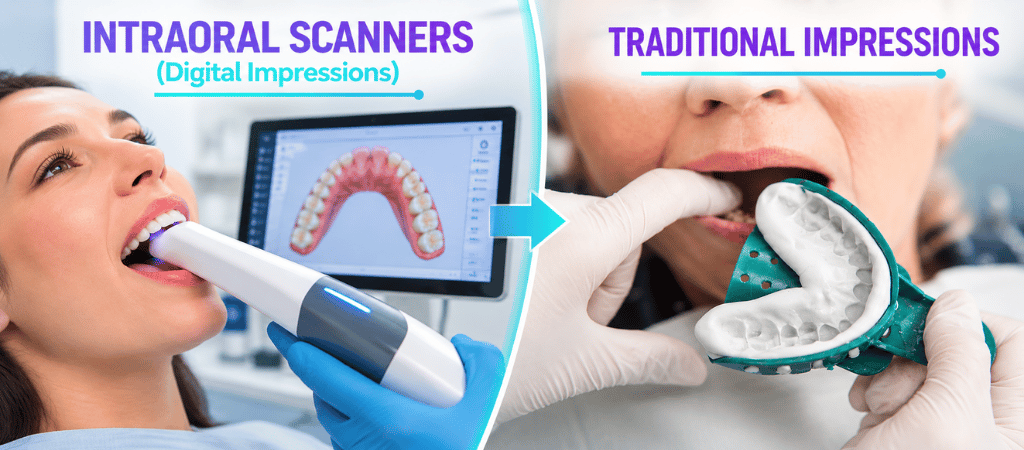
Intraoral Scanners vs Traditional Impressions: Why Digital Scanning Is More Comfortable

Quick Answer
Most patients find intraoral scanning more comfortable than traditional tray-and-material impressions. Digital scanning replaces the bulky tray and thick impression paste with a small handheld wand that captures images of the teeth directly, without anything that needs to set inside the mouth. Research comparing the two methods consistently reports less gagging, less anxiety, and shorter procedure times with digital scanning across children, adults, and older patients, although the right method for a given case still depends on what the treatment requires.
Quick Summary
- Traditional impressions use a tray filled with alginate or silicone material that must sit in the mouth for one to several minutes while it sets.
- Intraoral scanners use a handheld camera and light source to capture a live 3D digital model, with no tray or material at all.
- Clinical studies in children report significantly less gagging and a strong patient preference for digital scanning over conventional impressions.
- A digital scan can be paused, corrected, or restarted at any point; a setting impression tray generally cannot be adjusted once placed.
- Comfort benefits are especially noticeable for patients with a sensitive gag reflex, a small mouth, limited jaw opening, or a material allergy.
- Being more comfortable does not automatically mean more accurate in every situation — some complex cases still rely on conventional impressions.
- Your dentist will usually decide which method suits your specific treatment, taking comfort, accuracy needs, and case complexity into account.
Introduction
Anyone who has had a crown, a retainer, or braces fitted in the past may remember the same moment: a tray filled with soft, slightly chalky material pressed against the teeth, and being asked to sit still and breathe through the nose for a minute or two while it sets. For many people, that experience is the least pleasant part of an otherwise routine dental visit. Over the past decade, many dental clinics have started using intraoral scanners — small handheld devices that create a digital model of the teeth instead of a physical mould. This article explains, in plain terms, how each method works, why digital scanning tends to feel easier, and where traditional impressions may still be used.
What Is a Traditional Dental Impression?
A traditional, or conventional, dental impression is taken by filling a tray with a soft material — usually alginate or a silicone-based paste known as polyvinyl siloxane (PVS) — and pressing it over the upper or lower teeth. The patient holds still while the material sets, which typically takes one to a few minutes depending on the type used. Once removed, the tray carries a mould of the teeth and gums, which is later used to pour a plaster model or sent to a dental laboratory.
This method has been used in dentistry for a long time and remains a reliable way to record the shape of the teeth. However, the combination of a full tray in the mouth, the taste and texture of the material, and the need to stay still can be uncomfortable, particularly for anyone with a strong gag reflex.
What Is an Intraoral Scanner?
An intraoral scanner is a handheld wand-shaped device that a dentist or hygienist moves gently over the teeth and gums. It projects light onto the tooth surfaces and uses built-in cameras to capture a continuous stream of images, which scanning software stitches together in real time into a detailed 3D digital model. This model can be viewed immediately on a screen, stored digitally, and shared electronically with a dental laboratory — replacing the physical tray, material, and plaster model used in the conventional process.
Because there is no material that needs to set, the scanner can be lifted away and repositioned at any point, and any area that wasn’t captured clearly can simply be rescanned.
Intraoral Scanners vs Traditional Impressions: Comfort Compared
The table below summarises the main differences that affect a patient’s day-to-day experience in the dental chair.
| Aspect | Traditional Impression | Intraoral Scanner |
| What’s used | Tray filled with alginate or silicone material | Small handheld camera wand, no material |
| Time in mouth | Material typically needs 1–5 minutes to set | Scanning is continuous and can often be completed faster |
| Gag reflex | Tray bulk and material taste/texture can trigger gagging | Studies report gagging occurs less often with scanning |
| Ability to pause | Limited once material begins setting | Can be paused, repositioned, or redone at any time |
| Immediate feedback | Impression quality is checked after removal | 3D model can be reviewed on-screen right away |
| Suitability | Still used for certain complex or full-arch cases | Well suited to most crowns, aligners, and routine records |
Why Traditional Impressions Can Feel Uncomfortable
Several factors combine to make conventional impressions the part of a dental visit many patients like least:
- The tray itself takes up space at the back of the mouth, which can feel invasive, especially for people with a smaller mouth or a strong gag reflex.
- The material has a distinct taste and texture, and the sensation of it spreading toward the throat can trigger gagging even in patients who aren’t usually anxious about dental visits.
- Patients must stay still and breathe carefully through the nose while the material sets, which can feel stressful if breathing feels restricted.
- If the impression comes out with air bubbles, distortion, or an incomplete area, the entire tray often has to be redone from the start.
Why Digital Scanning Feels Easier
Digital scanning was designed to work around most of these pain points. Because no material is placed in the mouth, there is nothing to taste, nothing that needs to set, and no full tray taking up space at once. Clinical comparisons of the two methods have found that patients — including children — report less gagging and less overall discomfort with intraoral scanning, and in several pediatric studies, digital scans were also completed faster than conventional impressions. If a particular area needs to be captured again, the dentist can simply rescan that section rather than repeating the entire procedure, which shortens the overall time spent in the chair.
Comfort for Children
Children are often the group that benefits most noticeably from digital scanning. A full tray of impression material can be more difficult for a young child to tolerate, and the associated anxiety can make future dental visits harder for both the child and the dental team. In several comparative pediatric studies, the large majority of children preferred digital scanning over conventional impressions, with scans also completed in noticeably less time on average, and a lower rate of gagging observed during scanning than during alginate impressions.
Because the scanner can be introduced gradually — starting with a few teeth and building up — dentists often find it easier to keep a nervous child calm during a scan than during a conventional impression.
Comfort for Teens, Adults, and Senior Citizens
Teenagers undergoing orthodontic treatment frequently need repeated impressions or scans for aligners, retainers, and progress records, so comfort over multiple visits matters. Studies in younger orthodontic patients have found digital impressions rated as more comfortable than conventional ones, along with a strong patient preference for the digital method.
For adults and senior citizens, particular groups may benefit even more from digital scanning: those with a sensitive gag reflex, limited jaw opening, dentures, or sensitivities to impression materials. In a study involving hospitalised older adults living with dementia, gag reflex occurred far less often during intraoral scanning than during a conventional alginate impression, suggesting that scanning may also be a gentler option for patients who find it difficult to tolerate procedures or sit for long periods.
Does More Comfortable Mean Less Accurate?
Not necessarily, but the relationship is more nuanced than it may first appear. For single crowns, short-span bridges, aligners, and routine orthodontic records, digital scans generally provide impressions that are accurate and reliable when captured with good technique. However, for some complex situations — very long full-arch cases, certain implant work, or deep margins beneath the gum line — accuracy can depend heavily on the scanning technique used and the specific case, and a traditional impression may still be the more predictable choice in select circumstances.
In short: digital scanning tends to be the more comfortable option for most routine dental procedures, but the choice of technique for any individual case is a clinical decision your dentist makes based on what that specific treatment requires.
Myths vs Facts
Myth: Intraoral scanners are only used for cosmetic or high-end treatments.
Fact: Digital scanners are used across everyday dentistry, including crowns, aligners, retainers, and routine orthodontic records, not only in premium cosmetic cases.
Myth: If a clinic uses digital scanning, traditional impressions are never needed.
Fact: Many clinics, including Nova Dental Hospital, use both methods, choosing whichever is appropriate for the specific case, tissue conditions, and treatment plan.
Myth: Digital scanning is uncomfortable in its own way because of the bright light and wand size.
Fact: Most patients report the process as brief and non-invasive, and it can be paused at any time if something feels uncomfortable, unlike a setting impression tray.
Questions Patients Forget to Ask
- Will a digital scan or a traditional impression be used for my specific treatment, and why?
- If I have a strong gag reflex, does the clinic have a digital scanner available?
- How long will the scanning or impression appointment take?
- Will my child need a physical impression, or can a scan be used instead?
- If part of the scan needs to be redone, will that extend my appointment significantly?
How Nova Dental Hospital Approaches Digital Impressions
Nova Dental Hospital uses both digital scanning and conventional impression techniques, selecting the approach based on the treatment being planned, the patient’s comfort needs, and the clinical requirements of the case. For families and children, this generally means prioritising a calmer, less invasive experience wherever it is clinically appropriate, while still relying on conventional techniques when a specific case genuinely calls for them. Care principles such as child-friendly handling, careful case-by-case treatment planning, and clear communication about what to expect are applied regardless of which impression method is used, whether at the Gandhinagar or Ahmedabad location.
Key Takeaways
- Traditional impressions use a tray and setting material; digital scanning uses a handheld camera wand and creates a 3D model instead.
- Across age groups, patients generally report less gagging and greater comfort with digital scanning than with conventional impressions.
- Children in particular tend to prefer digital scans and often complete them faster than conventional impressions.
- Older adults and patients with a sensitive gag reflex or limited mouth opening may find scanning noticeably easier to tolerate.
- Comfort and accuracy are separate questions — the best method for a specific treatment is a decision your dentist makes case by case.
- Ask your dentist in advance which method will be used for your appointment, especially if you have a history of gagging or dental anxiety.
FAQ
Is an intraoral scan more comfortable than a traditional dental impression?
For most patients, yes. Clinical studies comparing the two methods generally report less gagging and greater comfort with digital scanning, since there is no tray or setting material involved.
Does an intraoral scan hurt?
No. The scanner does not touch the teeth with any pressure beyond light contact from the wand, and there is no material to bite into or hold in place.
How long does an intraoral scan take compared to a traditional impression?
This varies by case, but several pediatric studies found digital scans were completed in a similar or shorter time than conventional impressions, partly because there is no waiting for material to set.
Can children have a digital scan instead of a traditional impression?
In many cases, yes. Comparative studies in children generally found scanning better tolerated and preferred over conventional alginate impressions, though your dentist will confirm what is suitable for your child’s specific treatment.
Are digital impressions as accurate as traditional impressions?
For single crowns, aligners, and many routine cases, digital scans are generally considered accurate and reliable. For some complex full-arch or deep-margin cases, accuracy can depend on technique, and a traditional impression may still be preferred in select situations.
Is intraoral scanning suitable for people with a strong gag reflex?
Many patients with a sensitive gag reflex find scanning easier to tolerate than a full impression tray, since scanning does not require filling the mouth with material, and can be paused at any time.
Are intraoral scanners safe for elderly patients?
Digital scanning is generally well tolerated by older adults, including those with limited mobility or cognitive conditions, and some studies report lower rates of gagging compared with conventional impressions in this group.
Will my dentist always use a digital scanner instead of a traditional impression?
Not necessarily. Many clinics use both methods and choose the one best suited to your treatment, so it’s worth asking your dentist which approach will be used for your appointment.

Write a Comment
Recent Posts


Dry Socket After Tooth Extraction: Symptoms, Prevention & Treatment


