


Dental Braces in Gandhinagar: Metal, Ceramic, or Invisalign — Which Is Right for You?
Dental Braces in Gandhinagar: Metal, Ceramic, or Invisalign — Which Is Right for You?

The right orthodontic appliance is not always the most discreet one — it is the one that suits the clinical complexity, the patient’s lifestyle, and their ability to comply with the demands of treatment.
More Options Than Ever — and More Decisions to Make
Orthodontic treatment in Gandhinagar has changed significantly over the past decade. Where patients once had a single practical choice — metal braces — they now face a genuine decision between three distinct treatment approaches, each with different aesthetics, different mechanisms, different compliance requirements, and different clinical suitability. Metal braces. Ceramic braces. Clear aligners (Invisalign).
Each option has genuine clinical advantages and genuine limitations. A provider that recommends the same appliance to every patient — or defaults to whichever system generates the highest margin — is not giving patients the neutral, case-specific guidance they deserve. The right appliance for a particular patient depends on the clinical complexity of their case, their aesthetic priorities, their lifestyle, their compliance personality, and their budget.
This guide maps all three options honestly — how each works, what it achieves, who it suits, and where it falls short — so that patients consulting a dentist in Gandhinagar about orthodontic treatment have the information they need to ask the right questions and make an informed choice. Nova Dental Hospital offers all three options at its Gandhinagar clinic, which means the recommendation made here is clinically based, not product-based.
🔑 Key Takeaways
- Metal braces are the most clinically versatile orthodontic appliance — they can treat the widest range of complexity, require no patient compliance beyond keeping appointments, and are the most cost-effective option.
- Ceramic braces offer the same clinical versatility as metal braces with significantly reduced visibility — the tooth-coloured brackets blend with the enamel and are much less noticeable, particularly at conversational distance.
- Invisalign (clear aligners) is the most aesthetic option and is highly effective for mild to moderate cases — but it is the most compliance-dependent. Aligners must be worn 20 to 22 hours per day for the prescribed treatment duration. Patients who do not comply consistently get slower and less complete results.
- Orthodontic treatment is not solely about aesthetics. It improves bite function, reduces abnormal tooth wear, makes cleaning easier, and in many cases addresses jaw joint loading and gum health. The right appliance achieves these clinical goals reliably.
- The records appointment — clinical photographs, X-rays including a lateral cephalometric X-ray, and study models or digital scans — is the starting point for any orthodontic assessment. Treatment should never be recommended without a thorough records review.
- Retention after orthodontic treatment — wearing retainers — is lifelong and non-negotiable. Teeth that have been moved will relapse toward their original positions without retention. This is true regardless of which appliance was used for active treatment.
Why Orthodontic Treatment Is About More Than Straight Teeth
Before comparing the three appliance options, it is worth establishing what orthodontic treatment is actually for — because the answer goes significantly beyond aesthetics, and understanding this shapes which appliance is most appropriate.
The Clinical Objectives of Orthodontic Treatment
- Occlusal function: How the upper and lower teeth meet when the jaw closes — the bite relationship — directly affects how chewing forces are distributed. A poor bite overloads certain teeth, accelerates wear, and can contribute to jaw joint (TMJ) problems.
- Oral hygiene access: Crowded, overlapping teeth are significantly harder to clean than well-spaced ones. Plaque accumulates in the overlaps that brushing and flossing cannot reach, contributing to a higher decay and gum disease risk in the crowded areas.
- Tooth wear prevention: An anterior open bite, a deep bite, or a crossbite subjects certain teeth to abnormal forces and contact patterns that produce accelerated wear of the enamel. Correcting the bite with orthodontic treatment eliminates these wear patterns.
- Periodontal health: Well-aligned teeth with healthy interdental spaces have better bone support than teeth in abnormal positions — particularly teeth that are tipped or rotated, which may have thinner bone on the pressure side of the root.
- Aesthetics and confidence: The aesthetic outcome of orthodontic treatment is real and clinically significant — patient confidence, willingness to smile, and social engagement all improve with a corrected smile. This is a legitimate clinical objective, not a trivial one.
The appliance chosen should be capable of achieving all of these objectives for the patient’s specific case — not just the aesthetic ones.
Option 1 — Metal Braces: The Clinical Workhorse
How They Work
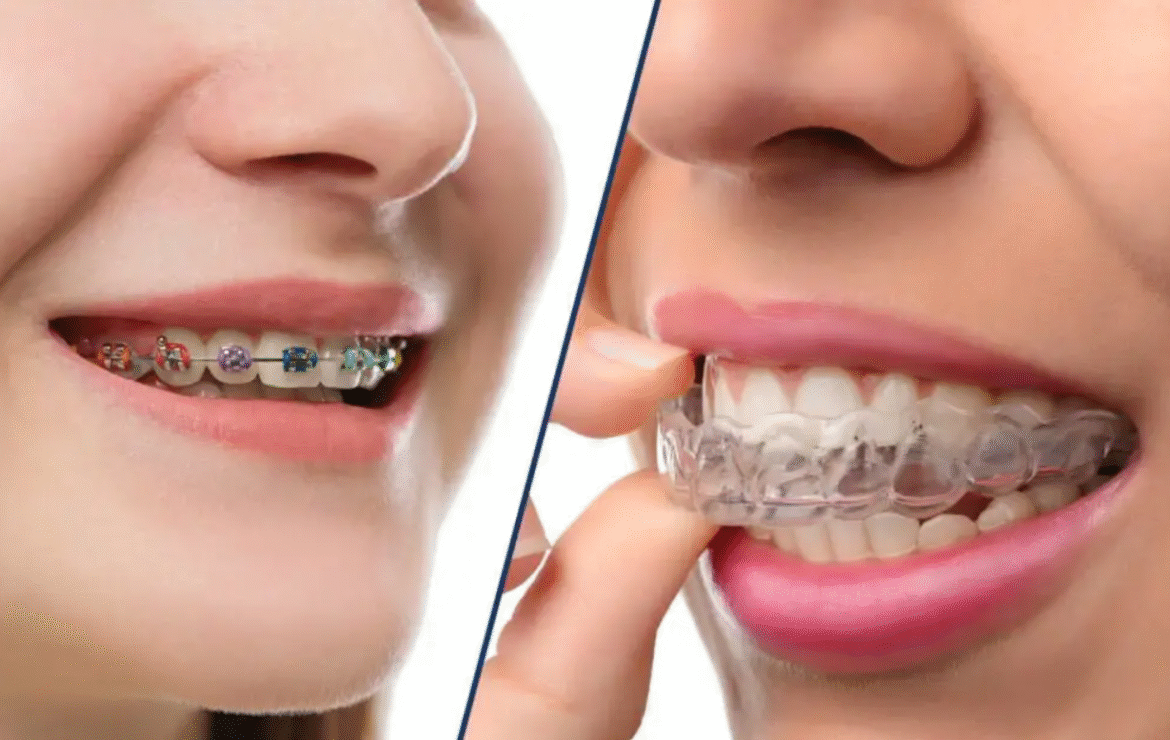
Metal braces consist of stainless steel brackets bonded directly to the tooth surfaces, connected by a continuous archwire held in place by elastic ligatures or self-ligating clips. The archwire exerts a gentle, continuous force on the brackets, which is transmitted to the teeth through the adhesive bond between bracket and enamel. As the teeth move, the archwire is progressively changed for stiffer wires — gradually increasing the force — until the teeth reach their planned positions.
The mechanics of fixed braces are precise and well-understood. The dentist has direct control over every aspect of tooth movement — the direction, the rate, and the sequence — through the wire specifications, bracket prescriptions, and the use of elastics, springs, or other adjuncts to achieve specific tooth movements.
Clinical Advantages
- Widest clinical range: Metal braces can treat everything from mild crowding to severe skeletal discrepancies. There is no orthodontic problem that is beyond the range of fixed appliances — which is why they remain the reference standard against which other systems are compared.
- No compliance required: The patient cannot remove metal braces. They work 24 hours a day regardless of patient behaviour. The only compliance required is attending appointments and avoiding certain foods.
- Most cost-effective: Metal braces are the most affordable orthodontic option in Gandhinagar. The difference in cost compared to ceramic braces or Invisalign can be significant — making metal braces the most accessible option for patients on a budget.
- Shortest treatment time for equivalent cases: Because force application is continuous and cannot be interrupted by aligner removal, metal braces typically achieve equivalent tooth movement in somewhat less time than removable aligner systems.
Limitations
- Aesthetics: Metal brackets are visible and, particularly for adult patients in professional or social environments, this is the primary reason patients look at alternatives.
- Food restrictions: Hard, sticky, and crunchy foods — raw carrots, apples, chewing gum, hard sweets — can damage brackets, bend wires, or dislodge ligatures. Patients need to modify their diet for the duration of treatment.
- Oral hygiene: Brackets and wires create many additional surfaces for plaque accumulation. Thorough cleaning around brackets requires more time and specific tools — interdental brushes, floss threaders, or water flossers. Inadequate cleaning during treatment risks enamel demineralisation around the bracket margins — the white spot lesions that can remain as permanent marks after braces are removed.
- Soft tissue irritation: During the first weeks of treatment, the brackets can irritate the inside of the lips and cheeks. This settles as the soft tissue adapts, but the initial adaptation period can be uncomfortable.
Best Suited For
Metal braces are the most appropriate choice for: complex orthodontic cases requiring precise biomechanical control; patients who are concerned about compliance (knowing they cannot remove the appliance removes the temptation); children and adolescents where compliance cannot be guaranteed; and patients for whom cost is a significant factor. For clinical complexity, there is no better tool.
Option 2 — Ceramic Braces: Clinical Precision With Less Visibility
How They Work
Ceramic braces work identically to metal braces — the same bracket-and-wire mechanism, the same wire progression, the same clinical control. The difference is the bracket material. Instead of stainless steel, the brackets are made from polycrystalline alumina (tooth-coloured ceramic) that closely matches the shade of the enamel. The archwire connecting the brackets may be a white-coated metal wire, further reducing the overall visibility of the appliance.
Clinical Advantages
- Same clinical versatility as metal: Ceramic brackets provide the same range of tooth movement and the same clinical control as metal brackets. There is no compromise in what the treatment can achieve.
- Significantly less visible: At conversational distance, ceramic braces are substantially less noticeable than metal. For adult patients who want the reliability of fixed appliances without the obvious appearance of metal brackets, ceramic braces are the primary alternative.
- Same compliance profile as metal: Like metal braces, ceramic braces are fixed and work continuously. Compliance is only required for appointment attendance and dietary modification.
Limitations
- Cost: Ceramic braces are more expensive than metal braces — the bracket material is more costly to manufacture. The difference in Gandhinagar is meaningful but not prohibitive for most patients who specifically want the aesthetic advantage.
- Staining: The elastic ligatures used with ceramic brackets can stain from tea, coffee, turmeric, and other pigmented foods and drinks. The staining affects the ligature (which is changed at each adjustment appointment) rather than the bracket itself — but between appointments, patients who consume heavily pigmented foods may notice discolouration. Self-ligating ceramic brackets avoid this issue by using a clip mechanism instead of elastic ligatures.
- Slightly more brittle: Ceramic brackets are less resistant to impact fracture than metal brackets. Patients who play contact sports should be aware of this — and should wear a mouthguard regardless of bracket material.
- More friction: Ceramic brackets generate slightly more friction against the archwire than metal brackets, which can slow tooth movement marginally — though the clinical significance of this is minor in most cases.
Best Suited For
Ceramic braces are the best option for patients who need the clinical versatility of fixed braces — including complex cases — but for whom the appearance of metal brackets is a significant concern. Adult patients in professional roles, patients attending important social or family events during treatment, and adolescents who are self-conscious about the appearance of metal brackets all benefit from ceramic as the fixed appliance of choice.
Option 3 — Invisalign (Clear Aligners): The Most Aesthetic Option
How It Works
Invisalign treatment uses a series of custom-fabricated, clear plastic aligners that fit precisely over the teeth. Each aligner in the series is slightly different from the last, applying controlled forces to move specific teeth incrementally toward their planned positions. The patient wears each aligner for one to two weeks before progressing to the next in the series. The total number of aligners in a treatment course ranges from as few as 10 to 14 (for simple cases) to 40 to 60 or more (for comprehensive cases).
The Invisalign treatment plan is generated from a digital scan of the patient’s teeth using the ClinCheck software — a three-dimensional simulation of every tooth movement from the starting position to the planned final position. The patient can review this simulation before committing to treatment, which is one of the most valued aspects of the planning process.
Clinical Advantages
- Most aesthetic: When worn, clear aligners are nearly invisible. They are the closest to invisible orthodontic option available. At conversational distance, most people cannot tell a patient is in active orthodontic treatment.
- Removable: Aligners are removed for eating and drinking (other than water), for brushing and flossing, and for specific social or professional occasions. This eliminates the food restrictions associated with fixed braces and makes oral hygiene significantly simpler — patients brush and floss normally without navigating around brackets and wires.
- Comfort: Clear aligners have no metal brackets or wires and do not cause soft tissue irritation. They typically produce less acute discomfort when a new aligner is placed than braces do at adjustment appointments, though they are not without sensation — pressure from the new aligner is felt for the first day or two after each change.
- Digital predictability: The ClinCheck simulation allows both the patient and the dentist to preview the planned outcome before treatment begins, giving a clear expectation of the result.
The Critical Limitation: Compliance
The most important limitation of Invisalign — and the one most often underestimated by patients choosing it — is compliance. Aligners must be worn for 20 to 22 hours per day to deliver the planned tooth movement on schedule. Every hour the aligner is out of the mouth is an hour during which no treatment is happening — and the teeth are free to begin returning toward their original positions.
Patients who remove their aligners for meals, brushing, and the occasional occasion — and then wear them consistently the rest of the time — achieve excellent results on schedule. Patients who remove their aligners when they are uncomfortable, when they are socialising, when they forget to put them back in after meals, or when they simply prefer not to wear them accumulate hours of non-compliance that extend their treatment, reduce the accuracy of the outcome, and in some cases require additional refinement aligners to correct the deviations.
This is not a judgement of patients who choose Invisalign — it is clinically important information. Patients considering Invisalign should honestly assess their own compliance personality before committing. A highly motivated, disciplined patient who will wear the aligners consistently gets outstanding results. A patient who knows they will struggle with compliance gets better results with fixed braces, which require no behavioural change beyond dietary modification.
Clinical Range
Invisalign is highly effective for mild to moderate orthodontic problems: crowding, spacing, overbite, crossbite (in many cases), and mild to moderate Class II cases. It has expanded its clinical range significantly over the past decade — including features for tooth extrusion, torque control, and molar movement that were once considered outside aligner capability.
However, for the most complex cases — severe crowding requiring extractions, significant skeletal discrepancies, complex molar movements, and cases requiring precise torque control on specific teeth — fixed braces remain the more reliable tool. The dentist’s honest assessment of whether a patient’s case is within Invisalign’s effective range is the most important input into this decision.
Best Suited For
Invisalign is the best choice for adult patients with mild to moderate cases who are highly motivated and reliable with compliance, who have professional or social environments where the appearance of braces would be a significant concern, and who value the ability to remove the appliance for oral hygiene. It is also appropriate for adolescents who meet the compliance criteria — the Invisalign Teen system provides compliance indicators and replacement aligners specifically designed for adolescent patients.
The Complete Comparison
| Feature | Metal Braces | Ceramic Braces | Invisalign |
| Visibility | Most visible — silver brackets | Much less visible — tooth-coloured | Nearly invisible when worn |
| Clinical range | Full range — all complexity levels | Full range — same as metal | Mild to moderate; complex cases may need braces |
| Compliance required | None beyond appointments | None beyond appointments | 20–22 hours/day wear — critical |
| Removable? | No — fixed for treatment duration | No — fixed for treatment duration | Yes — removed for eating, brushing, occasions |
| Food restrictions | Yes — hard/sticky foods avoided | Yes — same as metal; avoid staining drinks | None — aligner removed before eating |
| Oral hygiene | Harder — brackets and wires add surfaces | Same as metal | Easier — brush and floss normally without appliance |
| Comfort | Initial soft tissue irritation; settles | Same as metal | No brackets; pressure with each new aligner |
| Treatment duration | Benchmark — comparable cases fastest | Slightly longer than metal (minor difference) | Equivalent to braces for good compliers; longer for poor compliers |
| Cost (relative) | Most affordable | Moderate premium over metal | Highest — significant premium over both braces options |
| Retainer after treatment | Fixed and/or removable retainer | Fixed and/or removable retainer | Fixed and/or removable retainer |
How the Right Choice Is Made — The Records Appointment
No responsible orthodontist recommends an appliance without first taking full records — the clinical data needed to assess the case and plan the treatment. Before any recommendation is made at Nova Dental Hospital, the following records are gathered:
- Clinical photographs: Full-face and intraoral photographs documenting the starting position of the teeth and the smile aesthetics.
- Radiographs: An OPG panoramic X-ray gives an overview of all the teeth, roots, bone levels, and any unerupted teeth. A lateral cephalometric X-ray — a specific side-view X-ray of the skull — allows skeletal analysis of the jaw relationship, which is essential for planning cases that involve any jaw discrepancy or significant overbite/overjet.
- Digital scan or study models: A digital intraoral scan or plaster study models of both arches gives the three-dimensional tooth relationship needed to measure crowding, spacing, and the bite relationship accurately.
From this records set, the dentist can classify the orthodontic problem — its type, its severity, and its clinical requirements — and give the patient a specific recommendation on which appliance is most appropriate, with an honest account of why. A patient who wants Invisalign for a case that genuinely requires fixed braces should be told this clearly — not offered Invisalign with caveats that emerge mid-treatment.
Orthodontic Treatment at Nova Dental Hospital, Gandhinagar
Nova Dental Hospital offers dental braces and Invisalign clear aligners in Gandhinagar — both metal and ceramic fixed braces, and the full Invisalign system for eligible cases. The recommendation for each patient is based on the clinical assessment of their records, not on which appliance is easier to recommend or more commercially convenient.
Orthodontic treatment at the clinic covers the full range of cases — from simple crowding alignment in adolescents to complex misaligned teeth treatment in adults, and from children’s orthodontic assessment from age 7 through to adult treatment at any age. Retention management after treatment — fixed retainers and removable Essix retainers — is provided as standard, with explicit guidance on the lifelong nature of retainer wear.
For patients who want to understand which appliance suits their specific case before committing to treatment, a records and consultation appointment at Nova Dental Hospital gives the complete picture — clinical assessment, records, and a specific recommendation with full transparency about the clinical reasoning behind it.
Frequently Asked Questions
FAQ 1: Is Invisalign as effective as braces for crooked teeth?
For mild to moderate cases, yes — Invisalign can achieve results equivalent to fixed braces for compliant patients. For more complex cases — severe crowding, significant skeletal discrepancies, or specific precision movements — fixed braces (metal or ceramic) remain the more reliable tool. The key variables are the clinical complexity of the case and the patient’s compliance. A patient considering Invisalign for a complex case should ask specifically whether their case is within Invisalign’s effective range. The orthodontic team at Nova Dental Hospital will give an honest, case-specific answer based on the records.
FAQ 2: How long does orthodontic treatment take with braces vs Invisalign?
For equivalent cases, treatment duration is broadly comparable between fixed braces and Invisalign for patients who comply consistently with aligner wear. Most comprehensive orthodontic cases take 18 to 24 months regardless of appliance. Metal braces may be marginally faster for equivalent cases because force application is continuous. Invisalign treatment for non-compliant patients extends beyond the planned duration because the missed wear hours delay tooth movement. Simple cases — mild crowding in adults — can be completed in 6 to 12 months with either system.
FAQ 3: Can adults get braces in Gandhinagar?
Yes — there is no upper age limit for orthodontic treatment. The biological mechanism of tooth movement — bone remodelling in response to controlled force — works in adult bone as well as in adolescent bone, though the rate of movement may be slightly slower in older adults. Adults represent a growing proportion of orthodontic patients, and both fixed braces and Invisalign are appropriate for adult cases depending on the clinical situation. For adult patients who are concerned about the appearance of treatment, ceramic braces or Invisalign are the most aesthetically discreet options.
FAQ 4: Do I need to wear a retainer after braces?
Yes — indefinitely. Teeth that have been moved orthodontically have a tendency to relapse toward their original positions, driven by the elastic fibres of the periodontal ligament. Without retention, relapse is predictable — and it begins within days of the retainer being discontinued. The standard protocol at Nova Dental Hospital includes a fixed retainer (a thin wire bonded to the back of the front teeth) and a removable Essix retainer worn nightly. The fixed retainer provides passive lifelong retention; the removable retainer provides additional protection and allows the patient to monitor their retention compliance. Retainers are not optional and are not temporary — they are the last phase of orthodontic treatment and it is the lifelong phase.
FAQ 5: How much do braces cost in Gandhinagar?
The cost of orthodontic treatment in Gandhinagar varies by appliance type and case complexity. Metal braces are the most affordable option, followed by ceramic braces, with Invisalign typically at the highest price point. A precise cost cannot be given without a clinical assessment — the complexity of the case, the planned treatment duration, and any additional procedures (extractions, space opening) all affect the total. Nova Dental Hospital provides a full written treatment plan with a transparent cost breakdown before any treatment is scheduled. You are welcome to read about patient experiences on our Google Business Profile. To book a records and consultation appointment, call +91 9638 111 082.
🔑 Key Takeaways
- Metal braces offer the widest clinical range, require no patient compliance beyond appointment attendance, and are the most cost-effective option. They are the best choice for complex cases and for patients who cannot guarantee consistent aligner wear.
- Ceramic braces deliver identical clinical results to metal braces with significantly reduced visibility — the preferred fixed appliance for adult patients in professional or social environments who need the full range of fixed appliance treatment.
- Invisalign is the most aesthetic option and produces excellent results for mild to moderate cases in highly compliant patients. The 20 to 22 hours per day wear requirement is the critical clinical variable — patients who cannot meet it consistently get better results with fixed braces.
- The records appointment — photographs, OPG, lateral cephalometric X-ray, and digital scan — is the necessary first step before any appliance is recommended. Treatment without records is not responsible orthodontic planning.
- Retention after treatment is lifelong and non-negotiable regardless of which appliance is used. The fixed retainer and nightly removable retainer are the last phase of orthodontic treatment — and the most important phase for long-term stability.
- Nova Dental Hospital offers all three options in Gandhinagar and makes recommendations based on clinical assessment of each patient’s records — not on which system is most convenient to recommend.
Conclusion: The Right Braces Are the Ones That Work for Your Case and Your Life
The best orthodontic appliance is the one that achieves the right clinical outcome reliably for the patient’s specific case, within the demands of their lifestyle, and within a budget that makes treatment accessible rather than aspirational. For some patients that is metal braces. For others it is ceramic. For others — in the right case, with the right compliance commitment — it is Invisalign.
What it should never be is a recommendation made without records, without an honest clinical assessment, or without a transparent account of the limitations of each option for the specific case being discussed. At Nova Dental Hospital, orthodontic consultations start with records and end with a specific, honest recommendation — not a sales pitch for whichever system is most profitable to recommend.
If you are considering orthodontic treatment in Gandhinagar — for yourself or for a child — book a consultation at Nova Dental Hospital. The team will take the records, assess the case, and give you a clear picture of which treatment is most appropriate and why. As one of the best dental clinics in Gandhinagar for orthodontic treatment, the goal is always the right outcome — not the most expedient recommendation.

Related posts
Write a Comment
Recent Posts


