


All-on-4 & All-on-6 Full Arch Implants Explained
All-on-4 & All-on-6 Full Arch Implants Explained

Quick Answer
All-on-4 and All-on-6 are full arch dental implant techniques that replace an entire row of missing or failing teeth using a fixed prosthetic bridge anchored to four or six implants. All-on-4 is usually enough for most patients with adequate bone, while All-on-6 offers extra support for patients with higher bite force or slightly reduced bone volume. Both can often be completed without bone grafting and can provide a functional temporary bridge on the same day as surgery. |
Quick Summary
● All-on-4 uses four implants per arch; All-on-6 uses six, mainly for added stability. ● Both techniques can replace a full arch of 12–14 teeth with one fixed bridge. ● A temporary set of teeth can often be fitted the same day as surgery. ● Full healing and integration with the jawbone takes about three to six months. ● Bone grafting is usually unnecessary because implants are angled to use existing bone. ● Long-term survival rates for both techniques are consistently reported above 95 percent over 5–10 years in clinical literature. ● Candidacy depends on bone quality, gum health, and overall medical history, not age alone. ● A 3D CT scan during consultation is the most reliable way to decide between All-on-4 and All-on-6. |
Introduction
Losing most or all of the teeth in an arch changes the way a person eats, speaks, and smiles. For decades, the only options were removable dentures, which can slip, feel bulky, and require frequent adjustment. All-on-4 and All-on-6 full arch implants were developed to give patients a fixed, non-removable alternative that functions much like natural teeth. This guide explains what each technique involves, how they differ, who is a suitable candidate, and what to expect at every stage, so you can have an informed conversation with your dentist before deciding.
What Are All-on-4 and All-on-6 Implants?
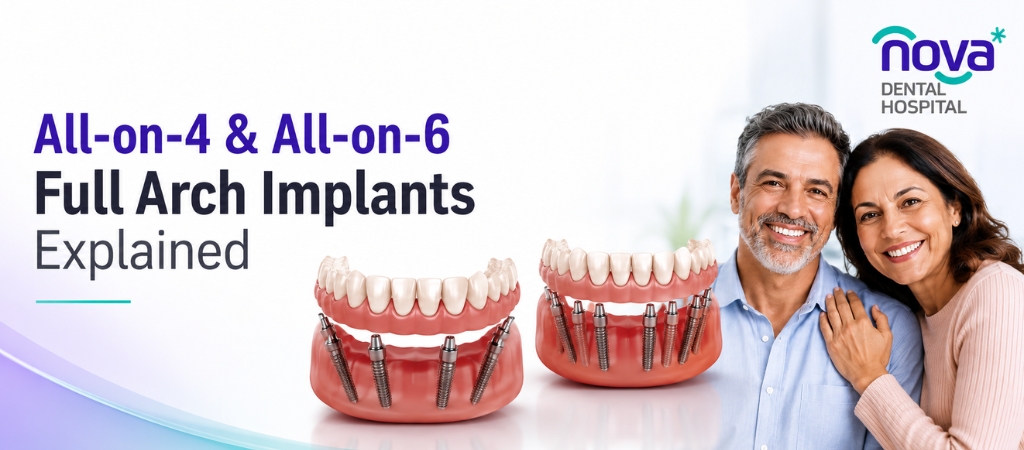
All-on-4 is a full arch restoration technique in which four titanium implants are surgically placed in strategic positions in the jaw — two positioned vertically at the front and two angled toward the back — to support a complete fixed bridge of teeth. All-on-6 follows the same principle but uses six implants, distributing chewing forces across more support points. Both techniques were designed to make use of the denser bone typically found at the front of the jaw, reducing the need for bone grafting even in patients who have lost bone volume over time.
| Expert Insight: “Patients often assume more implants automatically means a better outcome, but that isn’t always true,” says a Nova Dental prosthodontist. “The right number depends on bite force, bone density and arch length. A thorough 3D scan tells us far more than a general assumption.” |
How the Procedure Works: Step-by-Step Timeline
| Stage | What Happens | Typical Duration |
| Consultation & 3D Scan | Clinical exam, medical history review, CT scan to assess bone volume | 1 visit |
| Treatment Planning | Implant number and position finalised (All-on-4 or All-on-6) | 1–2 weeks |
| Implant Surgery | Implants placed under local anaesthesia/sedation; temporary bridge fitted | 1 day |
| Healing (Osseointegration) | Implants fuse with jawbone; soft-food diet recommended | 3–6 months |
| Final Prosthesis Fitting | Permanent, custom-made fixed bridge attached | 1–2 visits |
| Long-Term Maintenance | Routine cleanings and check-ups | Every 6 months |
All-on-4 vs All-on-6: Key Differences
Choosing between the two is not about which is universally “better,” but which matches an individual patient’s jaw structure and bite requirements.
| Factor | All-on-4 | All-on-6 |
| Number of Implants | 4 per arch | 6 per arch |
| Best Suited For | Adequate bone density, average bite force | Higher bite force, slightly reduced bone density, longer arch |
| Load Distribution | Good | More evenly distributed across additional points |
| Surgical Complexity | Comparatively simpler | Slightly more involved due to extra implant sites |
| Typical Healing Time | 3–6 months | 3–6 months |
| Relative Cost | Lower (fewer implants) | Higher (more implants and planning) |
Who Is a Good Candidate?
Most adults who have lost most or all of their teeth in an arch — whether from decay, gum disease, or injury — can be evaluated for All-on-4 or All-on-6. Good general health, manageable gum disease, and sufficient (even if reduced) bone volume are the main requirements. A patient with uncontrolled diabetes, active infection, or heavy smoking habits may need additional preparation or an alternative plan before implants can be safely placed.
| Patient Scenario: Consider a 58-year-old patient who has worn an ill-fitting denture for years and struggles to eat comfortably. After a CT scan shows moderate bone loss in the upper jaw but strong bone at the front, the dental team recommends All-on-6 for the upper arch to distribute pressure evenly, while All-on-4 is sufficient for the lower arch. This kind of individualised planning is typical, not the exception. |
Recovery and Aftercare
Mild swelling, soreness, and some bruising are normal for the first few days after surgery and are managed with prescribed medication and a soft-food diet. Most patients resume normal daily activities within two to three days, though strenuous exercise is usually paused for one to two weeks. Full osseointegration, where the implants fuse securely with the jawbone, takes three to six months, after which the final, permanent prosthesis is fitted.
Cost Considerations
The cost of All-on-4 or All-on-6 treatment varies depending on the number of implants, the materials used for the prosthesis (such as zirconia versus acrylic), the complexity of the case, and whether any preparatory procedures are needed. Because pricing depends heavily on individual diagnostics, the most reliable way to get an accurate estimate is a consultation with a CT scan and a written treatment plan, rather than relying on general online estimates.
Common Mistakes Patients Make
- Assuming All-on-6 is always superior — the right choice depends on individual bone and bite assessment, not on implant count alone.
- Skipping the CT scan step and relying only on a visual exam, which can lead to inaccurate treatment planning.
- Neglecting daily cleaning under the fixed bridge, which increases the risk of gum inflammation around the implants.
- Choosing a provider based on price alone rather than experience with full arch implant planning and prosthetic design.
Myths vs Facts
| Myth | Fact |
| Full arch implants always require bone grafting. | Both All-on-4 and All-on-6 are designed to use existing bone through angled placement, so grafting is often unnecessary. |
| The procedure is extremely painful. | Surgery is performed under anaesthesia; post-operative discomfort is generally mild to moderate and manageable with medication. |
| Implants need to be removed and cleaned like dentures. | The prosthesis is fixed in place and cleaned in the mouth using specific tools, not removed daily. |
| Older adults cannot get full arch implants. | Candidacy depends on overall health and bone quality, not age alone. |
Questions Patients Forget to Ask
- What happens if an implant fails to integrate — is there a revision plan?
- What material will the final prosthesis be made from, and how does that affect durability?
- How will my bite be adjusted over time as the prosthesis wears?
- What is the maintenance schedule after the first year?
- Is a temporary prosthesis included, and how many follow-up visits are needed before the final fitting?
Practical Action Plan
- Book a consultation and CT scan to assess bone density and arch structure.
- Discuss your medical history, including any conditions like diabetes or smoking habits, openly with your dentist.
- Review whether All-on-4 or All-on-6 (or a combination for upper and lower arches) fits your case.
- Ask for a written treatment plan with timeline and prosthesis material options.
- Plan for a soft-food diet and reduced activity during the initial healing period.
- Schedule routine six-month check-ups once the final prosthesis is fitted.
Nova Dental Expert Summary Box
| Nova Dental Hospital’s Guidance: Full arch implants are a significant decision, and the right technique depends on your unique bone structure and bite, not a one-size-fits-all answer. At Nova Dental Hospital in Gandhinagar and Ahmedabad, treatment planning begins with detailed 3D imaging and a personalised discussion of All-on-4 and All-on-6 options, so patients understand exactly what to expect before moving forward with family-focused, patient-first care. |
Key Takeaways
- All-on-4 and All-on-6 both replace a full arch of teeth with a fixed prosthesis.
- The difference lies in the number of implants and the level of support they provide.
- A CT scan is essential for accurate treatment planning.
- Bone grafting is usually avoidable with proper implant angling.
- Recovery involves an initial healing phase followed by three to six months of osseointegration.
- Long-term success depends heavily on daily cleaning and regular dental visits.
- Cost varies by case complexity and materials used, so individual consultation is essential.
FAQ Section
1. What is the main difference between All-on-4 and All-on-6 implants?
All-on-4 uses four implants per arch to support a full set of fixed replacement teeth, while All-on-6 uses six implants for additional support. All-on-6 is often recommended when a patient has higher bite force, a longer arch, or slightly reduced bone density, since the extra implants spread chewing pressure more evenly.
2. Is All-on-4 or All-on-6 more painful?
Both procedures are performed under local anaesthesia or sedation, so pain during surgery is minimal. Post-operative soreness and swelling are similar for both techniques and typically ease within three to five days with prescribed medication and a soft-food diet.
3. Can I get teeth in a day with All-on-4 or All-on-6?
Yes, in most cases a temporary fixed bridge can be attached the same day as implant placement, allowing patients to leave with a functional set of teeth. The final, permanent prosthesis is fitted after the implants have fully integrated with the jawbone, usually after three to six months.
4. Do I need bone grafting before All-on-4 or All-on-6 treatment?
One of the advantages of both techniques is that they are designed to work with a patient’s existing bone, often by angling the back implants to avoid areas of low bone volume. This means bone grafting is not required in most cases, though a dentist will confirm this after a 3D scan.
5. How long do All-on-4 and All-on-6 implants last?
With proper oral hygiene and regular dental visits, the implant fixtures themselves can last for decades, and long-term studies report survival rates consistently above 95 percent over 5 to 10 years. The prosthetic teeth on top may need adjustment, relining, or replacement roughly every 10 to 15 years due to normal wear.
6. Who is not a good candidate for full arch implants?
Patients with uncontrolled diabetes, active gum disease, heavy smoking habits, or very low bone density may need additional evaluation or preparatory treatment before proceeding. A thorough medical and dental history review during the consultation helps determine suitability.
7. How many teeth are replaced with All-on-4 or All-on-6?
Both techniques replace a full arch of teeth, typically 12 to 14 teeth, using a fixed prosthetic bridge supported by the implants. The number of implants (four or six) refers to the support structure, not the number of visible teeth.
8. What is the recovery time after full arch implant surgery?
Most patients return to normal daily activities within two to three days, though initial healing of the surgical site takes about one to two weeks. Full integration of the implants with the jawbone, known as osseointegration, takes three to six months.
9. Can All-on-4 or All-on-6 implants fail?
As with any surgical procedure, failure is possible, though uncommon when patients are properly screened and follow aftercare instructions. Common risk factors include smoking, poor oral hygiene, and untreated gum disease, all of which a dentist will discuss during planning.
10. Are All-on-4 and All-on-6 implants suitable for senior citizens?
Age alone does not disqualify a patient; overall health, bone quality, and healing capacity matter more than age. Many senior citizens successfully undergo full arch implant treatment after a complete health evaluation.
11. How do I clean All-on-4 or All-on-6 implants?
The fixed prosthesis is cleaned using a water flosser, interdental brushes, and a soft-bristled toothbrush to remove plaque from under and around the bridge. Regular professional cleanings every six months help prevent gum inflammation around the implants.
12. Is a full arch dental implant treatment available near Gandhinagar?
Yes, full arch implant evaluation and treatment planning, including All-on-4 and All-on-6 options, are available at dental hospitals offering advanced implantology services in Gandhinagar and Ahmedabad. A CT scan-based consultation is the first step to confirm candidacy.

Related posts
Write a Comment
Recent Posts


Dry Socket After Tooth Extraction: Symptoms, Prevention & Treatment


