


Retainers After Braces: How Long Do You Really Need to Wear Them?
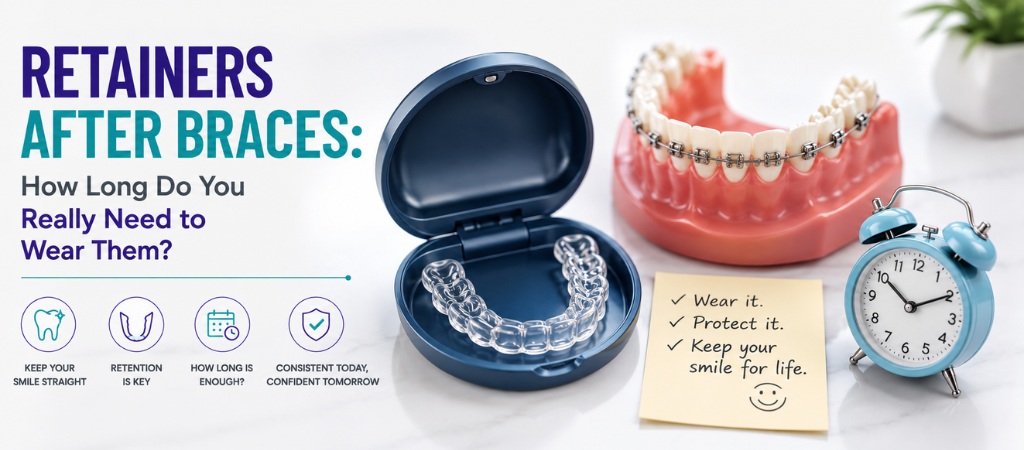
Retainers After Braces: How Long Do You Really Need to Wear Them?

Quick Answer
Most patients need to wear a retainer full-time (20–22 hours a day) for the first 4–6 months after braces are removed, then shift to night-only wear for at least 1–2 years. After that, most orthodontists recommend continued night-time wear indefinitely, because teeth can shift at any age. There is no fixed “finish line” — retention is a long-term commitment, not a short phase. |
Quick Summary
- Retainers are worn to hold teeth in their new position while the bone and gum tissue stabilize.
- Full-time wear (20–22 hours/day) is typical for the first 3–6 months after braces removal.
- Night-only wear usually follows for at least 1–2 years, and often longer.
- Long-term or indefinite night wear is the safest way to prevent relapse, since teeth can shift throughout life.
- Common retainer types include Hawley (wire and acrylic), clear/Essix (transparent plastic), and fixed/bonded retainers.
- Skipping retainer wear — even for a short break — is one of the most common causes of teeth shifting back after braces.
- Regular dental check-ups help confirm the retainer still fits and is doing its job.
Braces are only half the journey. Once brackets and wires come off, the teeth are in a new position, but the bone, gum fibres, and surrounding tissue have not yet “learned” to hold them there. This is where a retainer comes in — and it is arguably as important as the orthodontic treatment itself. Many patients assume that once braces are removed, the hard part is over. In reality, how consistently a retainer is worn in the months and years that follow often determines whether that hard-earned smile lasts a lifetime or slowly drifts back toward its original position.
This guide breaks down exactly how long retainers need to be worn, why the timeline is not the same for everyone, and what parents and patients often overlook during the retention phase.
Why You Need a Retainer After Braces
Teeth are held in the jawbone by a network of elastic gum and ligament fibres called the periodontal ligament. When braces move teeth into a new position, these fibres and the surrounding bone need time — usually several months to a few years — to remodel and firmly anchor the teeth in place. Until that remodeling is complete, teeth have a natural tendency to drift back toward their original alignment, a process dentists call orthodontic relapse.
Why this matters: Without a retainer, even minor, everyday forces — chewing, tongue pressure, or lip pressure — can gradually move teeth out of alignment within just a few months of braces removal.
Types of Retainers After Braces
Not all retainers look or function the same way. The right type often depends on the original bite issue, age, and lifestyle.
| Retainer Type | Description | Typical Use |
| Hawley Retainer | A removable retainer with a metal wire across the front teeth and an acrylic base molded to the palate or tongue side. | Durable, adjustable, commonly used for long-term retention. |
| Clear (Essix) Retainer | A transparent, custom-molded plastic tray similar to a clear aligner. | Popular for its near-invisible appearance; preferred by teens and adults. |
| Fixed (Bonded) Retainer | A thin wire bonded to the back of the front teeth, usually the lower arch. | Worn continuously without patient effort; often paired with a removable retainer on the opposite arch. |
Practical takeaway: Many orthodontists now combine a fixed retainer on the lower front teeth with a removable retainer for the upper arch, giving round-the-clock protection where relapse risk is highest, along with flexibility elsewhere.
How Long You Really Need to Wear a Retainer: The Realistic Timeline
Phase 1: Full-Time Wear (First 3–6 Months)
Immediately after braces are removed, most orthodontists recommend wearing the retainer 20–22 hours a day, removing it only to eat, drink (other than water), and brush. This period is when relapse risk is at its highest, since the supporting bone and fibres are still soft and adapting.
Phase 2: Night-Only Wear (Next 1–2 Years)
Once the orthodontist confirms the bite has stabilized, wear time is typically reduced to nights only — around 8–10 hours while sleeping. This phase is not optional; it is simply a lighter version of the same job the retainer was doing before.
Phase 3: Long-Term or Indefinite Night Wear
Here is what many patients are not told clearly enough: teeth can shift at any age, even decades after orthodontic treatment, due to natural aging, jaw growth changes, or even the gradual pressure of chewing over a lifetime. For this reason, most orthodontists now recommend continuing to wear a retainer at night a few times a week — indefinitely — for anyone who wants to keep their smile exactly where it is.
Real-life scenario: A patient who wore braces as a teenager and stopped using their retainer in their early twenties often notices, by their thirties, that the lower front teeth have become slightly crowded again — a textbook example of late relapse that regular night-time retainer wear could have prevented.
Expert Insight Sections
| Expert Insight 1: Retention Is a Lifelong Habit, Not a Phase Orthodontic retention does not have a true “end date.” The goal shifts from active correction to long-term maintenance, similar to wearing a seatbelt — it only works when it is actually used. |
| Expert Insight 2: Compliance Matters More Than Retainer Type A less expensive retainer worn consistently will outperform a premium retainer that is left in a drawer. The single biggest predictor of long-term results is how honestly the wearing schedule is followed. |
| Expert Insight 3: Fixed Retainers Still Need Monitoring A bonded wire retainer can quietly detach from one tooth without the patient noticing, since the wire may still hold the other teeth in place. Periodic dental check-ups help catch this early, before uneven movement occurs. |
Common Mistakes to Avoid
- Skipping the transition period: Jumping straight from full-time wear to occasional wear without following the orthodontist’s gradual reduction schedule.
- Assuming a short break is harmless: Even a one- to two-week gap, especially in the first year, can allow noticeable shifting, particularly in the lower front teeth.
- Ignoring a loose or ill-fitting retainer: Continuing to wear a retainer that no longer fits snugly can actually push teeth in unintended directions instead of holding them in place.
Myths vs Facts
| Myth | Fact |
| Once braces are off, the results are permanent. | Teeth remain mobile for life; consistent retainer wear is what keeps results stable. |
| Retainers are only needed for a year or two. | Most professionals recommend at least some night-time wear indefinitely, since relapse risk never fully disappears. |
| Clear retainers work exactly like Hawley retainers. | Both hold teeth in place, but they differ in durability, visibility, and how easily minor adjustments can be made. |
| If teeth feel fine, the retainer can be stopped. | Retainers should feel comfortably snug; noticeable tightness after a break is often an early sign teeth have already shifted. |
Questions Patients Forget to Ask
- What should I do the moment my retainer feels tight or difficult to insert?
- How do I clean my retainer properly without damaging it?
- What is the realistic cost and process if my retainer is lost or broken?
- Should my wisdom teeth be evaluated, since they can sometimes contribute to lower front crowding?
- How often should my retainer fit be professionally checked?
Practical Action Plan
- Follow the exact wear schedule given after braces removal — do not self-reduce wear time early.
- Store the retainer in its case every single time it is removed, to avoid loss or damage.
- Clean the retainer daily with a soft brush and lukewarm water; avoid hot water, which can warp plastic retainers.
- Schedule a retainer check-up 6–12 months after braces removal, and periodically afterward.
- If the retainer ever feels tight, book an appointment promptly rather than waiting — early shifting is far easier to correct than established relapse.
Nova Dental Expert Summary
There is no single universal number of months or years for retainer wear. The pattern most patients can expect is: full-time wear for roughly the first 3–6 months, night-only wear for at least the next 1–2 years, and continued periodic night wear beyond that for long-term stability. The specific schedule should always be confirmed by the treating orthodontist based on individual bite stability. |
How Nova Dental Hospital Can Help
Nova Dental Hospital, with facilities in Gandhinagar and Ahmedabad, supports patients through every stage of orthodontic care — from the initial evaluation for braces to long-term retention planning. This includes:
- Child-friendly and family-focused orthodontic care for patients of all ages.
- Personalized treatment planning, including retainer type selection based on bite pattern and lifestyle.
- Growth monitoring for younger patients whose jaws are still developing.
- Early diagnosis of retainer fit issues or early signs of relapse during routine dental checkups.
- Preventive dentistry guidance to support long-term oral health alongside orthodontic retention.
This information is intended for patient education. A qualified orthodontist should always confirm the exact retainer type and wearing schedule for an individual case.
Key Takeaways
- Retainers protect the results of braces treatment by holding teeth in place while bone and tissue stabilize.
- Expect full-time wear for the first 3–6 months, followed by night-only wear for 1–2 years or more.
- Long-term, periodic night wear is the safest approach, since teeth can shift at any life stage.
- Hawley, clear, and fixed retainers each have distinct advantages depending on lifestyle and bite complexity.
- Consistency matters more than which retainer type is chosen.
- A retainer that suddenly feels tight is an early warning sign that should not be ignored.
- Regular dental check-ups help catch fit issues, especially with fixed/bonded retainers.
Frequently Asked Questions
Q. How long do I need to wear a retainer after braces?
Typically full-time for the first 3–6 months, then nights only for at least 1–2 years, with many orthodontists recommending continued periodic night wear long-term.
Q. Do I really need to wear a retainer forever?
Not necessarily every single night forever, but most orthodontists recommend at least occasional night wear indefinitely, since teeth can shift at any age.
Q. What happens if I stop wearing my retainer too early?
Teeth can begin shifting back toward their original position within weeks to a few months, a process known as orthodontic relapse.
Q. Which retainer type is best — Hawley, clear, or fixed?
Each has trade-offs: Hawley retainers are durable and adjustable, clear retainers are less visible, and fixed retainers require no daily effort but need periodic monitoring.
Q. Can adults still get retainers after having braces years ago?
Yes. If teeth have shifted after stopping retainer use, a dentist or orthodontist can evaluate whether a new retainer or minor re-treatment is appropriate.
Q. Is it normal for a retainer to feel tight after a short break?
Occasional mild tightness after a missed night can be normal, but persistent tightness usually signals that some shifting has already occurred and should be checked.
Q. How do I know if my retainer no longer fits properly?
Signs include difficulty inserting it, visible gaps between the retainer and teeth, or noticeable looseness compared to when it was first fitted.
Q. Can a fixed retainer stay in place permanently?
Fixed retainers can last many years, but the bonding can weaken over time, so periodic dental checks are recommended to confirm it remains securely attached.
Q. Does retainer wear differ for teenagers versus adults?
The core principle is the same, though teenagers may need closer monitoring for compliance, while adults are generally more consistent but should still follow the same phased schedule.

Related posts

Write a Comment
Recent Posts


Dry Socket After Tooth Extraction: Symptoms, Prevention & Treatment


