


Adult Orthodontics: Is It Too Late to Get Braces or Invisalign After 30?
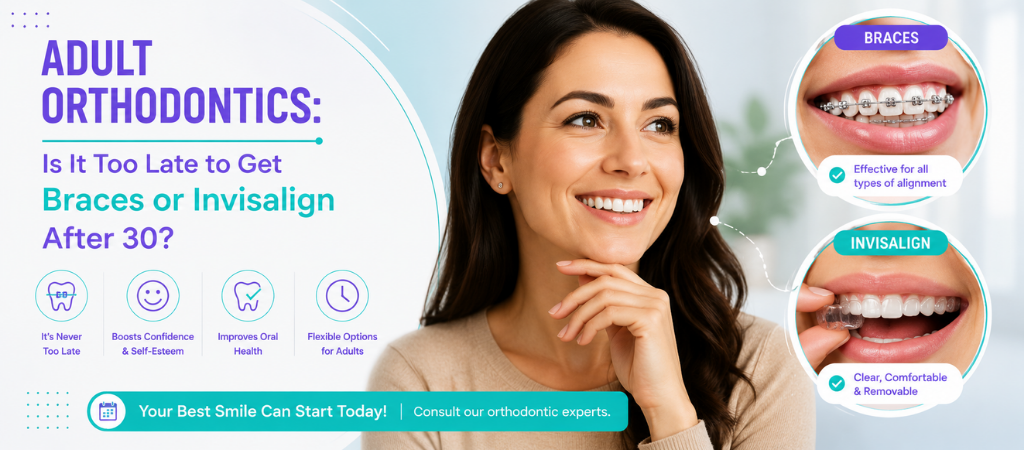
Adult Orthodontics: Is It Too Late to Get Braces or Invisalign After 30?

Quick Answer
| No — there is no upper age limit for orthodontic treatment. Teeth can move at any age because tooth movement depends on the periodontal ligament and bone remodelling process, which remains active throughout life. Adults over 30, 40, 50, and beyond routinely complete treatment with braces or Invisalign. The main difference for adults is that treatment planning must also account for gum health, bone density, and any existing dental work, which is why a proper evaluation matters more than age itself. |
Quick Summary
- Tooth movement is a biological process, not an age-restricted one — bone remodels around tooth roots at any life stage.
- Adults commonly seek treatment for crowding that has worsened with age, bite problems, or to correct issues left untreated since childhood.
- Options include metal braces, ceramic braces, lingual braces, and clear aligners such as Invisalign.
- Average adult treatment time is 12–24 months, depending on complexity, compared with 18–36 months for adolescents in more complex cases.
- Gum disease, bone loss, and missing teeth must be assessed and stabilised before movement begins.
- Clear aligners are often preferred by working professionals for their near-invisible, removable design.
- A thorough consultation — not a birthday — should decide candidacy for treatment.
Introduction
Many adults quietly live with crooked teeth, gaps, or a bite that never feels quite right, assuming braces are something they missed out on in their teenage years. This belief keeps a large number of adults from seeking care that could meaningfully improve their oral health, confidence, and long-term function. The truth is straightforward: orthodontic treatment works the same way in adults as it does in teenagers, because the biological mechanism that moves teeth does not switch off with age. What changes is not whether treatment can work, but how it needs to be planned. This guide walks through what actually determines candidacy for braces or Invisalign after 30, what to expect during treatment, and how Nova Dental Hospital approaches adult orthodontic care in Gandhinagar and Ahmedabad.
Why Age Isn’t a Barrier to Orthodontic Treatment
Teeth move through a process called bone remodelling. When gentle, sustained pressure is applied by braces or aligners, the bone on one side of the tooth root is gradually resorbed while new bone forms on the other side, allowing the tooth to shift into a new position. This cellular process, carried out by cells called osteoclasts and osteoblasts, continues throughout a person’s life. It is the same mechanism whether the patient is 14 or 54.
What does change with age is the surrounding environment the teeth are moving through. Adult jawbones have finished growing, so treatment cannot use growth to guide the bite the way it sometimes can in children. Adults are also more likely to have existing dental work — fillings, crowns, or missing teeth — and a higher likelihood of prior gum recession or bone loss. None of these rule out treatment; they simply need to be identified and managed as part of the plan.
| Expert Insight At Nova Dental Hospital, we see adult patients in their 30s, 40s, and 60s complete orthodontic treatment successfully every year. The determining factor is never the number on a birth certificate — it is the health of the gums and supporting bone. A patient with healthy periodontal tissue at 55 is often a better orthodontic candidate than a younger patient with active gum disease. |
Common Reasons Adults Seek Braces or Invisalign After 30
- Late crowding: teeth naturally shift and crowd slightly with age, even after childhood braces.
- Untreated bite problems from childhood, such as an overbite, underbite, or crossbite.
- Gaps that have widened over time, sometimes linked to gum recession or bone changes.
- Preparation for restorative work, such as aligning teeth before placing implants, crowns, or bridges.
- Jaw discomfort or uneven wear caused by a misaligned bite.
- A simple desire for a straighter smile and improved confidence in professional or social settings.
A common scenario at Nova Dental Hospital involves a patient in their late 30s who wore braces as a teenager but stopped using a retainer years ago. Over time, the lower front teeth gradually crowd again — a process called relapse. This is not a treatment failure; it is a natural reminder that teeth remain mobile for life, which is exactly why adult treatment is both possible and often successful.
Braces vs Invisalign for Adults: Comparing the Options
Adults today have more treatment choices than ever. The right option depends on the complexity of the case, budget, lifestyle, and personal preference regarding visibility and maintenance.
| Factor | Metal / Ceramic Braces | Clear Aligners (Invisalign) | Lingual Braces |
| Visibility | Ceramic is tooth-coloured; metal is visible | Nearly invisible | Hidden behind teeth |
| Removable | No | Yes, for eating and brushing | No |
| Best for | Complex bite and rotation corrections | Mild to moderate crowding or spacing | Adults wanting a fully hidden option |
| Typical duration | 12–24 months | 12–18 months (case-dependent) | 14–26 months |
| Maintenance | Regular adjustments; more food restrictions | Discipline to wear 20–22 hrs/day | Regular adjustments; harder to clean initially |
| Comfort | Occasional wire irritation | Generally comfortable, tray edges may need trimming | Tongue adjustment period |
| Expert Insight Invisalign is popular among working adults precisely because it is removable — but that flexibility only works if the patient is disciplined. Aligners that stay in a pocket instead of on the teeth do not move anything. Compliance, not the brand of aligner, is the biggest predictor of a good outcome. |
Treatment Duration and What to Expect at Different Adult Ages
Bone remodels slightly more slowly as a person ages, which can make treatment marginally longer than it would be for a teenager with an identical case. This difference is usually measured in a few months, not years, and is far less significant than the complexity of the misalignment itself.
| Age Range | General Tooth Movement Pace | Common Considerations |
| 30s | Comparable to younger adults | Possible orthodontic relapse from childhood treatment |
| 40s | Slightly slower bone turnover | Gum health assessment becomes more important |
| 50s and above | Slower but still effective | Bone density, missing teeth, and existing dental work reviewed closely |
Special Considerations for Adult Patients
Gum and Periodontal Health
Healthy gums are the foundation that orthodontic treatment relies on. Moving teeth through inflamed or receding gum tissue can accelerate bone loss, so any active gum disease is treated and stabilised first. This is one of the most important differences between adult and adolescent orthodontic planning.
Bone Density
Because bone remodelling drives tooth movement, adequate bone density supports predictable results. Where bone loss has already occurred — often from long-standing gum disease — the treatment plan is adjusted to move teeth more gently and with closer monitoring.
Existing Dental Work
Crowns, bridges, fillings, and missing teeth are all accounted for during planning. In many cases, aligning teeth before placing a permanent crown or implant actually improves the final restorative outcome, since it creates the ideal spacing and bite alignment first.
Common Mistakes Adults Make Before Starting Orthodontic Treatment
- Assuming age alone disqualifies them, and never booking a consultation to find out.
- Choosing a treatment type based on cost or trend alone, without an evaluation of their specific bite and crowding.
- Skipping a gum health check before starting treatment, which can lead to complications mid-treatment.
- Underestimating the discipline that clear aligners require, leading to slower or incomplete results.
- Stopping retainer use after treatment, which allows relapse and crowding to return over time.
Myths vs Facts: Adult Orthodontics
| Myth | Fact |
| Braces only work before adulthood. | Tooth movement relies on bone remodelling, which continues throughout life. |
| Invisalign is only for very minor cases. | Modern clear aligner systems can treat a wide range of mild to moderate cases, and some complex ones with attachments. |
| Adult treatment always takes years longer. | Duration mainly depends on case complexity, not age; the difference from age alone is usually small. |
| Straightening teeth is purely cosmetic after 30. | Correcting bite and alignment can reduce uneven wear, jaw strain, and difficulty cleaning crowded teeth. |
| Once you have gum recession, braces are off the table. | Stable, well-managed gum disease can still allow safe, carefully monitored tooth movement. |
Questions Patients Forget to Ask
- Will I need a retainer after treatment, and for how long?
- How will my gum health be monitored during treatment?
- What happens if I have a crown or missing tooth in the area being treated?
- How many hours a day do aligners actually need to be worn to stay on schedule?
- What is the realistic total cost, including retainers and follow-up visits?
Practical Action Plan
- Book a comprehensive orthodontic consultation, including X-rays and a gum health check.
- Share your full dental history, including any previous braces, crowns, or implants.
- Ask for a written comparison of suitable treatment options for your specific case.
- Clarify the expected timeline, number of visits, and retention plan before starting.
- Treat any active gum disease or cavities before orthodontic movement begins.
Nova Dental Expert Summary
| Nova Dental Hospital’s Guidance Age is not a barrier to orthodontic treatment — gum health, bone support, and the complexity of your bite are what actually determine your treatment plan. Our approach for adult patients begins with a full evaluation of periodontal health and bite function, followed by a personalised recommendation between braces, ceramic braces, or clear aligners. Whether you are 32 or 62, the goal is the same: a healthy, stable, and comfortable bite achieved through a plan suited to your individual mouth. |
How Nova Dental Hospital Can Help
Nova Dental Hospital provides comprehensive orthodontic evaluations for adults across Gandhinagar and Ahmedabad, combining gum health assessment, bite analysis, and personalised treatment planning. Our approach focuses on family-focused, patient-first care — reviewing each patient’s dental history, current oral health, and lifestyle before recommending between braces, ceramic braces, or clear aligner therapy. For adults balancing careers and family responsibilities, our team also considers appointment scheduling and treatment convenience as part of an honest, educational consultation, without pressure toward any single option.
Key Takeaways
- There is no maximum age for braces or Invisalign — bone remodelling continues throughout adulthood.
- Gum health and bone density matter more than age when assessing candidacy.
- Adults typically complete treatment in 12–24 months, depending on case complexity.
- Clear aligners suit mild to moderate cases and those wanting a discreet option; braces suit more complex corrections.
- Retainers are essential after treatment to prevent relapse, at any age.
- A proper consultation, not assumptions, should guide the decision to start treatment.
Frequently Asked Questions
Is it really too late to get braces after 30?
No. Orthodontic treatment can begin at any age as long as the gums and supporting bone are healthy enough to support tooth movement. Many adults in their 30s, 40s, and beyond complete treatment successfully.
How long does Invisalign take for adults?
Most adult cases take approximately 12 to 18 months, though mild cases may finish sooner and more complex cases can take longer. Your orthodontist can give a case-specific estimate after evaluation.
Do braces hurt more for adults than teenagers?
The discomfort level is generally similar. Adults may notice slightly more sensitivity to pressure due to denser bone, but this is manageable and temporary, typically easing within a few days of each adjustment.
Can I get braces if I already have gum disease?
Active, untreated gum disease should be addressed first. Once it is stabilised and under control, many patients can safely proceed with carefully monitored orthodontic treatment.
Will I need to wear a retainer forever after adult orthodontic treatment?
Long-term or indefinite retainer wear, at least part-time, is generally recommended for adults, since teeth can shift at any age without support to hold the new position.
Is Invisalign as effective as traditional braces for adults?
For mild to moderate crowding and spacing, clear aligners can be highly effective. More complex bite corrections may still be better suited to traditional or ceramic braces, which your dentist can advise on.
Can adults combine orthodontics with implants or crowns?
Yes. In fact, aligning teeth before placing an implant or crown often improves the fit, spacing, and long-term stability of the restoration.
Does age affect how much orthodontic treatment costs?
Cost depends mainly on the treatment type and case complexity rather than age itself. A consultation at Nova Dental Hospital can provide a personalised cost estimate.
What are the signs an adult might need orthodontic treatment?
Common signs include increasing crowding, new gaps, difficulty cleaning between teeth, jaw discomfort, or an uneven bite that has changed over the years.

Related posts
Write a Comment
Recent Posts
Бетон Казино: Ліцензія та Регуляція
Content Review 773-345742-4d1daa0c25b7


