


Teeth Grinding, Jaw Pain & Mouthguards: The Complete TMJ-Bruxism Guide
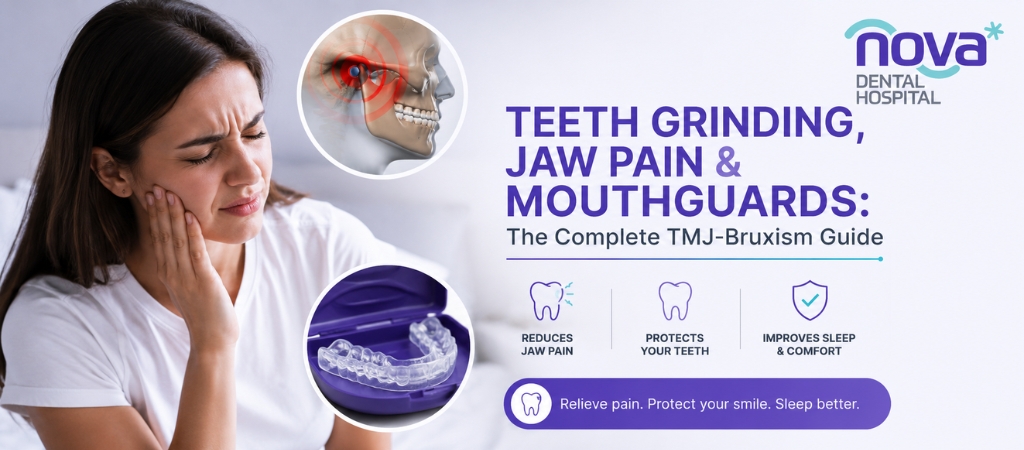
Teeth Grinding, Jaw Pain & Mouthguards: The Complete TMJ-Bruxism Guide

Quick Answer
Teeth grinding (bruxism) and jaw pain (often linked to temporomandibular joint, or TMJ, disorder) are two of the most common — and most overlooked — dental complaints among Indian adults and children. Bruxism is the habit of clenching or grinding teeth, usually during sleep, while TMJ disorder refers to pain or dysfunction in the jaw joint itself. The two frequently occur together, and in most mild-to-moderate cases, a combination of a custom-fitted mouthguard, stress management, and simple lifestyle changes brings lasting relief without surgery.
Quick Summary
- Bruxism is a habit (grinding/clenching); TMJ disorder is a joint problem — they often overlap but are not the same thing.
- Common triggers include stress, anxiety, misaligned bite, sleep disorders, and in children, growth-related changes or airway issues.
- Warning signs: morning headaches, sore jaw, worn-down teeth, clicking or locking jaw, and a partner noticing grinding sounds at night.
- Left untreated, bruxism can wear down enamel, crack teeth, and worsen jaw joint damage over years.
- Custom dentist-made night guards fit better and last longer than store-bought versions.
- Children can grind their teeth too — it is common in the primary-teeth stage and usually needs only monitoring.
- A dental evaluation helps identify the real cause instead of just managing the symptom.
Introduction
If you wake up with a sore jaw, a dull headache near your temples, or your partner has mentioned hearing you grind your teeth at night, you are far from alone. Bruxism and TMJ-related jaw pain affect people across every age group — from teenagers under exam stress to adults juggling long work hours. The challenge is that these conditions develop quietly. Enamel wears down gradually, jaw muscles tighten over months, and by the time pain becomes noticeable, some damage may already exist. This guide breaks down what is actually happening in your mouth and jaw joint, why it happens, and what realistic, non-alarming treatment looks like — including when a mouthguard is genuinely useful and when it is not enough on its own.
What Is Bruxism, and What Is TMJ Disorder?
Bruxism is the medical term for grinding, gnashing, or clenching the teeth, most often during sleep (sleep bruxism) but sometimes during the day (awake bruxism, often tied to concentration or stress). The temporomandibular joint (TMJ) is the hinge connecting your jawbone to your skull, located just in front of each ear. TMJ disorder (TMD) refers to pain, stiffness, clicking, or restricted movement in this joint or the muscles around it.
The two conditions are closely linked because repeated grinding places abnormal, sustained pressure on the jaw joint. Over time, this can inflame the joint, strain the surrounding muscles, and, in some cases, damage the cushioning disc inside the joint itself. Not everyone with bruxism develops TMJ disorder, and not everyone with TMJ pain grinds their teeth — but when both occur together, treatment usually needs to address them as a connected pair rather than in isolation.
Expert Insight
Parents often bring in a teenager thinking the jaw clicking is ‘just a habit,’ when actually the cause is a combination of exam-season clenching and a slightly uneven bite. Treating only the click and ignoring the clenching rarely gives lasting relief — the two need to be assessed together.
Common Causes and Risk Factors
Bruxism and TMJ disorder rarely have a single cause. In practice, a combination of the following factors is usually at play:
- Stress and anxiety — the single most common trigger in adults, often worse during exam periods, work deadlines, or major life changes
- Malocclusion — an uneven bite where the upper and lower teeth do not meet comfortably
- Sleep disorders — including sleep apnea, which is increasingly linked to nighttime grinding
- Missing or crooked teeth — which shift how the jaw closes and force uneven muscle strain
- Lifestyle factors — high caffeine intake, smoking, and alcohol use are associated with increased grinding frequency
- Growth-related changes in children — grinding of primary (milk) teeth is common between ages 3 and 6 and often resolves on its own
- Jaw injury or arthritis — direct trauma or joint inflammation can trigger TMJ symptoms even without any grinding habit
Recognising the Symptoms
Symptoms build gradually, which is why many people live with them for months before seeking help. Watch for:
- A dull, aching pain in front of the ear, in the jaw, or radiating to the neck and shoulders
- Morning headaches or a feeling of tight, tired jaw muscles on waking
- Clicking, popping, or grating sounds when opening or closing the mouth
- Jaw that occasionally locks, feels stuck, or has a limited range of opening
- Visibly flattened, chipped, or worn tooth edges
- Increased tooth sensitivity, especially to cold
- A partner or family member reporting grinding sounds during sleep
Bruxism vs TMJ Disorder — Quick Comparison
| Aspect | Bruxism | TMJ Disorder |
| What it is | A habit of grinding/clenching teeth | A problem in the jaw joint or surrounding muscles |
| Primary trigger | Stress, bite misalignment, sleep issues | Joint injury, arthritis, chronic muscle strain |
| Main sign | Worn or chipped teeth, jaw soreness | Clicking, locking, restricted jaw movement |
| First-line treatment | Custom night guard, stress management | Jaw exercises, splint therapy, physiotherapy |
| Can occur without the other? | Yes, without joint pain | Yes, without a grinding habit |
Diagnosis: What to Expect at a Dental Visit
A thorough evaluation typically includes a review of your symptoms and sleep patterns, a visual check for enamel wear or tooth fractures, gentle palpation of the jaw muscles and joint, and an assessment of your bite alignment. In select cases, dental X-rays or a referral for a sleep study may be recommended if sleep apnea is suspected as an underlying trigger. This assessment matters because treating jaw pain without identifying its cause often leads to temporary relief that returns within weeks.
Expert Insight
A patient who tries an over-the-counter guard from a pharmacy without a proper bite check may find it uncomfortable within days and stop wearing it altogether — which is worse than not treating it at all, since the underlying grinding continues unmanaged.
Mouthguards and Splints: What Actually Works
Mouthguards (also called night guards or occlusal splints) are the most common first-line treatment for bruxism-related jaw pain. They create a smooth barrier between the upper and lower teeth, absorbing grinding force and reducing joint strain.
| Type | Fit Quality | Typical Lifespan | Best For |
| Store-bought boil-and-bite | Generic, often bulky | 3–6 months | Very mild, occasional grinding |
| Custom dentist-fitted guard | Precise, comfortable | 2–5 years | Regular grinding, TMJ symptoms, long-term use |
| Soft night guard | Cushioned | 6–12 months | Mild clenching, children in transition stages |
| Hard acrylic splint | Rigid, most durable | 3–5 years | Moderate to severe bruxism with tooth wear |
A custom guard, made from an impression of your own teeth, distributes force evenly and is far more likely to be worn consistently — which is the single biggest factor in whether treatment succeeds.
Expert Insight
The best mouthguard is the one a patient will actually wear every night. Comfort and fit matter more than material choice, which is why a same-teeth-impression custom guard consistently outperforms generic versions in real-world use.
Beyond the Mouthguard: A Complete Treatment Approach
- Stress management — relaxation techniques, counselling, or simple awareness exercises to reduce daytime clenching
- Jaw physiotherapy — gentle stretching and muscle-relaxation exercises guided by a professional
- Bite correction — addressing an uneven bite through minor adjustments or orthodontic treatment if malocclusion is the root cause
- Lifestyle adjustments — reducing caffeine and alcohol, especially in the evening, and improving sleep hygiene
- Warm compresses — applied to the jaw to ease muscle tension during flare-ups
- Medical evaluation — for suspected sleep apnea or arthritis-related TMJ disorder, referral to the appropriate specialist
Bruxism in Children: When to Worry, When to Wait
Grinding in young children, particularly during the primary-teeth years, is common and usually not a cause for alarm — it often resolves as the permanent teeth erupt. However, parents should have a dentist check if grinding continues past age 8–10, is accompanied by jaw pain, headaches, or snoring, or shows signs of significant enamel wear. Persistent childhood grinding combined with snoring can sometimes point to airway or breathing issues that benefit from earlier evaluation.
Common Mistakes to Avoid
- Ignoring early symptoms — mild jaw soreness or occasional clicking is easiest to manage before it becomes chronic pain
- Relying only on painkillers — medication masks discomfort without addressing the underlying grinding or joint issue
- Using an ill-fitting store-bought guard long-term — poor fit can worsen bite alignment over time
- Assuming jaw clicking always needs treatment — occasional, painless clicking without other symptoms often does not require intervention
- Skipping the follow-up visit after getting a mouthguard — fit and effectiveness should be reviewed periodically
Myths vs Facts
| Myth | Fact |
| Teeth grinding only happens in stressed adults | Children commonly grind their primary teeth, often unrelated to stress |
| A mouthguard cures TMJ disorder completely | A guard manages symptoms; it works best alongside addressing the root cause |
| Jaw clicking always means a serious joint problem | Painless, occasional clicking without other symptoms is often harmless |
| Any night guard from a pharmacy works just as well as a custom one | Custom guards fit more precisely and are worn more consistently |
| TMJ disorder always requires surgery | Most cases improve with conservative treatment — surgery is a rare, last-resort option |
Questions Patients Forget to Ask
- Will my mouthguard need to be replaced or refitted as my bite changes over time?
- Could my jaw pain be linked to my sleep quality or snoring?
- Is my grinding related to a misaligned bite that orthodontic treatment could correct?
- What warning signs should prompt an earlier follow-up rather than waiting for the next check-up?
- Are there specific jaw exercises I should be doing at home between visits?
Practical Action Plan
- Note your symptoms for two weeks — jaw soreness, headache timing, and any sounds your partner reports
- Book a dental evaluation for a bite and joint assessment rather than self-diagnosing
- Ask specifically whether a custom-fitted guard is appropriate for your pattern of grinding
- Reduce evening caffeine and alcohol intake as a low-effort first step
- Schedule a follow-up review after 4–6 weeks of using a guard to check comfort and effectiveness
Nova Dental Expert Summary
Most cases of teeth grinding and jaw pain respond well to conservative, non-surgical care once the underlying cause is identified. A proper bite assessment, a well-fitted mouthguard, and attention to stress or sleep factors together address both the symptom and its source. Patients — and parents of grinding children — are best served by early evaluation rather than waiting for pain to become disruptive.
Key Takeaways
- Bruxism (grinding) and TMJ disorder (joint pain) often overlap but are distinct conditions.
- Stress, bite misalignment, and sleep issues are the most common underlying triggers.
- Morning headaches, jaw soreness, and worn teeth are early warning signs worth checking.
- Custom-fitted mouthguards outperform store-bought versions in comfort, fit, and consistency of use.
- Childhood grinding is common and usually temporary, but persistent cases deserve evaluation.
- Treatment works best when it combines a mouthguard with addressing the root cause, not the guard alone.
- Most cases are managed conservatively; surgery is rarely needed.
How Nova Dental Hospital Can Help
Nova Dental Hospital in Gandhinagar and Ahmedabad supports patients through every stage of TMJ and bruxism care — from an initial bite and joint assessment to fitting a custom-made night guard designed around your own teeth. For families, the focus includes growth monitoring in children with early grinding habits, personalised treatment planning based on the underlying cause rather than the symptom alone, and family-focused follow-up so that both parents and children understand what to watch for going forward. As a family dentist in Gandhinagar, Nova Dental Hospital also coordinates orthodontic evaluation where bite correction may reduce long-term grinding or joint strain.
Frequently Asked Questions
1. What is the main difference between bruxism and TMJ disorder?
Bruxism is the habit of grinding or clenching teeth, while TMJ disorder is pain or dysfunction in the jaw joint itself. They frequently occur together but can exist independently.
2. Can stress really cause jaw pain?
Yes. Stress is one of the most common triggers for both daytime clenching and nighttime grinding, which in turn strains the jaw joint and surrounding muscles.
3. How do I know if I need a mouthguard?
Signs like morning jaw soreness, visible tooth wear, headaches, or a partner reporting grinding sounds are reasons to have a dentist assess whether a guard is appropriate.
4. Are custom mouthguards worth the extra cost compared to store-bought ones?
For regular grinders or anyone with TMJ symptoms, yes — a custom fit improves comfort, durability, and the likelihood you will wear it consistently, which is what determines treatment success.
5. Is teeth grinding in children something to worry about?
Usually not. Grinding of primary teeth is common and often resolves on its own. It is worth a check if it continues past age 8–10 or comes with pain, snoring, or noticeable tooth wear.
6. Can TMJ disorder go away without treatment?
Mild cases sometimes improve with rest and reduced strain, but persistent clicking, pain, or locking should be evaluated, since untreated cases can worsen gradually.
7. Does jaw clicking always mean I have TMJ disorder?
Not necessarily. Painless, occasional clicking without other symptoms is common and often does not need treatment, but a dentist can confirm whether monitoring or care is needed.
8. How long does a custom night guard last?
With proper care, a custom-fitted guard typically lasts two to five years, depending on grinding intensity and how well it is maintained.
9. Can a poor bite really cause jaw pain?
Yes. An uneven bite (malocclusion) can force the jaw muscles and joint to work harder or unevenly, contributing to both grinding and TMJ symptoms over time.
10. Where can I get a bite and jaw assessment near Gandhinagar?
Nova Dental Hospital offers TMJ and bruxism evaluations at its Gandhinagar and Ahmedabad locations, including custom mouthguard fitting for adults and children.

Write a Comment
Recent Posts


