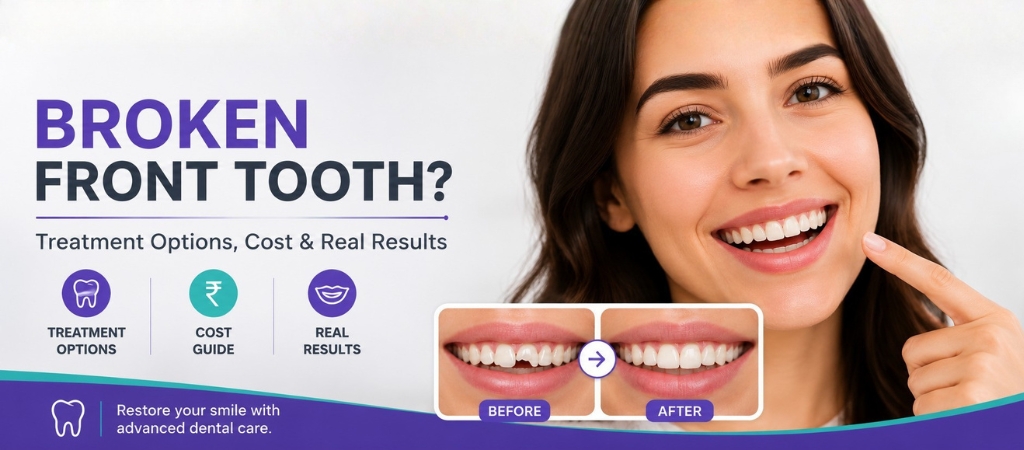
Broken Front Tooth? Treatment Options, Cost & Real Results
Broken Front Tooth? Treatment Options, Cost & Real Results

Quick Answer
Yes, most broken front teeth can be repaired. Small chips are usually fixed with composite bonding in a single visit. Larger or deeper fractures often need a veneer, crown, or root canal treatment first. See a dentist within 24 to 48 hours to protect the tooth, ease pain, and prevent infection.
Quick Summary
| Question | Answer |
| Can it be fixed? | Yes, in the vast majority of cases with bonding, a veneer, a crown, or root canal treatment plus a crown. |
| Is it an emergency? | Often yes, especially with pain, a visibly pink or bleeding centre, or a loose tooth. |
| Best treatment | Depends on how deep the fracture goes, from simple bonding to a crown or implant. |
| Recovery time | Same day for bonding; 1-2 weeks for a crown; several months for an implant. |
| Cost factors | Severity of the break, material used, lab work needed, and whether root canal treatment is required. |
| When to visit a dentist | Within 24-48 hours; immediately if you’re in severe pain or the tooth feels loose. |
A broken front tooth has a way of turning an ordinary day upside down. One moment you’re biting into an apple or heading up for a header on the football pitch, and the next you’re running your tongue over a jagged edge that wasn’t there before. It’s unsettling, and it’s also more common than most people realise. Front teeth sit at the front line of almost every fall, collision, and bite, which is exactly why dental trauma to the incisors is one of the most frequent reasons people call an emergency dentist.
What happens next matters. A tooth that’s treated promptly can often be restored to full function and a natural appearance, sometimes in a single appointment. A tooth that’s ignored, even for a few weeks, can develop complications that make treatment more complex and more expensive later on. In this guide, we’ll walk through what to do in the first hour after a break, how dentists decide between bonding, veneers, crowns, root canal treatment, and implants, what recovery looks like, and what genuinely affects the cost of treatment. The goal is simple: help you understand your options clearly enough to make a confident decision about your smile.
What Should You Do If Your Front Tooth Breaks?
The first 30 to 60 minutes after a break influence how well the tooth can be saved. Staying calm and following a few simple steps protects both the tooth and the nerve inside it.
Immediate steps:
- Rinse your mouth gently with warm water to clear away blood and debris.
- If you can find the broken piece, keep it moist in milk or saliva and bring it to your appointment.
- Apply a cold compress to your lip or cheek to reduce swelling.
- Cover any sharp edges with dental wax or sugar-free gum if it’s irritating your tongue or lip.
- Take an over-the-counter pain reliever if needed, following the packaging instructions.
What NOT to do:
- Don’t ignore a chip just because it doesn’t hurt; nerve damage isn’t always painful at first.
- Don’t try to file down a sharp edge yourself.
- Don’t use superglue or over-the-counter adhesives to reattach a fragment.
- Don’t eat on that side of your mouth until you’ve been assessed.
| Expert Insight A tooth that looks only mildly chipped can still have a hairline crack extending toward the root. We routinely see patients who waited because the tooth ‘didn’t hurt’, only to develop nerve involvement weeks later. When in doubt, get it checked. |
| Practical Action Plan ● Rinse and control bleeding with gentle pressure using clean gauze. ● Save any broken fragment in milk or saline. ● Call an emergency dentist the same day, even if pain is minimal. ● Avoid chewing on the affected tooth until it’s been examined. ● Keep the area clean with soft brushing around, not directly on, the injury. |
| Common Mistakes to Avoid ● Waiting to ‘see if it settles down’ before booking an appointment. ● Assuming a small chip is purely cosmetic and skipping an X-ray. ● Chewing ice, pens, or fingernails while waiting for treatment, risking further fracture. |
Can a Broken Front Tooth Be Fixed?
In almost every case, yes. What changes is how the tooth is fixed, and that depends on how deep the fracture runs.
- Minor fractures: small chips in the enamel, usually painless and treated with composite bonding.
- Moderate fractures: break extends into the dentin layer, often causing sensitivity to hot, cold, or air, typically needing a build-up, veneer, or crown.
- Severe fractures: the break reaches the pulp (nerve) and often causes noticeable pain or a visible pink or red centre, usually requiring root canal treatment before a crown is placed.
- Root fractures: the crack extends below the gum line into the root itself; these are the most complex cases and sometimes cannot be saved, making an implant or bridge the more predictable option.
Dentists decide on treatment based on a clinical exam, a bite test, sensitivity testing, and an X-ray to check the root and surrounding bone. The overall aim is always to preserve as much of your natural tooth structure as safely possible.
| Myth | Fact |
|---|---|
| A chipped front tooth will fix itself over time. | False. Tooth enamel cannot regenerate. Even a small chip can worsen over time due to everyday biting and chewing forces if left untreated. |
| If a broken front tooth doesn’t hurt, it’s not serious. | False. Some fractures may not cause immediate pain. Hidden nerve damage or internal cracks can develop into infection if left untreated. |
| A broken front tooth always needs a dental crown. | False. Many minor to moderate fractures can be successfully restored with composite bonding or a direct composite build-up, preserving more of the natural tooth structure. |
How Serious Is a Broken Front Tooth?
Severity depends on how much tooth structure is lost and whether the nerve is exposed. Watch for these signs:
- Sharp pain when biting down or when the tooth is exposed to air
- Lingering sensitivity to hot or cold that doesn’t fade within a few seconds
- A visible pink or reddish tinge at the centre of the fracture, which can indicate nerve exposure
- Swelling of the gum or face near the injured tooth
- A tooth that feels loose or has shifted position
- Persistent bleeding from the gum around the tooth
Any of these signs point toward an emergency situation. Complications to watch for over the following days include worsening pain, a dental abscess, or discolouration of the tooth, which can signal that the nerve is dying.
| Expert Insight The colour and location of the fracture line tell us a lot before we even pick up a probe. A clean horizontal chip near the biting edge is usually straightforward. A diagonal crack running toward the gum line needs far closer attention, since it can affect the tooth’s long-term prognosis. |
What Happens If You Leave a Broken Front Tooth Untreated?
Delaying treatment rarely makes things easier, and it often makes them worse. Here’s what can develop over time:
- Pain: exposed dentin or nerve tissue becomes increasingly sensitive and can develop into constant, throbbing pain.
- Infection: bacteria can enter through the crack and reach the pulp, leading to an abscess.
- Sensitivity: everyday triggers like cold drinks or brushing become uncomfortable.
- Nerve damage: an untreated crack can kill the nerve, sometimes without obvious warning until infection develops.
- Bone loss: a long-standing infection at the root tip can erode the surrounding jawbone.
- Tooth loss: in advanced cases, the tooth may become unsalvageable and require extraction.
Common Mistakes to Avoid ● Covering a sharp edge with wax indefinitely instead of seeking treatment. ● Assuming painkillers are a substitute for a dental exam. ● Waiting for a ‘convenient time’ when infection risk increases with every week of delay. |
What Causes a Front Tooth to Break?
Front teeth are thinner and more exposed than back teeth, which makes them especially vulnerable. Common causes include:
- Sports injuries, particularly contact sports played without a mouthguard
- Falls, especially in young children and older adults
- Road traffic accidents
- Teeth grinding or clenching (bruxism), which weakens enamel over time
- Biting hard foods like ice, nuts, or hard sweets
- Naturally weak or thin enamel
- Old, large fillings that no longer support the remaining tooth structure
Broken Front Tooth Treatment Options
Nova Dental Hospital’s approach is to preserve your natural tooth wherever it’s clinically sound to do so, then rebuild function and appearance using the most conservative option that will genuinely last. Here’s how each treatment works.
Composite Bonding
Who it’s for: small to moderate chips where enough healthy tooth structure remains.
Procedure: a tooth-coloured resin is sculpted onto the tooth in layers, shaped to match your bite, and hardened with a curing light.
Benefits: minimal to no enamel removal, completed in a single visit, and cost-effective compared to lab-made restorations.
Limitations: less durable than a crown or veneer, and can stain over time with coffee, tea, or tobacco.
Recovery: none required; you can eat normally once the anaesthetic, if used, has worn off.
Longevity: typically 4 to 8 years with good oral hygiene, longer with careful bite habits.
Dental Veneers
Who it’s for: chipped teeth where appearance is a priority, or when several front teeth need a uniform, refreshed look.
Procedure: a thin layer of enamel is prepared, an impression or digital scan is taken, and a custom porcelain or composite shell is bonded to the front surface.
Benefits: highly natural, stain-resistant (porcelain), and can improve shape, shade, and symmetry at the same time.
Limitations: requires removing a small amount of enamel, which is generally irreversible.
Recovery: minimal; mild sensitivity for a few days is normal.
Longevity: porcelain veneers commonly last 10 to 15 years with proper care.
Dental Crowns
Who it’s for: teeth with significant structural loss, or after root canal treatment, where the remaining tooth needs full coverage and support.
Procedure: the tooth is reshaped, scanned or impressed, and a custom cap is fitted over the entire visible portion of the tooth.
Benefits: restores strength as well as appearance, protecting a weakened tooth from further fracture.
Limitations: requires more tooth reduction than bonding or veneers.
Recovery: a temporary crown is worn for 1-2 weeks while the permanent one is made.
Longevity: typically 10 to 15 years, often longer.
Root Canal Treatment
Who it’s for: fractures deep enough to expose or damage the nerve, or teeth that have become infected after a break.
Procedure: the damaged nerve tissue is removed, the canal is cleaned and sealed, and the tooth is typically restored with a crown afterward for long-term strength.
Benefits: relieves pain caused by nerve damage and allows the natural tooth to be kept rather than extracted.
Limitations: the tooth can become more brittle over time and will usually need a protective crown.
Recovery: mild soreness for a few days; most people return to normal activity immediately.
Longevity: root-treated teeth commonly last decades when restored and maintained properly.
Dental Implant
Who it’s for: teeth broken below the gum line, root fractures, or cases where the natural tooth cannot be saved.
Procedure: a titanium post is placed into the jawbone to replace the tooth root, and a custom crown is attached once the implant has integrated with the bone.
Benefits: functions and looks like a natural tooth, and doesn’t rely on neighbouring teeth for support.
Limitations: requires adequate bone volume, involves a healing period, and is a more involved procedure than bonding or a crown.
Recovery: initial healing takes 1-2 weeks; full bone integration takes 3 to 6 months before the final crown is fitted.
Longevity: implants can last 20+ years, often a lifetime, with good oral hygiene.
| Expert Recommendation Whenever it’s clinically appropriate, we try to preserve the natural tooth before considering extraction or an implant. A tooth with an intact root, even after root canal treatment, generally offers better long-term bone health and a more predictable result than replacing it. Extraction and implants are excellent solutions when the tooth truly can’t be saved, but they’re a second line of treatment, not a first choice. |
Which Treatment Is Best for Your Broken Front Tooth?
Every case is different, but this comparison gives a general sense of how the main options stack up against one another.
| Treatment | Ideal Case | Procedure Time | Appearance | Durability | Maintenance | Relative Cost |
| Composite Bonding | Small chips, minor fractures | 30-60 min, 1 visit | Very good, can stain over time | Moderate (4-8 yrs) | Avoid staining foods, gentle brushing | Lower |
| Veneers | Cosmetic chips, shape/shade concerns | 2 visits over 1-2 weeks | Excellent, stain-resistant (porcelain) | High (10-15 yrs) | Routine hygiene, avoid biting hard objects | Moderate-High |
| Crowns | Larger structural loss | 2 visits over 1-2 weeks | Very good | High (10-15+ yrs) | Routine hygiene, night guard if grinding | Moderate-High |
| Root Canal + Crown | Nerve exposure or infection | 1-3 visits | Very good after crown | High (decades) | Regular checkups to monitor tooth | Moderate-High |
| Implant | Tooth cannot be saved, root fracture | Several months (staged) | Excellent, natural look | Very High (20+ yrs) | Routine hygiene, regular reviews | Higher |
How Much Does Broken Front Tooth Treatment Cost?
The exact fee depends on your individual case, so we don’t quote a fixed price without an examination. What we can explain are the factors that genuinely influence cost:
- Severity of the fracture, and how many teeth are involved
- Materials used, such as composite resin versus porcelain
- Diagnostic technology needed, including digital X-rays or 3D imaging
- Additional procedures required, such as root canal treatment before a crown
- The complexity of the case and the level of expertise required to achieve a natural, long-lasting result
| Expert Tip Choosing a treatment based on price alone can end up costing more in the long run. A restoration that’s rushed or under-engineered for the bite forces on a front tooth tends to fail earlier, meaning you pay for the same treatment twice. A proper clinical assessment helps you choose the option that’s genuinely cost-effective over its full lifespan, not just at the checkout. |
Clinical Insight: A Real Patient Outcome
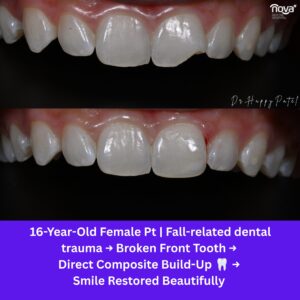
A 16-year-old female patient visited Nova Dental Hospital after experiencing fall-related dental trauma, which resulted in a fracture of the upper front tooth. Following a comprehensive clinical examination, the tooth was found to be suitable for direct composite build-up, allowing the natural tooth structure to be preserved without the need for more extensive treatment. The restoration was carefully shaped and color-matched to blend seamlessly with the adjacent teeth, restoring both aesthetics and function. The patient was advised on post-treatment care and maintaining good oral hygiene to support long-term results. The before-and-after images below demonstrate how conservative restorative dentistry can effectively repair a broken front tooth while preserving a natural-looking smile.
How Long Does Recovery Take?
Composite bonding: no downtime; you can eat and drink normally once any numbness fades.
Crowns: mild sensitivity around the temporary crown for 1-2 weeks; avoid sticky or very hard foods until the permanent crown is fitted.
Root canal treatment: some tenderness for a few days; most patients return to normal eating within 48 hours.
Implants: initial healing of 1-2 weeks, followed by a longer integration period of 3 to 6 months before the final crown is placed.
Practical Recovery Tips ● Stick to softer foods for the first day or two after any restorative work. ● Brush gently around the treated tooth, and floss carefully to avoid dislodging new restorations. ● Avoid biting directly on the treated tooth with hard foods like nuts or ice. ● Attend follow-up appointments so your dentist can check the fit and function of the restoration. ● Report any new pain, swelling, or looseness promptly rather than waiting for your next visit. |
How Can You Prevent a Broken Front Tooth?
Not every break can be avoided, but several habits meaningfully lower your risk:
- Wear a properly fitted sports mouthguard for contact sports and high-impact activities
- Use a night guard if you grind or clench your teeth while sleeping
- Avoid chewing ice, hard sweets, pens, or fingernails
- Attend regular dental checkups so small issues, like old fillings or enamel wear, are caught early
- Maintain good oral hygiene to keep enamel and gums strong
Practical Action Plan ● Book a mouthguard fitting before the start of a sports season. ● Ask your dentist about a night guard if you wake up with jaw soreness. ● Schedule a six-monthly checkup and stick to it. ● Swap hard-food habits like ice-chewing for safer alternatives. |
Why Choose Nova Dental Hospital?
A broken front tooth affects both function and confidence, so the treatment you choose deserves careful clinical judgement, not guesswork. At Nova Dental Hospital, our approach centres on:
- Experienced dentists skilled in restorative and cosmetic dental trauma cases
- Modern diagnostic technology, including digital X-rays, to accurately assess fracture depth
- Digital diagnosis and treatment planning for predictable, precise outcomes
- A conservative philosophy that preserves natural tooth structure whenever it’s safe to do so
- Natural-looking restorations matched carefully to your surrounding teeth
- Personalised treatment plans based on your specific fracture, bite, and goals
- Patient-centred care, with clear explanations at every step so you understand your options
Key Takeaways
- Most broken front teeth can be saved and restored to full function and appearance.
- Early diagnosis prevents complications like infection, nerve damage, and bone loss.
- Preserving your natural tooth is always the first goal before considering extraction or an implant.
- The right treatment depends on how deep the fracture runs, not on personal preference alone.
- A professional examination, including an X-ray, is essential before any treatment decision is made.
FAQs
Can a broken front tooth heal on its own?
No. Enamel and dentin cannot regenerate, so a broken tooth needs professional treatment to restore its shape, strength, and protection against infection.
Is a broken front tooth always a dental emergency?
Not always, but it should always be assessed promptly. It becomes an urgent emergency if there’s severe pain, a visible pink or bleeding centre, or looseness in the tooth.
How much does it cost to fix a broken front tooth?
Cost depends on the severity of the break and the treatment required, ranging from composite bonding to a crown, root canal treatment, or implant. A clinical exam is needed for an accurate estimate.
How long does composite bonding last on a front tooth?
Composite bonding typically lasts 4 to 8 years with good oral hygiene and by avoiding habits like nail-biting or chewing ice.
Will I need a root canal for a broken front tooth?
Only if the fracture has reached the nerve, causing exposure, infection, or persistent pain. Many chips and moderate fractures don’t require it.
Can a badly broken front tooth be saved, or does it need extraction?
Many severely fractured teeth can still be saved with root canal treatment and a crown. Extraction is generally reserved for fractures extending well below the gum line into the root.
What’s the fastest way to fix a broken front tooth before an event?
Composite bonding is usually the quickest option, often completed in a single same-day visit, provided the fracture is minor to moderate.
Does insurance cover broken front tooth treatment?
Coverage varies by provider and plan. Many insurers cover treatment for accidental dental trauma, so it’s worth checking your policy or asking our team to help clarify.
How can I tell if my broken tooth has damaged the nerve?
Signs include lingering sensitivity to hot or cold, a pink or red tint at the fracture site, throbbing pain, or swelling. A dentist can confirm nerve involvement with sensitivity testing and an X-ray.
Can veneers fix a chipped front tooth permanently?
Veneers aren’t permanent, but they are long-lasting, typically 10 to 15 years, and can be replaced when needed without affecting the health of the underlying tooth.

Related posts

Write a Comment
Recent Posts
Content Review 773-345742-4d1daa0c25b7