


Dental Crowns vs. Onlays: Your Definitive Guide to Restoring a Healthy Smile
Dental Crowns vs. Onlays: Your Definitive Guide to Restoring a Healthy Smile

Have you ever experienced a chipped tooth, a severe crack, or a large, painful cavity that feels too big for a simple filling? When a tooth is compromised by extensive decay or physical damage, a basic dental filling may not be enough to restore its strength and function. This is a common situation where your dentist will recommend a more advanced solution. Fortunately, modern dentistry offers two highly effective and durable restorative options: dental crowns and dental onlays.
While both dental crowns and dental onlays are designed to repair and protect a damaged tooth, they serve different purposes and are used in different scenarios. Understanding the fundamental differences between these two treatments is the first step toward making an informed decision about your oral health. This comprehensive guide will walk you through everything you need to know about dental crowns vs. dental onlays, including how they differ, the pros and cons of each, and how our expert team at Nova Dental Hospital in Gandhinagar helps you choose the best solution for your smile.
Understanding What a Dental Crown Is
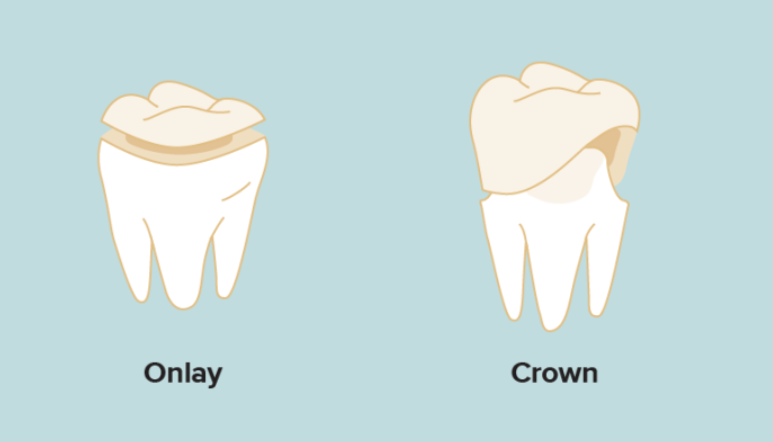
A dental crown is one of the most common and versatile restorative treatments in dentistry. In simple terms, a dental crown is a custom-made cap that is placed over a tooth, completely encasing it from the gum line up. It acts as a protective shield, restoring the tooth’s shape, size, strength, and appearance. Think of it as a helmet for your tooth—it provides full-coverage protection against further damage.
A dental crown is typically needed in specific situations where a tooth’s structural integrity has been severely compromised. You may need a dental crown to:
- Protect a weak or fractured tooth: A tooth with a large crack or fracture is at risk of breaking apart. A dental crown holds the tooth together, preventing it from further damage.
- Restore a severely worn-down tooth: Over time, teeth can wear down from grinding, clenching, or age. A dental crown can restore the tooth to its proper shape and size, improving both function and aesthetics.
- Cover and support a tooth with a large filling: When a cavity is so extensive that it requires a filling that takes up more than half of the tooth’s surface, the remaining natural structure can be weakened. A dental crown provides the necessary support to prevent the tooth from fracturing.
- Complete a root canal procedure: After a root canal, the tooth’s internal structure is cleaned out, which can leave it brittle. A dental crown is a vital final step to seal and protect the treated tooth, ensuring its long-term health and functionality.
Dental crowns are made from various materials, each with its own advantages. Porcelain and ceramic crowns are popular for their natural, tooth-colored appearance, making them ideal for front teeth. Zirconia is a newer material that offers exceptional strength and durability, perfect for molars. Gold and metal alloys are also used for their superior strength and longevity.
Understanding What a Dental Onlay Is
If a dental crown is a full-coverage helmet, a dental onlay is a precise, custom-fitted cap that covers only the damaged portions of a tooth. It is often referred to as a “partial crown” because it restores the tooth’s chewing surfaces, specifically one or more cusps (the raised points on the tooth). Unlike a traditional filling, an onlay is a solid, fabricated piece that is bonded to the tooth. This makes it a highly durable and long-lasting alternative to a filling, especially for larger areas of decay.
A dental onlay is the ideal choice for a more conservative restoration. Our dentists will recommend a dental onlay when:
- Decay is too extensive for a filling but not severe enough for a crown: An onlay bridges the gap between a filling and a full crown, providing more strength than a filling while preserving more natural tooth structure than a crown.
- A large portion of the tooth’s chewing surface needs to be restored: If a significant part of the tooth’s surface is damaged but the surrounding walls are healthy, an onlay can effectively restore the function without unnecessary tooth reduction.
- The patient wants to preserve as much natural tooth structure as possible: This is a key benefit of an onlay. By only restoring the damaged portion, the dentist maintains the integrity of the original tooth, which is always the best long-term outcome.
Like crowns, dental onlays are typically crafted from durable materials like porcelain, composite resin, or gold. Modern porcelain onlays are particularly popular because they can be precisely color-matched to your natural teeth, providing an aesthetically pleasing and seamless result.
A Head-to-Head Comparison: Dental Crowns vs. Dental Onlays
Deciding between a dental crown and a dental onlay can seem complex, but the choice is usually determined by the extent and location of the tooth’s damage. Let’s compare these two restorative solutions on a few key factors to help clarify their differences.
Procedural Differences
The preparation process is a major distinction. For a dental crown, the dentist must shave down the tooth on all sides and the top to create a stable base for the cap to fit over. This is a more invasive procedure that permanently alters a significant amount of the tooth’s natural structure.
For a dental onlay, the process is more conservative. The dentist only removes the decayed or damaged portion of the tooth. The remaining healthy structure is left intact, and the onlay is crafted to fit perfectly into the prepared area. This preserves more of your natural tooth, which is a major advantage.
Cost Comparison
The cost of a restorative procedure can vary, but generally, a dental onlay is more affordable than a dental crown. The price of a dental crown vs. dental onlay is influenced by several factors: the material used (porcelain and zirconia are more expensive than gold or metal), the location of the tooth, and the complexity of the restoration. Since an onlay requires less material and less extensive tooth preparation, it often results in a lower overall cost.
Durability and Longevity
Both dental crowns and dental onlays are designed to be long-lasting restorations, typically lasting between 5 to 15 years, and often much longer with proper care. The durability depends on the material, the quality of the cement used, and most importantly, your oral hygiene habits. Habits like grinding your teeth (bruxism), biting on hard objects, or a diet high in sugar can all shorten the lifespan of your restoration. While dental onlays are highly durable, a full-coverage dental crown may offer slightly better protection for a tooth that is already severely compromised or has had a root canal.
Aesthetic Results
Modern dentistry excels at creating restorations that look completely natural. Both dental onlays and dental crowns made from porcelain or ceramic can be custom-matched to the exact shade of your surrounding teeth, making them virtually indistinguishable from your natural smile. The aesthetic outcome often depends on the individual case and the dentist’s expertise in cosmetic dentistry.
Ideal Use Cases (Summary Table)
This table provides a quick reference for the key differences between a dental crown and a dental onlay.
| Feature | Dental Crown | Dental Onlay |
| Coverage | Full (entire tooth) | Partial (one or more cusps) |
| Preservation | Less natural tooth preserved | More natural tooth preserved |
| Ideal For | Extensive decay, post-root canal, severely fractured tooth | Moderate decay, damaged cusps, when a filling isn’t enough |
| Procedure | More invasive | More conservative |
| Cost | Generally more expensive | Generally less expensive |
The Nova Dental Approach: How We Help You Decide
We understand that the decision between a dental crown and a dental onlay can feel overwhelming. That’s why at Nova Dental Hospital in Gandhinagar, we believe in a transparent, patient-centric approach. Your dental health is a partnership, and our goal is to empower you with all the information you need to make the right choice.
Led by our skilled dentists, our team begins with a thorough and precise examination. We use advanced diagnostic tools, including digital X-rays and intraoral scanners, to get a detailed, 3D view of your tooth. This allows us to accurately assess the extent of the damage and determine the most appropriate course of action. We will present you with all your options, clearly explaining the benefits and drawbacks of both a dental crown and a dental onlay for your specific situation. Our recommendation will always prioritize the most effective and conservative treatment to protect your smile.
Aftercare and Maintenance for Long-Lasting Results
Once your dental crown or dental onlay is in place, proper aftercare is essential for its longevity. Both restorations are highly durable, but they still require the same care as your natural teeth.
- Practice Excellent Oral Hygiene: Brush at least twice a day and floss daily to prevent plaque buildup around the restoration and the gum line.
- Avoid Damaging Habits: Refrain from chewing on hard objects like ice or hard candies, as this can chip or crack your restoration. If you grind your teeth at night, a custom-fitted mouthguard can help protect your investment.
- Schedule Regular Check-ups: Regular visits to our dental clinic in Gandhinagar are crucial. During these appointments, we can check the condition of your dental crown or dental onlay and ensure your overall oral health is on track.
Frequently Asked Questions (FAQ) – Dental Crowns vs. Onlays
Q1: Are dental crowns and onlays painful to get?
- Absolutely not. The procedure for both a dental crown and a dental onlay is designed to be as comfortable as possible. We use advanced local anesthesia to numb the area, ensuring you feel no pain during the treatment. Many patients are surprised by how comfortable the experience is.
Q2: How long do the procedures take?
- The standard process for both a dental crown and a dental onlay typically requires two visits. The first visit involves preparing the tooth and taking an impression, while the second is for the final placement of the permanent restoration. We value your time and work efficiently to get you in and out quickly, without compromising on quality.
Q3: Will my insurance cover a dental crown or onlay?
- Most dental insurance plans provide coverage for restorative procedures like dental crowns and onlays, as they are considered essential for maintaining oral health. The percentage of coverage can vary, so we recommend you check with your provider. Our team can also help you understand your benefits and financing options.
Q4: How do I know if I need a filling, onlay, or a crown?
- The only way to know for sure is through a professional examination. If you are experiencing tooth pain, sensitivity, or have visible damage, it is crucial to book a consultation. Our experienced dentists at Nova Dental Hospital will use advanced diagnostic tools to assess the extent of the damage and recommend the most appropriate solution, whether it’s a simple filling, a conservative dental onlay, or a durable dental crown.
Q5: Where can I get a dental crown or onlay in Gandhinagar?
- Nova Dental Hospital is a leading dental clinic located in Gandhinagar, specializing in high-quality restorative dentistry. We are conveniently situated to serve patients from the surrounding areas, including those searching for a dentist near PDPU or a dental clinic near GIFT City.
Conclusion: Your Path to a Restored Smile
The choice between a dental crown and a dental onlay is a crucial one for restoring the health and beauty of a damaged tooth. While a dental crown provides full protection for a severely compromised tooth, a dental onlay offers a conservative solution that preserves more of your natural tooth structure.
No matter which treatment is right for you, rest assured that our expert team at Nova Dental Hospital in Gandhinagar is committed to providing world-class, painless care. We use modern technology and a patient-first approach to ensure a stress-free and positive experience.
Book your appointment today and let us help you restore your smile with confidence!

Related posts
Write a Comment
Recent Posts


