


Dental Implants for a Single Missing Tooth: Is It Really Better Than a Bridge?
Dental Implants for a Single Missing Tooth: Is It Really Better Than a Bridge?

Losing a single tooth can feel like a minor inconvenience — but it rarely stays minor for long. Whether it happened due to decay, injury, or an extraction, that one gap in your smile can quietly trigger a chain of dental complications you may not notice until months or years later.
The good news? Replacing a missing tooth today is more effective, natural-looking, and accessible than ever before. Two options dominate the conversation: dental implants and dental bridges. Both can restore your smile, but they work very differently — and the right choice depends on your oral health, budget, and long-term goals.
Whether you are in Gandhinagar, Ahmedabad, or anywhere in Gujarat, this guide breaks down everything you need to know — including realistic costs in INR — so you can walk into your dentist’s appointment fully informed.
Quick Answer: For a single missing tooth, a dental implant is generally the preferred long-term solution because it preserves jawbone, protects adjacent healthy teeth, and offers a natural look and feel. A dental bridge can be a faster and more affordable alternative, but it does not prevent bone loss and may require replacement over time. The best option depends on your oral health, budget, and treatment goals.
Why Replacing a Missing Tooth Matters More Than You Think
Many patients choose to “wait and see” after losing a tooth, especially when the gap is not visible. This is one of the most common — and costly — dental mistakes.
Here is what happens when a missing tooth is left untreated:
- Neighbouring teeth gradually shift toward the empty space, misaligning your bite
- The opposing tooth may over-erupt, moving out of its socket over time
- Jawbone loss begins within months — there is no tooth root to stimulate the bone
- Chewing becomes less efficient, placing extra strain on remaining teeth
- Speech can be affected, especially for front tooth gaps
- Risk of gum disease and further tooth loss increases significantly
The longer you wait, the more complex and expensive your treatment options become. Bone loss in particular can eliminate the implant option unless a bone graft is performed first.
What Is a Dental Implant?
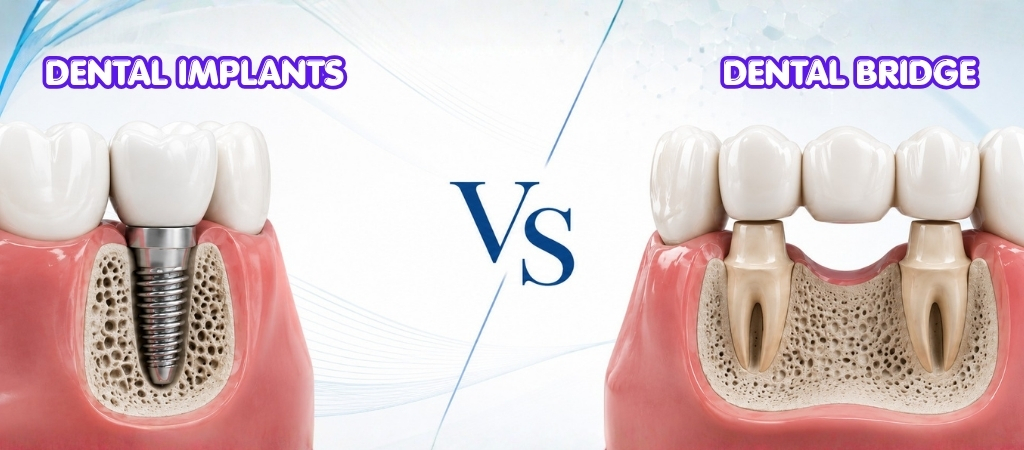
A dental implant is a small titanium post surgically placed into the jawbone to replace a missing tooth root. Once it fuses with the bone — a process called osseointegration — a custom-made crown is placed on top, creating a restoration that looks, feels, and functions like a natural tooth.
How the Procedure Works
- Consultation, digital X-rays, and 3D bone assessment (CBCT scan)
- Surgical placement of the titanium implant into the jawbone
- Healing period of 3–6 months for osseointegration
- Placement of abutment and final crown
Advantages of Dental Implants
- Stimulates jawbone and prevents bone loss
- Does not involve or damage adjacent healthy teeth
- Can last a lifetime with proper care
- Looks, feels, and functions like a natural tooth
- Easy to maintain — brush and floss normally
Limitations of Dental Implants
- Requires adequate bone density — bone grafting may be needed if bone loss has occurred
- Involves a surgical procedure under local anaesthesia
- Higher upfront cost compared to bridges
- Longer treatment timeline of 3–6 months
- Requires medical fitness evaluation — not always suitable for uncontrolled diabetics or heavy smokers
What Is a Dental Bridge?
A dental bridge is a fixed prosthetic device that bridges the gap left by a missing tooth. A traditional three-unit bridge uses crowns placed on the two adjacent teeth (abutments), with a false tooth (pontic) suspended between them.
Types of Dental Bridges
- Traditional Bridge: Most common — crowns on both adjacent teeth supporting the pontic
- Cantilever Bridge: Uses only one adjacent tooth as support (less common)
- Maryland (Resin-Bonded) Bridge: Bonded to backs of adjacent teeth — minimal tooth preparation required
Advantages of Dental Bridges
- No surgery involved — faster and less invasive
- Lower initial cost than implants
- Treatment completed in 2–3 weeks
- Suitable for patients with insufficient bone density
- Well-established, reliable restorative option
Limitations of Dental Bridges
- Requires permanently grinding down two healthy adjacent teeth
- Does not prevent jawbone loss beneath the missing tooth
- Harder to clean — requires special floss threaders
- May need replacement after 10–15 years
- Risk of decay under the crowns if hygiene is neglected
Dental Implant vs Dental Bridge: Side-by-Side Comparison
| Factor | Dental Implant | Dental Bridge |
| Purpose | Replaces the missing tooth root and crown | Replaces the missing tooth crown by utilizing adjacent teeth as supports |
| Cost (India) | ₹25,000–₹70,000+ per implant (excluding grafting if required) | ₹8,000–₹45,000+ depending on material and number of units |
| Cost in Gandhinagar / Ahmedabad | ₹25,000–₹60,000+ | ₹8,000–₹30,000+ |
| Treatment Duration | Usually 3–6 months (may be immediate in selected cases) | Usually 1–3 weeks |
| Surgical Procedure | Required | Not required |
| Effect on Adjacent Teeth | No preparation of neighboring teeth required. Healthy natural teeth remain untouched. | Usually requires significant reduction (cutting) of adjacent teeth to support the bridge, even when those teeth are healthy and free from decay. |
| Conservative Approach | Most conservative fixed option for replacing a single missing tooth because it preserves adjacent healthy teeth. | Less conservative, as healthy tooth structure is often sacrificed to support the bridge. |
| Jaw Bone Preservation | Helps maintain bone volume by transmitting chewing forces to the jawbone. | Does not prevent bone resorption at the missing tooth site. |
| Bone Loss at Missing Tooth Site | Significantly reduced compared to untreated missing teeth. | Bone shrinkage beneath the bridge pontic continues over time. |
| Oral Hygiene Maintenance | Similar to natural teeth; regular brushing, flossing, and professional maintenance required. | Requires additional cleaning aids such as floss threaders or interdental brushes beneath the pontic. |
| Longevity | High long-term success rate; often 15–25+ years with proper maintenance. | Typically 8–15 years, depending on supporting teeth, materials, and oral hygiene. |
Quick Summary: Dental Implant vs Dental Bridge
| Feature | Dental Implant | Dental Bridge |
|---|---|---|
| Preserves Healthy Teeth | ✅ Yes | ❌ No (usually requires cutting adjacent teeth) |
| Preserves Jaw Bone | ✅ Yes | ❌ No |
| Surgery Required | ✅ Yes | ❌ No |
| Faster Treatment | ❌ No | ✅ Yes |
| Long-Term Conservative Solution | ✅ Yes | ❌ Less Conservative |
| Lower Initial Cost | ❌ No | ✅ Yes |
7 Reasons Many Dentists Prefer Implants for a Single Missing Tooth
1. Implants Preserve Your Jawbone
When a tooth root is lost, the jawbone beneath it begins to resorb (shrink). A dental implant mimics the root and provides stimulation needed to maintain bone volume. A bridge offers no such benefit — bone loss continues silently beneath the pontic.
2. No Damage to Healthy Adjacent Teeth
To place a traditional bridge, two perfectly healthy teeth on either side of the gap must be permanently reduced in size. An implant stands completely alone — your healthy teeth remain untouched.
3. Superior Natural Appearance
Implant-supported crowns are fabricated to precisely match the shape, colour, and translucency of your natural teeth. Because they emerge from the gumline like real teeth, they tend to look more natural than bridges — especially for front teeth.
4. Longer Lifespan and Better Long-Term Value
A well-maintained dental implant can last 20–30 years or even a lifetime. A bridge typically requires replacement after 10–15 years. When long-term replacement costs are factored in, implants often become the more economical choice.
5. Normal Oral Hygiene Routine
Implants are cleaned like natural teeth — regular brushing and flossing. Bridges require special cleaning tools beneath the pontic, and neglecting this can lead to decay in the supporting teeth.
6. Restored Chewing Efficiency
Because an implant is anchored directly in the bone, it restores close to 100% of natural bite force — no dietary restrictions, no discomfort.
7. Reduces Risk of Future Dental Problems
By preventing bone loss and protecting adjacent teeth, an implant reduces the risk of future tooth loss, bite issues, and gum disease — making it a genuinely preventive investment, not just a cosmetic fix.
When a Dental Bridge May Be the Better Choice
Dental implants are not always the right answer. A bridge may be more appropriate in these situations:
- Budget constraints: If the upfront cost of an implant is not feasible, a bridge is a clinically sound alternative
- Faster timeline needed: A bridge can be completed in 2–3 weeks — ideal before an important event
- Insufficient bone volume: Patients with significant bone loss may need bone grafting before an implant — a bridge avoids this step
- Medical contraindications: Uncontrolled diabetes, blood thinners, or active cancer treatment may affect implant candidacy
- Adjacent teeth already need crowns: If neighbouring teeth have decay or old fillings requiring crowns, a bridge can serve dual purpose
Dental Implant vs Bridge Cost in Gandhinagar and Ahmedabad
Cost is a primary concern for most patients. Here is a realistic breakdown for the Gujarat region:
Dental Implant Cost
- Titanium implant + crown in Gandhinagar / Ahmedabad: ₹25,000–₹55,000 per tooth
- Premium implant brands (Straumann, Nobel Biocare): ₹50,000–₹80,000+
- Bone grafting (if required): ₹10,000–₹25,000 additional
- Across India (metro cities like Mumbai, Delhi): ₹40,000–₹80,000+
Dental Bridge Cost
- Traditional PFM bridge (3-unit) in Gandhinagar / Ahmedabad: ₹8,000–₹18,000
- All-ceramic or zirconia bridge: ₹18,000–₹30,000+
- Maryland bridge: ₹6,000–₹12,000
Long-Term Cost Perspective
A ₹35,000 implant that lasts 25+ years may ultimately cost far less than a ₹12,000 bridge replaced every 12–15 years — especially when you factor in maintenance and dental work on the crowned adjacent teeth. Always discuss the total lifetime cost with your dentist, not just the initial price.
Prices vary by city, clinic, dentist’s experience, implant brand, and whether additional procedures like bone grafting are required. At Nova Dental Hospital in Gandhinagar, transparent pricing and flexible installment options are available.
Real Patient Scenarios
Scenario 1: Priya, 34 — IT Professional, GIFT City, Gandhinagar
Priya lost a lower molar due to an infection. A CBCT scan confirmed adequate bone density. Despite the higher cost, she chose a dental implant to avoid compromising her healthy adjacent teeth. Three years later, she reports zero maintenance issues and says the implant feels completely natural.
Scenario 2: Mahesh, 52 — Teacher, Ahmedabad
Mahesh lost a premolar after an extraction. X-rays showed mild bone loss and his budget was limited. His dentist recommended a zirconia bridge at ₹22,000. The procedure was completed in two appointments over two weeks. He was advised to maintain hygiene carefully and reassess in 10–12 years.
Scenario 3: Nisha, 45 — Business Owner, Gandhinagar
Nisha had a front tooth missing after an accident. Appearance was her top priority. Minor bone grafting was required, adding ₹14,000 to the total cost. She opted for an implant anyway — the final crown was indistinguishable from her natural teeth and she has not looked back since.
Getting Dental Implant or Bridge Treatment at Nova Dental Hospital, Gandhinagar
If you are based in Gandhinagar, Kudasan, GIFT City, or nearby areas of Ahmedabad, Nova Dental Hospital is a trusted choice for both dental implant and dental bridge treatment.
| Nova Dental Hospital — Clinic at a Glance | |
| Clinic | Nova Dental Hospital |
| Location | 308-309, Radhe Times Square, Near Hotel Management Institute, PDPU–Kamalam Road, Kudasan, Gandhinagar – 382421 |
| Doctor | Dr. Happy Patel (BDS) — 10+ Years Clinical Experience |
| Timing | Mon–Sat: 9 AM – 9 PM | Sun: 9:30 AM – 1:30 PM |
| Contact | +91 9638 111 082 | novadentalindia@gmail.com |
Why Patients in Gandhinagar and Ahmedabad Choose Nova Dental Hospital
- In-house Advanced CBCT 3D imaging for precise implant planning and bone assessment before surgery
- Led by Dr. Happy Patel (BDS) — 10+ years of clinical experience in implants, crowns, and restorative dentistry
- Both dental implants and all types of dental bridges available under one roof
- Transparent cost consultation — no hidden charges, flexible installment options available
- Strict sterilization and infection control protocols
- Conveniently located near PDPU campus — easily accessible from GIFT City and central Gandhinagar
- NRI-friendly dental care with international standards of treatment
Book a consultation at Nova Dental Hospital: Call +91 9638 111 082
Expert Recommendation: Which Should You Choose?
If you are in good general health, have adequate bone density, and can manage the cost and timeline — a dental implant is generally the superior long-term choice for replacing a single missing tooth. It protects adjacent teeth, prevents bone loss, and can last a lifetime.
However, a dental bridge remains a clinically proven, reliable option and an excellent choice when implants are not suitable or accessible. Neither option should be dismissed — they solve the problem differently.
The most important step? Do not delay tooth replacement. Every month the gap remains, your bone and neighbouring teeth are at increased risk.
Always consult a qualified dentist or prosthodontist who can evaluate your X-rays, bone condition, overall health, and goals before recommending the right treatment.
Key Takeaways
- One missing tooth should never be ignored — bone loss and shifting begin within months
- Dental implants preserve jawbone, protect adjacent teeth, and can last a lifetime
- Dental bridges are faster, less invasive, and more affordable upfront
- Implant cost in Gandhinagar / Ahmedabad: ₹25,000–₹55,000+; Bridge: ₹8,000–₹30,000+
- Long-term costs may favour implants when replacement and adjacent tooth care are factored in
- The best choice depends on bone condition, health, budget, and treatment goals
- Nova Dental Hospital in Gandhinagar offers both options with advanced CBCT-guided treatment planning
Frequently Asked Questions (FAQs)
1. How long does a dental implant last?
A dental implant, with proper care and regular dental check-ups, can last 20–30 years or even a lifetime. The crown on top may need replacement after 15–20 years due to normal wear.
2. Is dental implant surgery painful?
The procedure is performed under local anaesthesia, so you should feel little to no pain during surgery. Mild discomfort, swelling, and soreness for 3–5 days after are normal and manageable with medication. Most patients return to normal activity within 1–2 days.
3. What is the cost of a dental implant in Gandhinagar and Ahmedabad?
In Gandhinagar and Ahmedabad, dental implant costs typically range from ₹25,000 to ₹55,000 per tooth depending on the implant brand, additional procedures like bone grafting, and the clinic. At Nova Dental Hospital in Gandhinagar, a transparent cost estimate is provided during your first consultation.
4. Which is more affordable — implant or bridge in Gandhinagar?
A dental bridge has a lower initial cost (₹8,000–₹30,000) compared to an implant (₹25,000–₹55,000+) in Gandhinagar and Ahmedabad. However, when long-term replacement and maintenance costs are factored in, implants often prove more economical over time.
5. Can smokers get dental implants?
Smoking significantly increases the risk of implant failure by impairing healing and gum tissue recovery. It is not an absolute contraindication, but most dentists strongly advise stopping smoking before and after surgery. Your dentist will assess this individually.
6. Do dental bridges damage the adjacent healthy teeth?
Yes — a traditional bridge requires permanently reducing (grinding down) the enamel of the two teeth beside the gap. These teeth are then covered with crowns, making them permanently dependent on crowning and more vulnerable to future decay.
7. Can a dental implant fail?
Implant failure is uncommon but possible. Risk factors include smoking, uncontrolled diabetes, poor oral hygiene, infection, and inadequate bone density. Success rates in healthy patients are generally 95–98% over 10 years. Regular follow-ups are essential.
8. What happens if I don’t replace a missing tooth at all?
Leaving a gap untreated causes adjacent teeth to shift or tilt, the opposing tooth to over-erupt, progressive jawbone loss, difficulty chewing, changes in facial appearance, and increased risk of gum disease and further tooth loss. The longer you wait, the more complex treatment becomes.
9. Which option feels more natural — implant or bridge?
Most patients report that dental implants feel closest to natural teeth because they are anchored in the bone like real roots. Bridges feel stable and comfortable too, but patients occasionally notice a slight difference, particularly in complex cases.
10. Is bone grafting always needed before a dental implant?
No — bone grafting is only required if there is insufficient bone volume to support the implant. This is more likely when a tooth has been missing for a long time. At Nova Dental Hospital, a CBCT 3D scan is used to accurately assess bone volume before recommending any procedure.
12. Does Nova Dental Hospital also treat patients from Ahmedabad?
Yes. Many patients from Ahmedabad visit Nova Dental Hospital in Gandhinagar for dental implants, bridges, and other specialist treatments. The clinic is approximately 25–35 minutes from most parts of Ahmedabad and offers advanced CBCT diagnostics not always available in standard clinics.

Related posts
Write a Comment
Recent Posts


