


Composite Bonding vs Veneers: Which Is Right for Minor Smile Flaws?
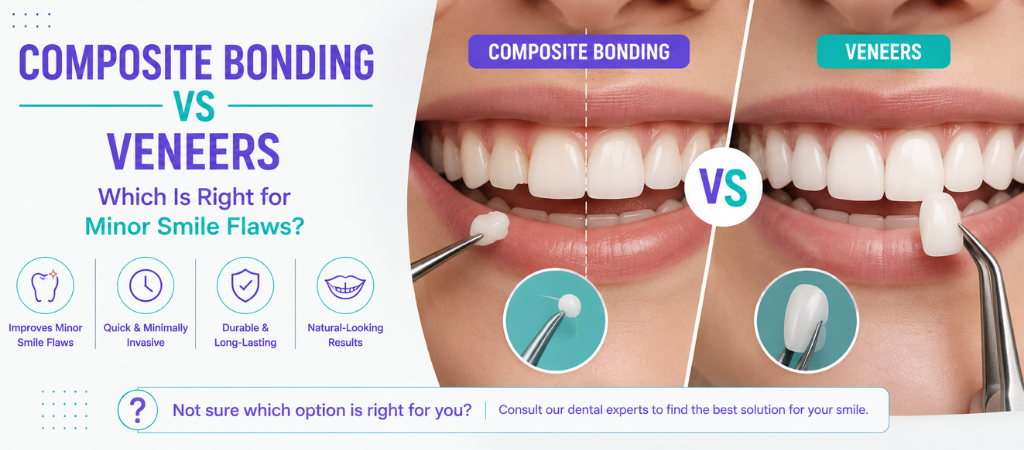
Composite Bonding vs Veneers: Which Is Right for Minor Smile Flaws?

Quick Answer
| For small chips, minor gaps, or slight discolouration, composite bonding is usually the faster, more affordable, and more conservative choice — it can often be completed in a single visit without removing enamel. Veneers suit more visible front teeth, multiple flaws, or patients who want a longer-lasting, stain-resistant result, but involve some enamel preparation and a higher cost. Your dentist’s clinical evaluation is what ultimately decides the better fit for your smile. |
Quick Summary
- Composite bonding uses tooth-coloured resin sculpted directly onto the tooth; veneers are thin custom shells bonded over the front surface.
- Bonding usually costs less and can often be finished in one appointment; veneers typically need two or more visits.
- With good care, bonding lasts roughly 4–8 years, while porcelain veneers can last 10–15 years or longer.
- Veneers generally resist staining better than composite resin over time.
- Bonding is more conservative — it often needs little to no enamel removal, making it easier to reverse.
- Veneers tend to work better for correcting several visible flaws at once, especially on front teeth.
- Both can treat chips, gaps, discolouration, and minor misalignment — severity and goals decide which fits best.
- A clinical dental evaluation is the only reliable way to confirm the right option for your specific smile flaw.
Introduction
A chipped edge from biting into a hard sweet, a stubborn stain from years of chai, or a small gap between the front teeth — these are some of the most common reasons parents and adults visit Nova Dental Hospital in Gandhinagar and Ahmedabad. When the flaw is minor, two treatments usually come up in the conversation: composite bonding and veneers. Both can noticeably improve a smile, but they work differently, cost differently, and suit different situations. This guide breaks down how each treatment works, what separates them, and how to figure out which one actually fits your tooth, your budget, and your long-term goals.
What Is Composite Bonding?
Composite bonding is a cosmetic procedure where a tooth-coloured composite resin is applied directly onto the tooth, shaped to correct the flaw, and then hardened with a curing light. Because the material is built up in layers on the existing tooth, little to no natural enamel needs to be removed.
Bonding works well for small chips, minor gaps, slightly uneven edges, and mild discolouration on one or two teeth. Most cases are completed in a single visit, since the resin is sculpted and polished chairside rather than made in a lab.
What Are Dental Veneers?
Veneers are thin, custom-made shells — usually porcelain or, in some cases, composite — that are bonded onto the front surface of a tooth to change its shape, size, or colour. Porcelain veneers are typically fabricated in a dental lab from an impression of the prepared tooth, which usually means two visits: one for preparation and impressions, and a second to bond the finished veneers.
Veneers are generally recommended when several front teeth need correction together, when a more dramatic or uniform smile change is desired, or when long-term stain resistance matters more than upfront cost.
Composite Bonding vs Veneers: Key Differences
| Factor | Composite Bonding | Veneers (Porcelain) |
| Material | Tooth-coloured composite resin | Custom-fabricated porcelain shell |
| Enamel Removal | Minimal to none | Typically requires slight enamel reduction |
| Visits Needed | Usually 1 visit | Usually 2 visits |
| Typical Lifespan | 4–8 years | 10–15+ years |
| Stain Resistance | Moderate — can pick up stains over time | High — porcelain resists staining well |
| Reversibility | More reversible, minimal tooth alteration | Considered a more permanent commitment |
| Best For | Small chips, minor gaps, single-tooth touch-ups | Multiple flaws, front-tooth makeovers, longer-term results |
| Relative Cost | Lower per tooth | Higher per tooth |
Which Option Suits Your Smile Flaw?
| Type of Flaw | Usually Better Suited To |
| Small chip on one tooth | Composite bonding |
| Minor gap between two front teeth | Composite bonding or veneers, depending on gap size |
| Slight discolouration on one tooth | Composite bonding |
| Multiple stained or uneven front teeth | Veneers |
| Uniform smile makeover across visible teeth | Veneers |
| Budget-conscious, single-visit fix | Composite bonding |
Expert Insight: A flaw that looks “minor” cosmetically can still involve deeper enamel wear or a bite issue underneath. Nova Dental’s clinicians routinely check bite alignment and enamel thickness before recommending bonding or veneers, since treating only the visible surface can mask an underlying problem.
Cost Comparison in India
Pricing varies by city, clinic, material, and the number of teeth treated, so these are general, indicative ranges rather than fixed quotes. As a rough guide, composite bonding tends to fall in the lower cost bracket per tooth compared to porcelain veneers, largely because it skips lab fabrication and usually needs only one sitting. Porcelain veneers cost more per tooth but are often positioned as a longer-term investment given their extended lifespan. For an accurate, personalised estimate, an in-person consultation and examination at Nova Dental Hospital is recommended, since the final cost depends on the specific tooth, material choice, and treatment plan.
Durability & Maintenance
Composite bonding is durable for everyday use but is softer than porcelain, so it can chip or stain with habits like nail-biting, biting on pens, or frequent tea and coffee consumption. Polishing during routine dental visits helps keep it looking fresh.
Veneers, particularly porcelain ones, are more resistant to wear and staining, but they still require good oral hygiene, a night guard if the patient grinds their teeth, and avoidance of using teeth as tools to open packets.
Expert Insight: Regardless of which treatment is chosen, the surrounding natural teeth and gums need the same preventive care — brushing twice daily, flossing, and six-monthly checkups. Cosmetic work does not replace the need for basic preventive dentistry; it works best alongside it.
Common Mistakes Patients Make
- Choosing veneers purely for a dramatic look without considering the enamel removal involved, which is not reversible.
- Assuming composite bonding is a permanent, one-time fix, when in reality it needs occasional polishing or touch-ups over the years.
- Skipping a bite and gum evaluation before treatment, which can lead to the new bonding or veneer failing prematurely if an underlying issue (like grinding) is untreated.
Myths vs Facts
| Myth | Fact |
| Veneers always look fake or too white. | When properly shade-matched and shaped by an experienced dentist, veneers can look very natural. |
| Composite bonding never stains. | Composite resin can pick up mild staining over time, especially with tea, coffee, or tobacco use. |
| Bonding and veneers fix crooked teeth. | Both address minor cosmetic flaws in shape or colour, not significant misalignment, which usually needs orthodontic treatment. |
| Veneers ruin your natural teeth. | Veneers involve some enamel reduction, but when placed correctly by a trained dentist, the underlying tooth structure is protected, not damaged. |
Questions Patients Forget to Ask
- Will this treatment need to be repeated, and roughly how often?
- What happens if I grind my teeth at night — do I need a night guard afterward?
- How will this match my other teeth as they naturally change colour with age?
- Is my tooth flaw purely cosmetic, or is there an underlying bite or enamel issue?
- What is the realistic day-to-day care routine to make this treatment last as long as possible?
Practical Action Plan
- Note down exactly which tooth or teeth bother you, and whether the flaw is a chip, gap, stain, or shape issue.
- Book a cosmetic dental evaluation to check enamel condition, bite, and gum health before deciding.
- Ask for a side-by-side explanation of bonding versus veneers for your specific case, including expected lifespan and cost.
- Discuss your budget and how many teeth need treatment, since this affects which option is more practical.
- Plan for maintenance — polishing visits for bonding, or a night guard for veneers if you grind your teeth.
Nova Dental Expert Summary
| For a single small chip, gap, or stain, composite bonding is typically the practical first step — conservative, quicker, and reversible. For patients wanting a more uniform, longer-lasting result across several visible teeth, veneers are usually the stronger long-term option. The right decision depends on an in-person evaluation of the tooth, the bite, and the patient’s expectations — not on the flaw’s appearance alone. |
How Nova Dental Hospital Can Help
Choosing between composite bonding and veneers works best alongside a thorough, personalised evaluation rather than a decision made from a photo or a general guide. At Nova Dental Hospital, patients in Gandhinagar and Ahmedabad can expect family-focused care that looks at the whole picture — enamel condition, bite alignment, and gum health — before recommending a cosmetic option. The approach centres on preventive dentistry, early diagnosis of underlying issues, and personalised treatment planning, so that cosmetic improvements are built on a foundation of long-term oral health rather than a quick fix.
Key Takeaways
- Composite bonding suits small, single-tooth flaws and is usually completed in one visit.
- Veneers suit multiple or more visible flaws and generally last longer, but cost more and involve enamel preparation.
- Bonding is more reversible; veneers are a more permanent commitment.
- Porcelain veneers resist staining better than composite resin over time.
- Cost depends on the number of teeth, material, and clinic — get a personalised estimate.
- Both treatments need ongoing oral hygiene and regular dental checkups to last.
- An in-person evaluation, not just visual assessment, should guide the final decision.
Frequently Asked Questions
What is the main difference between composite bonding and veneers?
Composite bonding is a resin applied and shaped directly on the tooth, usually in one visit, while veneers are custom-made shells bonded over the tooth, usually requiring two visits and, in most cases, some enamel reduction.
Which lasts longer, composite bonding or veneers?
Porcelain veneers generally last longer — often 10 to 15 years or more with good care — compared to composite bonding, which typically lasts around 4 to 8 years before needing a touch-up or replacement.
Is composite bonding painful?
Composite bonding is usually painless and often doesn’t require anaesthesia, since little to no enamel is removed. Some mild sensitivity can occur if the tooth was previously chipped or sensitive.
Do veneers damage natural teeth?
When placed correctly, veneers are designed to protect the prepared tooth surface. Some enamel is removed to fit the veneer, which is why the process is considered less reversible than bonding, but it does not harm the tooth when done by a trained dentist.
Can composite bonding fix a gap between front teeth?
Yes, composite bonding can close small to moderate gaps between teeth. Larger gaps may be better suited to veneers or orthodontic treatment, depending on the case.
How much do veneers cost in India?
Veneer costs vary widely based on material, city, and number of teeth treated. Porcelain veneers generally cost more per tooth than composite bonding. A personalised quote requires an in-person consultation.
Can I switch from composite bonding to veneers later?
In most cases, yes. Since bonding preserves more of the natural tooth, patients can often move to veneers later if they want a more permanent or extensive result.
Do veneers or bonding stain like natural teeth?
Composite bonding can stain somewhat like natural enamel, especially with tea, coffee, or tobacco use. Porcelain veneers resist staining significantly better over time.
Is composite bonding or veneers better for a single chipped tooth?
For a single minor chip, composite bonding is usually the more practical and conservative first option, since it’s quicker, less invasive, and more affordable.
Where can I get composite bonding or veneers near Gandhinagar?
Nova Dental Hospital, serving Gandhinagar and Ahmedabad, offers cosmetic dental evaluations to help determine whether composite bonding or veneers suit your specific smile flaw.

Related posts

Write a Comment
Recent Posts


