


Bone Grafting Before Dental Implants: Why It’s Sometimes Needed
Bone Grafting Before Dental Implants: Why It’s Sometimes Needed

Quick Answer
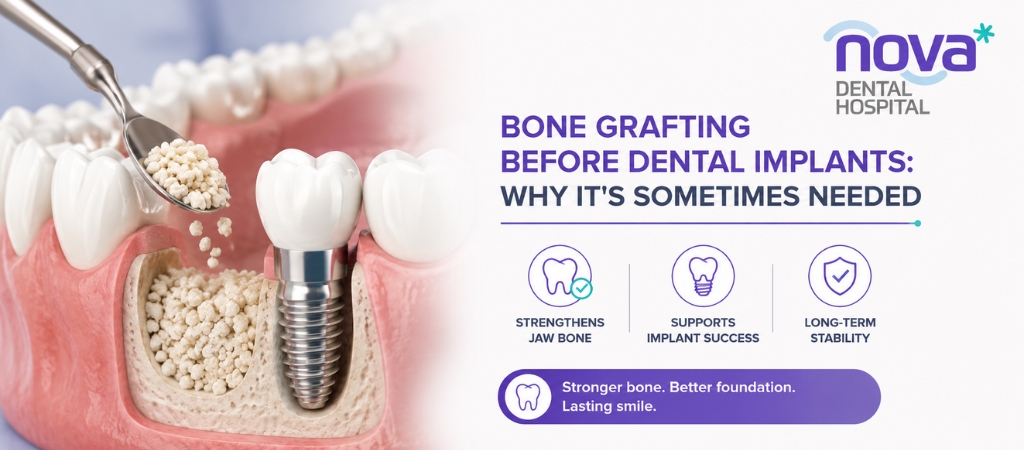
Bone grafting is sometimes needed before dental implants when the jawbone lacks enough height, width, or density to securely hold an implant. This can happen after long-term tooth loss, gum disease, injury, or a missing tooth left untreated for years. The graft rebuilds bone volume so the implant can fuse properly with the jaw — a process called osseointegration — giving it a stable, long-lasting foundation.
Quick Summary
- Bone grafting adds volume and density to the jaw where natural bone has been lost.
- Not every implant patient needs a graft — it depends on individual bone health, assessed via X-ray or CT scan.
- Common causes of bone loss include long-term missing teeth, gum disease, and old dentures.
- Grafting materials can come from the patient’s own body, a donor source, animal tissue, or synthetic material.
- Minor grafts heal in 3–4 months; larger grafts (like sinus lifts) may need 6–9 months before implant placement.
- The procedure is done under local anaesthesia and is generally no more uncomfortable than a tooth extraction.
- Skipping a needed graft increases the risk of implant failure, so it is a protective step, not an optional add-on.
Introduction
For many patients considering dental implants, the treatment plan is straightforward: assess the tooth, place the implant, and restore the smile. But for a meaningful number of patients, the dentist recommends an additional step first — bone grafting. This can feel like an unexpected complication, especially when a patient has already mentally prepared for implant surgery. In reality, bone grafting is a well-established, routine part of implant dentistry, designed to give the implant the strongest possible foundation. Understanding why it is sometimes necessary — and what it actually involves — helps patients approach the process with confidence rather than apprehension.
Why Dental Implants Depend on Healthy Jawbone
A dental implant is not just a replacement tooth sitting on the gum — it is a titanium or zirconia post that is surgically anchored into the jawbone itself, mimicking the root of a natural tooth. For this anchor to hold securely over decades of biting and chewing, the surrounding bone needs sufficient height, width, and density. When bone volume is inadequate, an implant may not integrate properly, may become loose over time, or may fail outright.
The jawbone is a living tissue that remodels constantly, and it relies on the stimulation of tooth roots to maintain its shape and strength. Once a tooth is lost, that stimulation stops, and the bone in that area gradually resorbs — often losing a significant portion of its width within the first year alone.
Common Reasons Bone Grafting Becomes Necessary
- Long-standing tooth loss: When a tooth has been missing for months or years without replacement, the bone in that space naturally shrinks.
- Periodontal (gum) disease: Advanced gum disease erodes the bone that supports the teeth, leaving less structure for an implant.
- Ill-fitting dentures: Dentures that rest directly on the gum, without root stimulation, accelerate bone loss over time.
- Trauma or injury: A fractured jaw or facial injury can damage bone structure in the area needed for implant placement.
- Sinus proximity (upper jaw): In the upper back jaw, the sinus cavity can leave too little bone height, requiring a sinus lift graft.
Types of Bone Grafting Procedures
Nova Dental Hospital’s clinical team selects the graft type based on the location, size, and cause of bone loss.
| Graft Type | Source | Best Suited For |
| Autograft | Patient’s own bone (e.g., chin, jaw, or hip) | Larger defects needing strong, natural regeneration |
| Allograft | Processed donor bone from a tissue bank | Moderate bone loss where a second surgical site is best avoided |
| Xenograft | Processed bone from animal source (commonly bovine) | Providing a scaffold for the body’s own bone to grow into |
| Alloplast | Synthetic, biocompatible material | Patients preferring a fully synthetic option |
| Sinus Lift | Graft material placed beneath the sinus membrane | Upper back jaw with limited bone height near the sinus |
| Ridge Augmentation | Graft material along the jaw ridge | Narrow ridges lacking sufficient width |
What to Expect During the Procedure
Bone grafting is typically performed under local anaesthesia in a single outpatient visit. The dentist or oral surgeon places the grafting material at the deficient site, sometimes alongside a protective membrane, and closes the gum tissue over it. Many patients describe the experience as comparable to a tooth extraction — some pressure during the procedure, followed by mild soreness for a few days afterward.
Expert Insight
- “Most patients are relieved to learn that grafting adds only a few months to the overall timeline, not years. It is a foundation-building step, similar to reinforcing soil before laying a building’s base,” notes the implant dentistry team at Nova Dental Hospital.
Recovery and Healing Timeline
| Graft Size | Typical Healing Time | Notes |
| Minor socket graft | 3–4 months | Often done at the time of tooth extraction |
| Moderate ridge graft | 4–6 months | May involve a second procedure to expose the site |
| Sinus lift (major) | 6–9 months | Longest healing time due to graft volume and location |
During healing, patients are advised to follow a soft-food diet initially, maintain gentle oral hygiene around the site, avoid smoking (which significantly slows bone healing), and attend follow-up visits so the clinical team can monitor integration before proceeding to implant placement.
Expert Insight: Why Patience Pays Off
A common concern is whether it’s possible to “rush” healing to get the implant sooner. Clinically, this is not advisable — placing an implant into a graft that hasn’t fully matured reduces the chance of successful osseointegration and can lead to implant mobility or loss. The additional months invested in proper healing directly protect the long-term success of the implant.
Expert Insight: Not Every Patient Needs the Same Approach
Bone loss is not uniform — two patients missing the same tooth for the same length of time may have very different bone volumes, depending on genetics, gum health history, and how the tooth was lost. This is why a 3D CT scan, rather than a standard X-ray alone, is often used at Nova Dental Hospital to precisely map bone height and width before recommending (or ruling out) a graft.
Common Mistakes Patients Make
- Assuming grafting is always avoidable: Some patients seek a second opinion hoping to skip the graft entirely, without addressing why it was recommended — this can lead to implant complications later.
- Ignoring post-graft care instructions: Smoking, poor oral hygiene, or skipping follow-ups during healing are the most common causes of graft failure.
- Delaying replacement after tooth loss: Waiting years before considering an implant allows bone resorption to progress, often making grafting necessary when it might have been avoidable.
Myths vs Facts
| Myth | Fact |
| Bone grafting means something went wrong with your treatment plan. | It is a routine, proactive step used in a large share of implant cases and simply reflects individual bone anatomy. |
| Bone grafting is extremely painful. | Most patients report discomfort similar to a tooth extraction, manageable with standard pain relief. |
| You can get an implant right after a graft. | Grafts need time to integrate with existing bone — typically 3 to 9 months — before an implant can be safely placed. |
| Synthetic grafts don’t work as well as natural bone. | Modern synthetic and donor materials are extensively researched and commonly used with high success rates. |
Questions Patients Forget to Ask
- Which specific area of my jaw needs grafting, and why?
- What type of graft material will be used, and are there alternatives?
- How will you confirm the graft has healed before placing the implant?
- What happens if the graft doesn’t integrate as expected?
- Are there lifestyle factors (like smoking) that could affect my healing?
Practical Action Plan
- Get a detailed evaluation, including a CT scan, before assuming a graft is or isn’t needed.
- Ask your dentist to explain which type of graft is recommended and why, based on your specific bone loss.
- Plan your treatment timeline realistically — allow 3–9 months between grafting and implant placement.
- Follow all post-procedure care instructions closely, especially around smoking and oral hygiene.
- Attend every follow-up appointment so healing can be verified before moving to the next stage.
Nova Dental Expert Summary Box
Bone grafting is a well-established, evidence-based step used when the jawbone needs additional support before an implant can be placed safely. At Nova Dental Hospital, treatment planning begins with detailed imaging to determine whether grafting is genuinely necessary, followed by a personalised timeline that balances thorough healing with the patient’s overall treatment goals. The objective is always a stable, long-lasting implant outcome — not the fastest possible procedure.
Key Takeaways
- Bone grafting rebuilds jawbone volume so a dental implant has a stable foundation.
- It is commonly needed after long-term tooth loss, gum disease, or in the upper jaw near the sinus.
- Several graft material options exist, chosen based on the individual case.
- Healing time ranges from about 3 to 9 months depending on graft size and location.
- The procedure itself is generally comparable in discomfort to a tooth extraction.
- Skipping a recommended graft raises the risk of implant failure later on.
- A CT scan gives the most accurate picture of whether grafting is needed.
- Following post-procedure care closely is essential for successful healing.
How Nova Dental Hospital Can Help
Nova Dental Hospital’s implant dentistry team, based in Gandhinagar with a secondary location in Ahmedabad, uses detailed diagnostic imaging to assess bone health before recommending any implant-related procedure. Each treatment plan is built around the individual’s bone anatomy and healing needs, with an emphasis on child-friendly and family-focused care across generations, preventive dentistry guidance to protect long-term oral health, early diagnosis of bone loss risk factors, and personalised treatment planning that keeps patients informed at every stage.
FAQ Section
Do all dental implant patients need bone grafting?
No. Bone grafting is only recommended when imaging shows insufficient bone height, width, or density at the implant site. Many patients proceed directly to implant placement without needing a graft.
How painful is a bone graft procedure?
Most patients describe the discomfort as similar to a tooth extraction, and it is well managed with local anaesthesia and standard pain relief afterward.
How long do I need to wait between grafting and implant placement?
This varies by graft size and location — typically 3 to 4 months for minor grafts and up to 6 to 9 months for larger procedures like a sinus lift.
What materials are used for bone grafting?
Options include the patient’s own bone (autograft), donor bone (allograft), animal-derived bone (xenograft), or synthetic biocompatible material (alloplast).
Can I get dental implants without bone grafting?
In some cases, alternatives like shorter or narrower implants may be considered, but this depends entirely on individual bone anatomy assessed by imaging.
Does smoking affect bone graft healing?
Yes. Smoking significantly slows bone healing and increases the risk of graft failure, so avoiding it during recovery is strongly advised.
Is bone grafting covered by dental insurance in India?
Coverage varies by insurer and policy. It’s best to check directly with your insurance provider and clinic regarding the specific procedure codes.
How do I know if I need a sinus lift instead of a standard graft?
A sinus lift is specifically needed when there isn’t enough bone height in the upper back jaw due to the position of the sinus cavity — this is determined through a CT scan.
What happens if a bone graft fails to integrate?
In rare cases where integration doesn’t occur as expected, the site may need to be re-evaluated and, occasionally, re-grafted before implant placement proceeds.

Related posts
Write a Comment
Recent Posts

Dry Socket After Tooth Extraction: Symptoms, Prevention & Treatment


