


Front Tooth vs Molar Root Canal: Why the Procedure Differs
Front Tooth vs Molar Root Canal: Why the Procedure Differs

Quick Answer
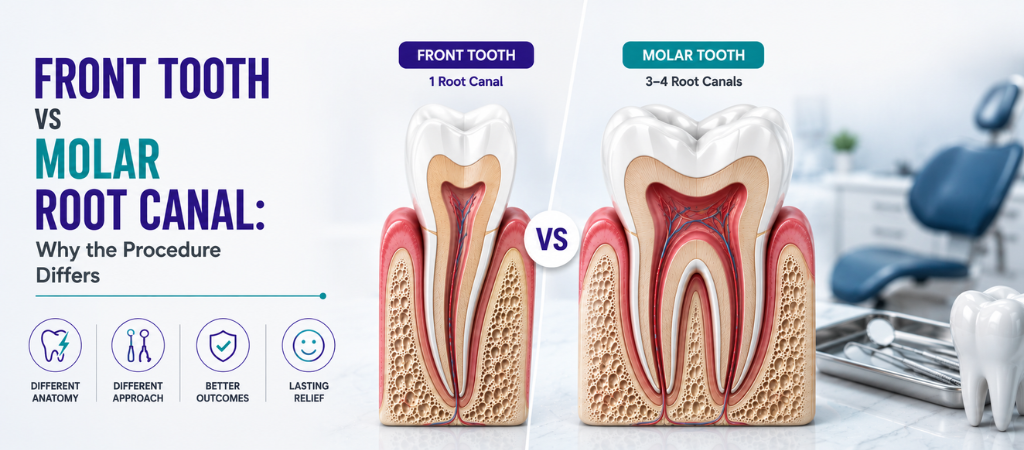
A root canal differs on a front tooth versus a molar mainly because of tooth anatomy. Front teeth (incisors and canines) usually have a single, straight canal, so treatment is quicker and more predictable. Molars have two to four curved canals and absorb heavy chewing pressure, so the procedure takes longer, demands more precision, and almost always ends with a protective crown. The underlying goal — removing infected pulp and saving the natural tooth — stays the same for both.
Quick Summary
- Front teeth typically have 1 canal; molars usually have 2–4 canals.
- A front tooth root canal often takes 30–60 minutes; a molar can take 60–90+ minutes and sometimes two visits.
- Molars almost always need a crown afterward; front teeth may need only a filling or a cosmetic restoration.
- Both procedures use local anesthesia and are no more uncomfortable than a routine filling.
- Root canal success rates are high — generally in the 85–95% range — when followed by proper restoration and care.
- Delaying treatment on either tooth raises the risk of the infection spreading or the tooth being lost.
- If a milk tooth is involved, a pediatric dentist may recommend a different approach based on the child’s age.
- Nova Dental Hospital in Gandhinagar and Ahmedabad evaluates every tooth individually with imaging before planning treatment.
Introduction
Hearing that you need a root canal can bring up the same worry for most patients: how bad will this be? The honest answer is that it depends on which tooth is involved. A root canal on a front tooth and a root canal on a molar share the same purpose — removing infected or inflamed pulp and sealing the tooth to stop pain and prevent further damage — but the anatomy of each tooth changes how the treatment unfolds. Understanding these differences in advance helps patients and parents know what to expect, ask better questions at the appointment, and make confident decisions about care.
Understanding Tooth Anatomy: Why Structure Matters
Every tooth has a hollow space inside called the pulp chamber, which extends into narrow root canals containing nerves and blood vessels. The number and shape of these canals depends on the tooth’s job. Incisors and canines, the teeth used for biting and cutting, generally have one root and one relatively straight canal. Molars, positioned at the back of the mouth for grinding food, usually have two to three roots and two to four canals that are often curved, narrow, or branching.
Expert Insight: “Anatomy — not the presence of pain — is the biggest factor in how long a root canal takes. A tooth with four curved canals simply requires more time to clean and seal thoroughly than a tooth with one straight canal.”
Front Tooth Root Canal: What to Expect
Consider a 28-year-old patient who chips a front tooth in a fall and later develops sensitivity as the pulp becomes infected. Because incisors typically have a single canal that is easy for the dentist to access and see, the procedure is usually completed in one sitting of about 30 to 60 minutes. The main consideration afterward is aesthetics — since this tooth is visible when speaking and smiling, the dentist plans the final restoration, whether a tooth-colored filling or a crown, to match the natural shade and shape of the surrounding teeth.
Practical takeaway: if a front tooth is involved, ask specifically how the final restoration will be matched to your smile, not just whether the infection is resolved.
Molar Root Canal: What to Expect
Now consider a 45-year-old patient with a deep cavity in a lower molar that has reached the pulp. Because this tooth may have three to four curved canals hidden behind roots that are harder to reach, the dentist often uses magnification and specialized instruments to locate and clean every canal. The appointment commonly runs 60 to 90 minutes and, depending on complexity, may be split across two visits. Since molars absorb the full force of chewing, a crown is almost always recommended afterward to prevent the weakened tooth from cracking.
Common Mistake: Patients sometimes skip the crown after a molar root canal once the pain is gone, not realizing the tooth is now more brittle and prone to fracture under normal biting pressure.
Comparison Table: Front Tooth vs Molar Root Canal
| Feature | Front Tooth (Incisor/Canine) | Molar |
| Number of canals | Usually 1 | Usually 2–4 |
| Root structure | Single, relatively straight root | Multiple roots, often curved |
| Average procedure time | 30–60 minutes | 60–90+ minutes |
| Typical visits needed | 1 visit | 1–2 visits |
| Restoration required | Filling or crown, based on remaining structure | Crown almost always recommended |
| Access & visibility | Easier for the dentist to reach | More limited; often needs magnification |
| Chewing load after treatment | Lower | Higher — full grinding force |
| Aesthetic priority | High — tooth is visible when smiling | Lower priority; function matters most |
Why Molars Take Longer and Need More Care
The added time for molar treatment isn’t about the dentist being overly cautious — it reflects real anatomical complexity. Curved and branching canals must each be located, cleaned, shaped, and sealed individually, and missing even one canal can allow infection to persist. Many dental teams use dental operating microscopes or magnifying loupes along with digital imaging to map the canal system accurately before starting, which improves the chance of a lasting result.
Expert Insight: “We treat every molar as if it may have an extra hidden canal until imaging proves otherwise. That mindset is what keeps re-treatment rates low.”
Restoration Differences: Filling vs Crown
After the canals are cleaned and sealed, the tooth needs a final restoration to protect it. Front teeth, which handle lighter biting forces and are less prone to fracture, can sometimes be restored with a simple filling if enough natural structure remains, though a crown may still be advised for extra protection or a better cosmetic match. Molars, in contrast, endure the full force of chewing every day, and root canal treatment removes the living tissue that once made the tooth flexible and resistant to cracking. A full crown is the standard recommendation for molars to prevent fracture over time.
Practical takeaway: don’t judge whether you need a crown by how the tooth feels — judge it by which tooth was treated and how much natural structure remains.
Pain, Recovery & Sensitivity Differences
Both procedures are performed under local anesthesia and are generally no more uncomfortable than getting a filling. Mild soreness for a few days afterward is normal for either tooth. Molars may feel slightly more tender simply because they are used more heavily during chewing, so a softer diet for a day or two is often recommended. Front teeth recover quickly, though patients should avoid biting directly into hard foods with a newly restored tooth until it has fully settled.
Expert Insight: “Persistent swelling, throbbing pain, or a fever after treatment is not normal recovery — patients should contact their dentist promptly rather than waiting it out.”
Common Mistakes to Avoid
- Assuming pain going away on its own means the infection has healed — it often means the pulp has died, which does not resolve the underlying problem.
- Skipping the crown after a molar root canal, leaving the tooth vulnerable to cracking under normal chewing.
- Delaying treatment on a front tooth because it seems purely cosmetic, when an untreated infection can still spread to the jawbone.
- Not asking how many canals imaging revealed before treatment begins, which can lead to surprises about time or cost mid-procedure.
Myths vs Facts
| Myth | Fact |
| Root canal treatment is extremely painful. | With modern local anesthesia, the procedure feels similar to getting a filling. |
| A molar root canal always needs multiple visits. | Many molar root canals are completed in a single sitting; it depends on canal complexity. |
| A root-canal-treated front tooth will look artificial. | With proper shade-matched restoration, the tooth can look identical to its neighbors. |
| If the tooth doesn’t hurt anymore, you can skip the crown. | Pain relief doesn’t mean the tooth is protected — a crown prevents fracture, especially on molars. |
Questions Patients Forget to Ask
- How many canals did the imaging show for this specific tooth?
- Will I need a crown, and how soon after treatment should it be placed?
- What happens if a canal is missed or the infection returns?
- How will this treatment affect the appearance of my front tooth?
- What is the expected long-term success rate for this particular tooth?
Practical Action Plan
- Get a dental X-ray or CBCT scan to confirm the number and shape of canals before treatment.
- Ask whether the procedure can be completed in one visit or will require follow-up.
- Discuss the final restoration plan — filling vs crown — before treatment begins, not after.
- Follow post-treatment care instructions, including a softer diet for a day or two.
- Schedule the crown placement promptly if one is recommended, especially for a molar.
Nova Dental Expert Summary
Whether a root canal is being done on a front tooth or a molar, the goal is always to save the natural tooth and remove infection safely. The right approach depends on the tooth’s anatomy, its role in chewing or appearance, and imaging findings — not on assumptions. A thorough evaluation before treatment is the best way to set accurate expectations for time, comfort, and the restoration that follows.
Key Takeaways
- Front teeth generally have one canal; molars usually have two to four.
- Molar root canals take longer and often need a crown afterward; front teeth may need only a filling.
- Both procedures use anesthesia and involve similar discomfort levels to a filling.
- Delaying treatment on any tooth increases the risk of the infection spreading.
- Imaging before treatment helps confirm canal count and avoid surprises.
- Aesthetic matching matters most for front teeth; structural protection matters most for molars.
- A qualified dentist or endodontist should assess each tooth individually before recommending treatment.
How Nova Dental Hospital Can Help
Nova Dental Hospital approaches every root canal case, whether it involves a front tooth or a molar, with individualized imaging and treatment planning rather than a one-size-fits-all process. The team focuses on child-friendly and family-focused care, preventive dentistry to catch problems early, and personalized treatment planning that considers both function and appearance. For families in Gandhinagar and Ahmedabad, this means a treatment plan built around the specific tooth, the patient’s age, and their long-term oral health goals.
FAQ Section
1. How many root canals does a molar usually have?
Most molars have two to four canals, though the exact number varies by tooth and person, which is why imaging is done before treatment.
2. Is a root canal on a front tooth less painful than on a molar?
Not necessarily. Both use local anesthesia, so pain levels during the procedure are generally similar; any difference is usually in treatment time, not discomfort.
3. Do I always need a crown after a molar root canal?
In most cases, yes. Molars bear heavy chewing forces and become more brittle after treatment, so a crown is typically recommended for long-term protection.
4. Can a front tooth root canal be completed in one visit?
Often yes, since front teeth usually have a single, accessible canal, though complexity can still vary case by case.
5. How long does recovery take after a molar root canal?
Mild soreness for a few days is common for either tooth type; molars may feel slightly more tender due to their role in chewing.
6. Why do molars need more time for root canal treatment?
Their curved, multiple canals take longer to locate, clean, and seal thoroughly compared to the single straight canal typical of front teeth.
7. Will my front tooth look natural after a root canal?
With a well-matched filling, veneer, or crown, a treated front tooth can look very similar to its neighboring teeth.
8. What happens if I delay root canal treatment?
Delaying treatment can allow the infection to spread, increase pain, and raise the risk of losing the tooth altogether.
9. Are root canal success rates different for front teeth vs molars?
Success rates are generally high for both, though front teeth can be slightly more predictable due to simpler canal anatomy.
10. Where can I get root canal treatment in Gandhinagar?
Nova Dental Hospital offers root canal evaluation and treatment for both front teeth and molars at its Gandhinagar and Ahmedabad locations.

Related posts

Write a Comment
Recent Posts


