


Why Do Dental Implants Fail? Risks, Warning Signs & Prevention
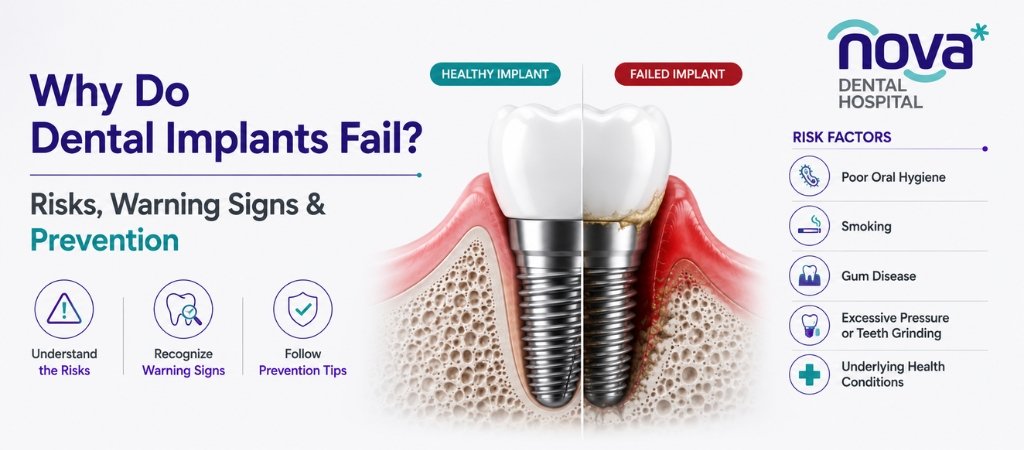
Why Do Dental Implants Fail? Risks, Warning Signs & Prevention

Quick Answer
| Dental implants fail in roughly 5–10% of cases, most often due to peri-implantitis (gum and bone infection around the implant), insufficient bone density, smoking, uncontrolled diabetes, poor surgical placement, or excessive bite force. Most failures happen either in the first year (during healing) or after several years (from gum disease around the implant). Early detection through regular checkups makes most failures preventable or treatable. |
Quick Summary
- Dental implants have a strong long-term success rate — most studies report 90–98% survival over 5–10 years.
- Around 5–10% of implants fail; about 70% of failures occur within the first year after placement.
- Peri-implantitis (infection and bone loss around the implant) is the leading cause of late failure.
- Smoking, uncontrolled diabetes, poor bone density, and teeth grinding meaningfully raise the risk.
- Warning signs include looseness, persistent pain, gum swelling or bleeding, and a change in bite.
- Most failing implants can be treated if caught early; some require implant removal and replacement.
- Regular dental checkups and good oral hygiene are the single most effective prevention strategy.
Introduction
A dental implant is meant to be a permanent solution — a titanium root that fuses with the jawbone (a process called osseointegration) to support a lifelike replacement tooth. For the large majority of patients, that is exactly what happens. But implants are still a surgical procedure placed in a living, changing mouth, and like any medical intervention, they can occasionally fail.
If you’re reading this because your implant feels loose, painful, or “different” than it used to, or because you’re researching implants before treatment and want to understand the real risks, this guide walks through exactly why failure happens, what the warning signs look like, and how Nova Dental Hospital approaches prevention and early correction.
How Common Is Dental Implant Failure?
Large-scale studies consistently place overall implant failure in the range of about 2% to 10%, with most well-run clinical registries reporting figures toward the lower end of that range — commonly under 3–5% — when implants are placed and maintained correctly. One large national dataset of nearly 159,000 implants recorded an overall failure rate of 2.21%, with early failure (during the healing phase, before the crown is even attached) accounting for the majority of losses.
Put differently: implants remain one of the most predictable treatments in modern dentistry, but they are not risk-free, and understanding the failure pattern helps you know what to watch for and when.
| Timeframe | Typical Survival Rate* |
| 3 years | ~98–99% |
| 5 years | ~95–98% |
| 10 years | ~90–97% |
| 15 years | ~86–90% |
*Figures are approximate ranges drawn from published clinical cohort studies; individual outcomes vary by patient health, implant location, and clinic protocols.
Early Failure vs Late Failure
Dental implant failure generally falls into two distinct categories, and knowing which one applies helps explain both the cause and the likely treatment path.
Early Implant Failure (before or shortly after the crown is placed)
This happens when the implant fails to properly fuse with the jawbone — a process clinicians sometimes describe informally as the body “rejecting” the implant, though it is more accurately a failure of osseointegration. Contributing factors typically include:
- Overheating of the bone during drilling
- Insufficient bone density or quality at the placement site
- Infection introduced during or shortly after surgery
- Excessive load or movement on the implant before it has fully integrated
Late Implant Failure (months to years after successful integration)
Once an implant has successfully fused with the bone, the leading long-term threat is peri-implantitis — an inflammatory condition, similar to gum disease, that gradually breaks down the bone and soft tissue supporting the implant. Left untreated, it is the most common reason a previously stable, well-functioning implant eventually loosens and fails.
| Expert Insight #1 “Most late-stage implant problems don’t appear overnight. They build gradually through plaque accumulation around the implant, just like gum disease around a natural tooth. This is exactly why the six-month follow-up visits we recommend after implant placement matter as much as the surgery itself.” |
What Causes Dental Implants to Fail? Key Risk Factors
Implant failure is rarely caused by a single factor — it’s usually a combination of biological, mechanical, and lifestyle elements. The main contributors seen in clinical practice include:
1. Peri-Implantitis (Gum and Bone Infection)
Plaque buildup around the implant base triggers inflammation that, if untreated, spreads to the supporting bone. It is considered the single most common cause of late implant failure and is largely preventable with consistent oral hygiene and professional cleanings.
2. Insufficient Bone Density
An implant needs adequate bone volume and quality to anchor securely. Patients with bone loss from long-term missing teeth, osteoporosis, or prior gum disease may need a bone graft or sinus lift before or during implant placement to reduce failure risk.
3. Smoking
Smoking restricts blood flow to the gums and bone, slows healing, and is one of the most consistently identified risk factors for both early and late implant failure across clinical studies.
4. Uncontrolled Diabetes and Certain Medical Conditions
Poorly controlled blood sugar impairs healing and increases infection risk. Autoimmune conditions and certain medications (such as bisphosphonates affecting bone remodeling) can also influence integration.
5. Excessive Bite Force or Teeth Grinding (Bruxism)
Unlike natural teeth, implants have no periodontal ligament to absorb shock. Chronic grinding or clenching can overload the implant, loosen the crown, or fracture components over time.
6. Poor Surgical Planning or Placement
Implant angle, depth, and spacing all affect long-term stability. This is one of the strongest reasons to choose a clinic with dedicated implantology experience and 3D imaging for treatment planning.
7. Foreign Body or Material Sensitivity
True titanium allergy is rare, but it is a recognized, documented cause of unexplained implant failure when more common causes have been ruled out.
| Common Mistake #1 Assuming that mild discomfort a few days after surgery is automatically a sign of failure. Some soreness and swelling during the first week is normal healing — the concerning signs are pain that worsens after day 5–7, or any mobility in the implant itself. |
| Common Mistake #2 Skipping the 6-month and annual implant review visits once the crown feels “settled.” Peri-implantitis often develops silently, with no pain until bone loss is already significant. |
| Common Mistake #3 Continuing to smoke immediately around the time of surgery, assuming it only affects lungs and not healing. Smoking is one of the most modifiable risk factors for implant failure. |
Warning Signs of a Failing Implant
Catching a problem early dramatically improves the chances of saving the implant rather than needing full replacement. Watch for:
- A loose or shifting feeling when you bite or chew
- Pain or throbbing that increases rather than improves after the first week
- Swollen, red, or bleeding gums around the implant
- Visible gum recession exposing part of the implant
- Difficulty chewing or a change in how your bite feels
- Pus or an unpleasant taste near the implant site — a sign of possible infection
- Visible movement of the crown itself
Myths vs Facts
| Myth | Fact |
| “Implants can’t fail once they’ve healed.” | Late failure from peri-implantitis can occur years after successful healing without ongoing care. |
| “Any pain means the implant is failing.” | Mild, improving discomfort in the first week is normal; worsening or late-onset pain is the concerning pattern. |
| “A failed implant means implants aren’t right for me.” | Most patients with a failed implant can be successfully re-treated after the site heals or is grafted. |
| “Only smokers get implant failure.” | Smoking raises risk, but bone quality, hygiene, and bite force matter for every patient. |
Can a Failing Implant Be Saved? Treatment & Prevention
The right response depends entirely on how early the problem is caught:
- Peri-implant mucositis (early gum inflammation, no bone loss): typically resolved with professional deep cleaning and improved home care.
- Peri-implantitis with bone loss: may require specialized cleaning of the implant surface, antimicrobial therapy, or in some cases bone grafting to regenerate lost support.
- Mechanical issues (loose crown, screw loosening): often correctable by re-tightening or replacing the prosthetic component without removing the implant itself.
- Complete integration failure: the implant may need removal, followed by a healing period and, often, a bone graft before a new implant can be placed.
| Expert Insight #2 “A failing implant is not automatically a lost implant. The single biggest factor in whether we can save it is how early it’s identified — which is exactly why we build follow-up visits into every implant treatment plan, not just the surgery date.” |
Practical Action Plan
- Note any change in sensation, looseness, or gum appearance as soon as you notice it — don’t wait for pain.
- Schedule a dental review promptly rather than waiting for your next routine visit if something feels different.
- Maintain twice-daily brushing and daily interdental cleaning around the implant, just as you would a natural tooth.
- Keep every scheduled implant review appointment, even when the implant feels completely normal.
- If you smoke, seek support to quit — even reducing frequency around any dental procedure meaningfully improves healing.
- Mention any diabetes, osteoporosis, or bone-affecting medication to your dentist before implant planning begins.
| Expert Insight #3 “We tell every implant patient the same thing: the surgery gets the implant in, but daily hygiene and regular reviews are what keep it in for 15-plus years. It’s a shared responsibility between the clinical team and the patient.” |
Questions Patients Forget to Ask
- “What is my personal risk profile based on my bone density and medical history?”
- “How many follow-up visits are included, and what happens at each one?”
- “What early warning signs should I personally watch for, given my risk factors?”
- “If this implant fails, what would the replacement process look like?”
- “Do I grind my teeth, and if so, do I need a night guard to protect the implant?”
How Nova Dental Hospital Can Help
Nova Dental Hospital in Gandhinagar approaches implant treatment as a long-term relationship rather than a single procedure. This includes detailed pre-treatment imaging and bone assessment to plan placement accurately, personalized treatment planning based on individual risk factors such as bone density, smoking history, or bruxism, and structured follow-up review visits designed to catch early signs of peri-implantitis before they progress. For families managing care across generations — from teenagers with early orthodontic needs to senior citizens considering implants — the same family-focused, preventive philosophy applies across every stage of treatment.
Nova Dental Expert Summary Box
Dental implant failure affects a small minority of patients — typically 5–10% — and is most often linked to peri-implantitis, inadequate bone density, smoking, or uncontrolled medical conditions. Early failures usually relate to healing and integration; late failures usually relate to ongoing gum and bone health around the implant. The clearest path to prevention is consistent oral hygiene, honest disclosure of health and lifestyle factors before treatment, and keeping every scheduled review appointment. Most complications, when caught early, are treatable without losing the implant. |
Key Takeaways
- Implant failure is uncommon (roughly 5–10%) but not impossible — understanding the risk factors helps you reduce it.
- Peri-implantitis is the leading cause of late failure and is largely preventable with good hygiene and checkups.
- Smoking, uncontrolled diabetes, low bone density, and bruxism are the main modifiable and non-modifiable risk factors.
- Warning signs — looseness, worsening pain, gum bleeding, bite changes — should prompt a prompt dental review, not a wait-and-see approach.
- Most failing implants can be treated successfully if identified early.
- Regular follow-up visits are as important to long-term success as the surgery itself.
FAQ Section
What percentage of dental implants fail?
Most clinical studies report failure rates between roughly 2% and 10%, with well-maintained implants at reputable clinics typically falling toward the lower end of that range.
How soon after placement do implants usually fail?
Most failures that do occur happen within the first year, during the osseointegration (healing and fusion) period. Late failures, mainly from peri-implantitis, can occur years later.
Is dental implant failure painful?
It can involve pain, but not always — many cases of peri-implantitis progress with minimal or no pain until bone loss is already present, which is why routine reviews matter more than waiting for symptoms.
Can a failed dental implant be replaced?
In most cases, yes. Depending on the cause, this may involve removing the implant, allowing the site to heal (sometimes with a bone graft), and placing a new implant afterward.
Does smoking really affect implant success?
Yes — smoking is one of the most consistently documented risk factors for both early and late implant failure due to its impact on blood flow and healing.
Are older patients more likely to experience implant failure?
Age itself is less important than bone quality and overall health. However, some studies note higher early failure rates in older age groups, often linked to reduced bone density.
What is peri-implantitis?
It’s an inflammatory condition affecting the gum and bone around a dental implant, similar to gum disease around natural teeth, and is the leading cause of late implant failure.
How can I tell the difference between normal healing and a failing implant?
Normal healing discomfort typically improves steadily over the first week. Pain that worsens, persists beyond a week, or is accompanied by looseness or swelling warrants a prompt dental review.
Do dental implants need special maintenance compared to natural teeth?
The core routine is similar — brushing, interdental cleaning, and regular checkups — but implants also need periodic professional monitoring for peri-implantitis, which can progress silently.
Where can I get a dental implant evaluated in Gandhinagar?
Nova Dental Hospital, with locations serving Gandhinagar and Ahmedabad, offers implant assessment, imaging, and follow-up review as part of a structured, family-focused treatment plan.

Related posts
Write a Comment
Recent Posts


Dry Socket After Tooth Extraction: Symptoms, Prevention & Treatment


