


Sinus Lift Surgery: What It Is and Why Upper Implants Sometimes Need It
Sinus Lift Surgery: What It Is and Why Upper Implants Sometimes Need It

Quick Answer
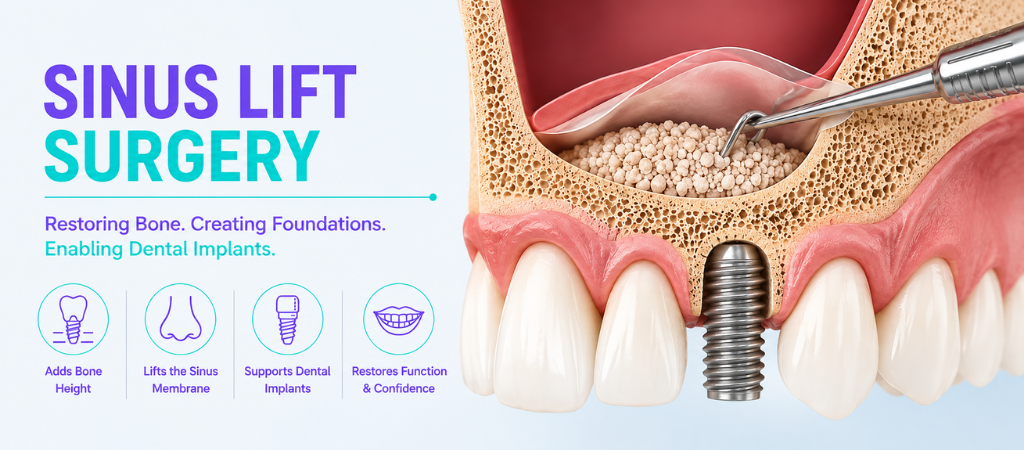
A sinus lift (sinus augmentation) is a bone-grafting procedure performed in the upper back jaw, just below the maxillary sinus, to build enough bone height for a stable dental implant. It’s usually needed when natural bone in this area has thinned due to tooth loss, gum disease, or the sinus expanding with age. Recovery before implant placement typically takes 4 to 9 months. Peer-reviewed studies consistently report high implant survival after sinus lift procedures, generally in the 94–97% range, when the case is planned with proper imaging and performed by a trained specialist.
Quick Summary
- A sinus lift adds bone above the upper jaw ridge, below the sinus floor, to support an implant.
- It’s mainly required for the upper back teeth (premolar/molar) region, not front teeth.
- Common causes: long-term tooth loss, thin natural bone, or an enlarged sinus cavity.
- Two main techniques: lateral window and osteotome (crestal) approach.
- Healing generally takes 4–9 months before the implant is placed; sometimes both are done together.
- Clinical studies report implant survival rates of roughly 94–97% after sinus lift procedures.
- A CBCT (3D) scan is the most reliable way to confirm if you need one.
- Most patients return to normal routines within 3–5 days.
Introduction
If your dentist has recommended a dental implant for a missing upper back tooth and mentioned a “sinus lift,” it’s natural to feel unsure about what that means. This procedure is one of the most common reasons implant treatment in the upper jaw takes a little longer than in the lower jaw. It sounds more dramatic than it is — for most patients, it is a well-tolerated, predictable part of getting a long-term, stable implant rather than a separate, high-risk surgery. This guide explains, in plain terms, what a sinus lift involves, why the upper jaw sometimes needs it, what recovery looks like, and the questions worth asking before you proceed.
What Is Sinus Lift Surgery?
A sinus lift, also called sinus augmentation or maxillary sinus floor elevation, is a surgical procedure that adds bone graft material between the upper jawbone and the membrane lining the maxillary sinus (an air-filled cavity behind your cheekbones). The goal is simple: create enough solid, healthy bone height so a dental implant has a stable foundation to anchor into, similar to how a fence post needs firm ground to stay upright.
This is not a treatment on its own — it is a preparatory step that makes implant placement possible or more predictable in cases where the natural bone in the upper back jaw is too thin or too close to the sinus space.
Why Do Upper Dental Implants Sometimes Need a Sinus Lift?
Dental implants need a minimum amount of bone height and density to integrate securely — a biological process called osseointegration. In the upper back jaw, several natural factors can reduce the available bone over time:
- Tooth loss: once a molar or premolar is missing, the jawbone that used to support it gradually resorbs (shrinks) because it’s no longer being stimulated by chewing forces.
- Sinus pneumatization: the maxillary sinus can naturally expand and drop lower into the jaw with age, especially after teeth in that area have been missing for years.
- Periodontal (gum) disease: long-standing gum disease can accelerate bone loss around the roots before extraction.
- Anatomical variation: some people simply have a naturally lower sinus floor or thinner bone in this region.
Expert Insight
At Nova Dental Hospital, one of the most common patient scenarios we see is someone who lost an upper molar 5–10 years ago and only considered an implant recently. The longer the gap, the more likely some sinus lift or bone grafting is needed — which is one reason early evaluation after tooth loss is genuinely useful.
Who Typically Needs a Sinus Lift?
Not every upper implant requires this step. A sinus lift is generally considered when 3D imaging (CBCT) shows less than roughly 4–6 mm of usable bone height below the sinus floor at the planned implant site. Your dentist or oral surgeon will assess this precisely rather than estimating from a regular X-ray, since 2D images can be misleading in this area.
Common patient scenarios
- A patient missing an upper first or second molar for several years, with thin bone confirmed on CBCT.
- A long-term denture wearer whose jawbone has resorbed significantly over time.
- A patient with adequate bone width but insufficient height specifically near the sinus.
Types of Sinus Lift Procedures
There are two established surgical approaches, chosen based on how much bone height is missing and the specific implant plan.
| Factor | Lateral Window Technique | Osteotome (Crestal) Technique |
| Best for | Very thin residual bone (commonly under 4 mm) or larger height gains | Adequate residual bone (commonly 4–6 mm or more) needing a smaller lift |
| Access | Small window opened on the side of the jawbone | Access from the implant socket itself, from below |
| Invasiveness | Slightly more involved; direct visibility of the membrane | More conservative and less invasive; less direct visibility |
| Implant timing | Often staged — graft heals first, implant later | Can often be combined with implant placement |
| Typical healing before implant | 4–9 months | Immediate to a few months, case-dependent |
| Reported implant survival | Around 94–98% across published studies | Comparable survival; no significant difference vs. lateral approach in meta-analyses |
The Procedure: What to Expect, Step by Step
- Assessment: A CBCT scan measures your exact available bone height and sinus anatomy.
- Anesthesia: The area is numbed with local anesthesia; sedation is optional for anxious patients.
- Access: A small opening is made in the bone (lateral window) or through the implant site (osteotome).
- Membrane elevation: The sinus membrane is gently lifted to create space above the jawbone.
- Grafting: Bone graft material is placed in this new space to encourage new bone growth.
- Closure: The site is closed with sutures, and healing begins.
- Healing and implant placement: Once the graft matures into solid bone, the implant is placed (or, in select cases, placed at the same visit).
Recovery Timeline & What to Expect
| Recovery Stage | Approximate Timing | What’s Normal |
| Initial healing | 3–7 days | Mild swelling, some nasal congestion, tenderness |
| Soft tissue healing | 2–3 weeks | Sutures dissolve/removed; discomfort resolves |
| Bone graft maturation | 4–9 months | New bone forms and hardens; no visible symptoms |
| Implant placement | After maturation confirmed | Follow-up CBCT confirms readiness |
Expert Insight
Patients are often surprised that the surgery itself is brief, but the waiting period before implant placement is the longer part. This isn’t a delay caused by the procedure failing — it’s simply the biological time bone needs to mature and become strong enough to support an implant long-term.
Risks and Safety Considerations
Sinus lift surgery has a long track record in oral implantology and is considered predictable when performed by a trained specialist with proper imaging. As with any surgical procedure, some risks exist and should be discussed openly:
- Sinus membrane perforation — the most common intra-operative complication, reported in an estimated 20–25% of procedures across published studies. Most perforations are identified and repaired during surgery, and research shows this generally does not reduce long-term implant survival when managed properly.
- Infection or graft complications — reduced with good oral hygiene and following post-operative instructions.
- Temporary sinus congestion or minor nosebleeds in the days following surgery.
- Rarely, graft material may not integrate as expected, requiring re-evaluation.
A thorough medical history review — including smoking status, sinus health, and any chronic conditions — helps your dental team reduce these risks before treatment begins.
Sinus Lift and Implant: Combined or Staged?
Whether the implant is placed at the same time as the sinus lift or afterward depends mainly on how much existing bone height you have. If there’s enough bone to hold the implant stable on its own (often 4–5 mm or more), your surgeon may place both together. If bone height is minimal, a staged approach — graft first, implant later — gives the strongest, most predictable long-term result.
Cost Factors to Understand
In India, sinus lift surgery is generally priced per sinus, with reported ranges roughly between ₹25,000 and ₹1,50,000 depending on the technique, the amount and type of graft material used, and case complexity. Straightforward crestal (osteotome) lifts with minimal grafting tend to sit at the lower end, while more extensive lateral window procedures with larger bone deficits cost more. This is typically separate from the implant fee itself. Rather than comparing quoted prices alone, ask what is included — imaging, graft material, follow-up visits, and the implant — so you’re comparing complete treatment plans, not isolated numbers.
Myths vs Facts
| Myth | Fact |
| A sinus lift means something went wrong with my jaw. | It usually reflects normal, expected bone changes after tooth loss — not a medical problem. |
| It’s a major, high-risk surgery. | It’s a well-established, minor oral surgical procedure with predictable outcomes. |
| I’ll need to wait a year with no tooth at all. | Temporary tooth replacement options are usually available during healing. |
| Sinus lifts always delay implants by many months. | In select cases with adequate bone, the implant can be placed the same day. |
Common Mistakes Patients Make
- Delaying evaluation for years after losing an upper back tooth, allowing more bone loss to occur.
- Relying on a regular dental X-ray instead of a CBCT scan for a procedure this precise.
- Not disclosing sinus infections, allergies, or smoking habits, which can affect healing.
- Skipping post-operative instructions (like avoiding nose-blowing or heavy exertion) in the first two weeks.
Questions Patients Forget to Ask
- How much bone height do I currently have, based on my CBCT?
- Will my implant be placed at the same time, or in a separate visit later?
- What graft material will be used, and why is it recommended for my case?
- What temporary tooth options are available during healing?
- What symptoms after surgery should prompt me to call the clinic immediately?
Practical Action Plan
- Get a CBCT (3D) scan to accurately assess your bone height and sinus anatomy.
- Discuss both lateral window and osteotome options and understand why one is recommended.
- Share your full medical history, including sinus issues, smoking, and medications.
- Ask for a written treatment timeline covering healing, review scans, and implant placement.
- Follow post-operative care instructions closely to support healing.
Nova Dental Expert Summary Box
In summary:
A sinus lift is a routine, well-understood step in upper jaw implant planning — not a sign of a complicated case. With accurate 3D imaging, a clear treatment timeline, and an experienced surgical team, most patients move from evaluation to a stable, functioning implant without major disruption to daily life. The most important decision a patient can make is getting proper imaging and an honest discussion of options before starting treatment.
Key Takeaways
- A sinus lift adds bone below the maxillary sinus so an upper implant has enough support.
- It’s typically needed for upper premolar/molar implants, not front teeth.
- Two techniques exist — lateral window and osteotome — chosen based on bone deficit size.
- Healing before implant placement generally takes 4–9 months, though some cases allow same-day placement.
- CBCT imaging is essential for accurate diagnosis and planning.
- Risks are low and manageable with an experienced surgical team.
- Early evaluation after tooth loss can reduce the extent of bone grafting needed later.
How Nova Dental Hospital Can Help
Planning an upper dental implant involves more than placing a single tooth — it requires understanding each patient’s bone anatomy, healing capacity, and long-term goals. At Nova Dental Hospital, evaluation for procedures like sinus lift surgery is built around accurate diagnostic imaging, personalized treatment planning, and clear communication about timelines and options at every step.
- Careful diagnostic imaging (CBCT) to assess bone height and sinus anatomy before recommending any grafting procedure.
- Personalized treatment planning based on each patient’s bone density, medical history, and implant goals.
- A family-focused approach for patients of all ages, from young adults to senior citizens exploring implant options.
- Preventive guidance for patients considering implants after recent tooth loss, to minimize future bone loss.
- Coordinated care between general dentistry, oral surgery, and implant follow-up for a smoother patient experience.
This information is educational and general in nature, informed by published clinical literature on maxillary sinus augmentation and implant outcomes. Every case is different, and a specific recommendation — including technique, graft material, and timeline — can only be made after a clinical examination and CBCT imaging review.
Frequently Asked Questions
1. What is a sinus lift surgery?
It’s a procedure that adds bone graft material below the maxillary sinus in the upper jaw to create enough bone height for a stable dental implant.
2. Why do upper implants need a sinus lift and lower implants usually don’t?
The lower jaw doesn’t have a sinus cavity nearby, so bone height is rarely a limiting factor there. The upper back jaw sits close to the maxillary sinus, which can restrict available bone.
3. Is sinus lift surgery painful?
Most patients report mild discomfort, similar to a tooth extraction, managed with standard pain relief. The procedure itself is done under local anesthesia.
4. How long does recovery take before the implant is placed?
Typically 4 to 9 months for the graft to mature into solid bone, though this varies by individual healing and the amount of grafting done.
5. Can the implant be placed on the same day as the sinus lift?
Yes, in cases where there’s already enough natural bone height to stabilize the implant. Your surgeon will confirm this using CBCT imaging.
6. Is sinus lift surgery safe?
Yes, it is a well-established procedure in oral implantology. Published studies report implant survival rates around 94–97% after sinus lift procedures, when performed by a trained specialist using proper imaging and technique.
7. Will a sinus lift affect my breathing or sinuses long-term?
No. Any congestion or mild discomfort is temporary and resolves within the initial healing period; the sinus continues to function normally afterward.
8. What happens if I skip the sinus lift and try to place the implant anyway?
Placing an implant without adequate bone support increases the risk of instability, poor integration, or implant failure over time.
9. How do I know if I need a sinus lift?
A CBCT (3D) scan and clinical evaluation by your dentist or oral surgeon will confirm whether your bone height is sufficient or if grafting is needed.
10. Where can I get evaluated for a sinus lift near Gandhinagar or Ahmedabad?
Nova Dental Hospital, with locations serving Gandhinagar and Ahmedabad, offers CBCT-based implant evaluation and sinus lift planning as part of comprehensive implant care.

Related posts
Write a Comment
Recent Posts


