Dental Implant Cost in Gandhinagar: What Changes the Price
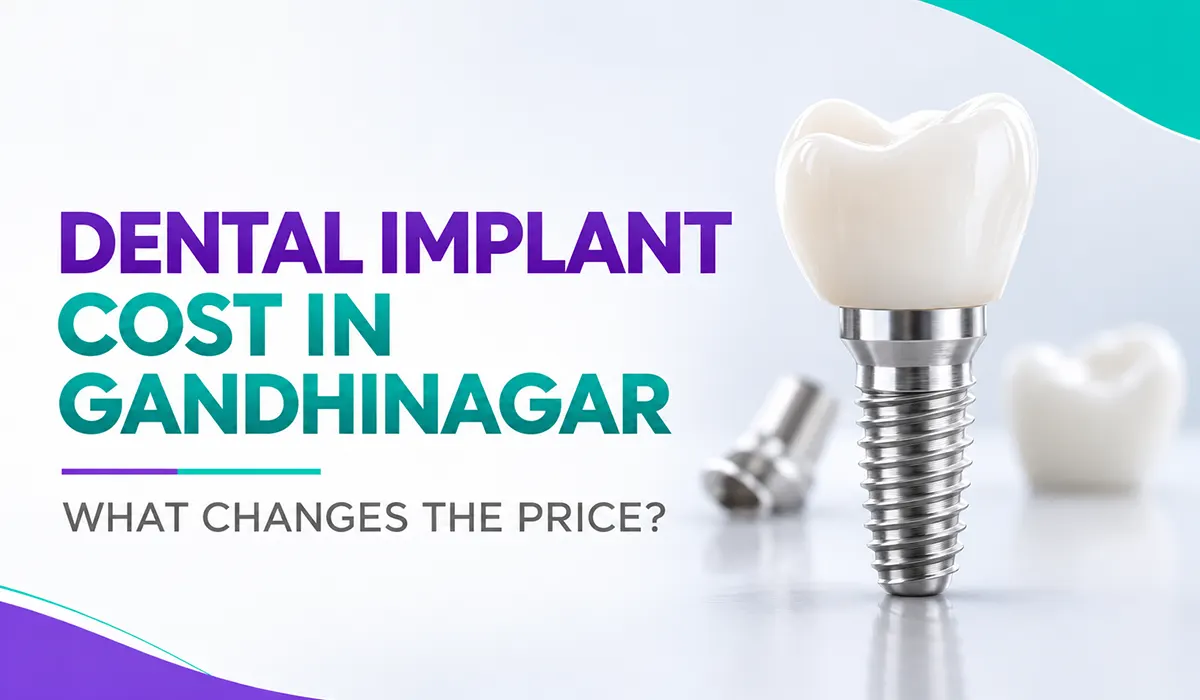
Dental Implant Cost in Gandhinagar: What Changes the Price

A single dental implant in Gandhinagar usually costs between ₹25,000 and ₹90,000 in 2026, including the crown. For a well known mid-range implant system with a zirconia crown, a quote of ₹35,000 to ₹60,000 is common. A full jaw of fixed teeth on four to six implants (All-on-4 or All-on-6) usually costs ₹2.5 lakh to ₹6.5 lakh per jaw.
The gap between the lowest and highest quotes is real, and it is not random. Five things move the price the most: the implant brand, the crown material, the health of your jawbone, the position of the missing tooth, and how many teeth you are replacing. This guide explains each one in plain words, so you can read any quote and know what you are paying for.
Dental implant price ranges in Gandhinagar (2026)
These are typical ranges seen across clinics in Gandhinagar and Ahmedabad. They are not a quote. Your own cost can only be confirmed after an examination and a 3D scan.
| Treatment | What is usually included | Typical range |
|---|---|---|
| Single implant, value system (Indian or entry-level brand) | Implant, abutment, metal-ceramic crown | ₹25,000 to ₹40,000 |
| Single implant, mid-range system (for example Osstem, Dentium, Adin) | Implant, abutment, zirconia crown | ₹35,000 to ₹60,000 |
| Single implant, premium system (for example Nobel Biocare) | Implant, abutment, zirconia or E.max crown | ₹55,000 to ₹90,000 |
| CBCT (3D) scan for planning | Scan of jawbone, nerves and sinus | ₹1,500 to ₹4,000 |
| Bone graft at one site | Graft material, membrane if needed | ₹8,000 to ₹25,000 |
| Sinus lift (one side) | Graft, membrane, surgery | ₹20,000 to ₹50,000 |
| Implant-supported denture (one jaw) | 2 to 4 implants, attachments, removable denture | ₹1,00,000 to ₹2,50,000 |
| All-on-4 fixed teeth (one jaw) | 4 implants, temporary teeth, final fixed bridge | ₹2,50,000 to ₹5,00,000 |
| All-on-6 fixed teeth (one jaw) | 6 implants, temporary teeth, final fixed bridge | ₹3,50,000 to ₹6,50,000 |
What you are paying for: the three parts of an implant
Many people think of an implant as one item. It is actually three parts, and each one has its own cost.
- The implant (fixture): a small titanium or zirconia post placed in the jawbone. It acts as the new root. Most implants are titanium. You can read how the two materials compare in our guide to titanium vs zirconia implants.
- The abutment: the connector that joins the implant to the tooth on top. Stock abutments cost less. Custom abutments cost more but can give a better fit and gum shape, which matters most for front teeth.
- The crown: the visible tooth. Its material changes both the look and the price. More on this below, and on our dental crown and bridge page.
Around these three parts sit the steps you do not see: the consultation, the CBCT scan, the surgery itself, local anaesthesia, the healing check, the impressions or digital scan for the crown, and follow-up visits. A clear quote lists all of these.
9 things that change the price of a dental implant
1. The implant brand and system
This is the biggest single factor. Implant systems from established companies have years of published research, wide parts availability and long-term support. That matters because you may need a replacement screw or a new crown 10 or 15 years from now, and the parts have to match. Lower-cost systems can work well in simple cases, but ask which brand you are getting and whether its parts will still be available later.
At Nova Dental Hospital, Dr. Happy Patel works with several international systems, including Nobel Biocare, Osstem, Dentium and Adin, and chooses one based on your bone and bite rather than one size for everyone. You can see the full list on our dental implants in Gandhinagar page.
2. The crown material
A metal-ceramic (PFM) crown is the most affordable and is strong for back teeth. A zirconia crown costs more, has no metal, and looks more natural. E.max (lithium disilicate) is often chosen for front teeth where looks matter most. The difference between these options can be ₹5,000 to ₹15,000 per tooth.
3. The health of your jawbone
An implant needs enough bone height and width to hold firmly. After a tooth is lost, the bone in that spot slowly shrinks. If it has shrunk too much, a bone graft is needed first. This adds cost and usually 3 to 6 months of healing time. Our guide on bone grafting before dental implants explains when it is needed and why skipping it raises the risk of failure.
4. The position of the missing tooth
Upper back teeth sit just below the sinus. When the bone there is thin, a sinus lift may be needed to make room for the implant. This is one of the most common reasons two people with “one missing tooth” get very different quotes. Read more in sinus lift surgery and why upper implants sometimes need it.
Front teeth can also cost more, not because the surgery is harder, but because the gum shape and crown colour need extra care to look natural.
5. How many teeth you are replacing
Each missing tooth does not always need its own implant. Two implants can carry a three-tooth bridge. Four to six implants can carry a full jaw of fixed teeth. This lowers the cost per tooth for bigger cases. For full jaws, see our guide to All-on-4 and All-on-6 full arch implants, or our full mouth rehabilitation page if several teeth also need crowns or root canals. Our article on full mouth rehabilitation costs covers those bigger plans in detail.
6. Immediate or conventional timing
In a conventional plan, the implant heals for 3 to 6 months before the crown goes on. In an immediate plan, a temporary tooth is fixed on the same day. Immediate teeth need good bone and add the cost of a temporary crown or bridge. They suit some cases very well, but not every case.
7. Treatment needed before the implant
If the tooth is still in your mouth, it has to be removed first. If your gums are infected, that infection must be treated before an implant goes in, because gum disease is a leading cause of implant problems later. These steps are separate from the implant price. See gum treatment and gum infection treatment.
Health habits matter too. Smoking and uncontrolled diabetes both slow healing and raise the risk of failure. Our article on why smoking is a risk for implant patients explains why.
8. Planning technology
A CBCT scan shows the bone in 3D, along with the nerve in the lower jaw and the sinus in the upper jaw. It costs extra, but it is the safest way to plan where the implant goes and to know upfront whether a graft is needed. That means fewer surprises on your bill. Digital scanning for the crown also helps with fit and comfort, as explained in intraoral scanners vs traditional impressions.
9. The dentist’s experience and aftercare
Implant dentistry is surgery plus careful prosthetic work. Experience shows in planning, in handling complications, and in what happens after the crown is fitted. Ask who places the implant, how many they have placed, and what the follow-up plan is. Regular check-ups protect your implant from peri-implantitis, the gum and bone infection that causes most late failures.
Two patients, one missing tooth, very different bills
These two examples are illustrative, built from typical cases, to show how the factors above add up.
Patient A lost a lower back tooth three months ago. The CBCT scan shows good bone. The plan is a mid-range implant with a zirconia crown.
- CBCT scan: about ₹2,500
- Implant, abutment and zirconia crown: about ₹45,000
- Total: about ₹47,500, over roughly 3 to 4 months
Patient B lost an upper back tooth six years ago. The bone has thinned and the sinus sits low. The plan needs a sinus lift before the implant.
- CBCT scan: about ₹2,500
- Sinus lift: about ₹35,000
- Implant, abutment and zirconia crown: about ₹45,000
- Total: about ₹82,500, over roughly 9 to 12 months
Same tooth type, same implant brand, almost double the cost. The difference is the bone, and the bone is shaped by how long the gap was left open. Replacing a lost tooth sooner often keeps the cost lower.
Implant vs bridge vs denture: what each costs over time
The cheapest option today is not always the cheapest over 10 to 15 years. Here is a fair comparison for replacing one or a few missing teeth.
| Option | Typical upfront cost | How long it usually lasts | Costs that come later |
|---|---|---|---|
| Single implant with crown | ₹25,000 to ₹90,000 | The implant can last decades. The crown may need replacing after 10 to 15 years. | Check-ups and cleaning. A new crown if it wears or breaks. |
| Three-unit bridge | About ₹25,000 to ₹75,000 | Often 10 to 15 years | Neighbouring teeth are trimmed and can decay or need root canals. The whole bridge is replaced when it fails. |
| Removable partial or full denture | About ₹10,000 to ₹45,000 per jaw | Often 5 to 8 years | Relines and remakes as the jawbone keeps shrinking. Adhesives. |
For a deeper look at these choices, read dental implant vs bridge for a single missing tooth, dental bridges: procedure, cost and how they compare to implants, and full mouth rehabilitation: implants vs dentures. If you already wear a loose denture, mini dental implants can be a lower-cost way to hold it in place, and our dentures page covers every denture type.
Why a very cheap implant quote can cost more later
An advertised price of ₹10,000 to ₹15,000 for “an implant” is usually the post alone. The abutment, crown, scan and follow-ups are added later. Sometimes a low price also means an unnamed implant system, no 3D scan, or no clear plan if something goes wrong.
Most implants do well. A large review of long-term studies found that about 96 out of 100 modern implants were still in place after 10 years (Howe and colleagues, Journal of Dentistry, 2019). The same review found the risk of losing an implant was higher in people over 65. When implants do fail, it is usually because of poor planning, infection or bone problems that were missed. Our article on why dental implants fail covers the warning signs. Redoing a failed implant almost always costs more than doing it well the first time.
Questions to ask before you agree to a quote
Take this list to your consultation. A good clinic will answer every question in writing.
- Which implant brand will you use, and why that one for me?
- Does the price include the abutment and the final crown? What crown material?
- Is the CBCT scan included, or charged separately?
- Will I need a bone graft or sinus lift? Is that already in this quote?
- Will I get a temporary tooth while the implant heals? Is it included?
- How many visits are included, and are follow-up checks charged?
- What happens, and what do I pay, if the implant does not fuse with the bone?
- Can I pay in stages through the treatment?
Does insurance cover dental implants in India?
Most health insurance policies in India do not cover dental implants unless the tooth was lost in an accident. Some corporate and premium plans offer partial cover, so check your policy wording before treatment. Our article on dental insurance in India explains what is usually covered and what is not. You can also see the plans we accept on our dental insurance plans page.
Implant treatment is usually paid in stages that match the visits, not all on the first day. Nova Dental Hospital offers easy payment options, and our team can explain them when we share your estimate. For routine care that protects your implants over the years, take a look at our yearly dental health care plans.
Visiting from abroad?
Many NRI patients plan implant treatment during a visit home to Gujarat. Because implants need healing time, the work is often split across two trips: the implant on the first visit and the final crown on the next, 3 to 6 months later. Our NRI dental care page explains how we plan around your travel dates.
How Nova Dental Hospital plans and prices your implant
We do not give a fixed implant price over the phone, because we cannot know your bone condition without seeing it. Here is what happens instead.
- Examination: Dr. Happy Patel checks the gap, your gums, your bite and your neighbouring teeth.
- CBCT scan: a 3D scan shows bone height, width and the position of nerves and sinus. This tells us upfront whether you need a graft.
- Options and costs: we explain the options that suit your case, from implant brand to crown material, along with the cost of each.
- Written estimate: you get a written estimate before any treatment starts, so there are no surprises later.
- Treatment and follow-up: implant placement under local anaesthesia, healing checks, the final crown, and regular reviews after that.
Our clinic is in Kudasan, close to PDPU and GIFT City, and is open until 9 PM from Monday to Saturday, plus Sunday mornings. Instruments are sterilised in a B-Class autoclave. You can see our equipment on the facilities page and read what patients say in our clinic reviews.
Want to know what your implant will cost?
Book a consultation and CBCT check with Dr. Happy Patel. You will leave with a clear plan and a written estimate.
Call +91 96381 11082 | Message us on WhatsApp | Book online
308/309, Radhe Times Square, Near Hotel Management Institute, PDPU-Kamalam Service Road, Kudasan, Gandhinagar 382421. Get directions
Frequently asked questions
How much does one dental implant cost in Gandhinagar?
One dental implant with its abutment and crown usually costs ₹25,000 to ₹90,000 in Gandhinagar. Value systems with a metal-ceramic crown sit at the lower end. Premium international systems with a zirconia or E.max crown sit at the higher end. Bone grafting or a sinus lift, if needed, is added on top.
Is the crown included in the implant price?
Not always. Some clinics quote the implant post alone, which is why some prices look very low. Always ask whether the quote includes the implant, the abutment and the final crown, and which crown material is used.
Why do upper back tooth implants often cost more?
The bone under the sinus in the upper back jaw is often thin, especially if the tooth was lost years ago. A sinus lift may be needed to create enough bone for the implant. This adds about ₹20,000 to ₹50,000 and several months of healing.
How much does All-on-4 cost in Gandhinagar?
All-on-4 fixed teeth usually cost ₹2.5 lakh to ₹5 lakh per jaw. All-on-6 usually costs ₹3.5 lakh to ₹6.5 lakh per jaw. The final teeth material, the implant brand and whether you need extractions first all change the price.
Can I get a dental implant for ₹15,000?
Some clinics advertise implants at this price, but it usually covers the implant post only. Once the abutment, crown and scan are added, the total is often closer to ₹25,000 to ₹35,000 or more. Ask for the full, final price in writing before you decide.
Are implants cheaper in Ahmedabad than in Gandhinagar?
The price ranges are very similar in both cities. The brand, the crown material and your bone condition change the cost far more than the city does. Choose the clinic based on planning, experience and aftercare, not distance alone.
How long does implant treatment take, and do I pay all at once?
A simple single implant usually takes 3 to 4 months from placement to final crown. Cases with bone grafting or a sinus lift can take 6 to 12 months. Payment is usually split across the main stages of treatment rather than paid in full on the first day.
Is a dental implant worth the cost?
For most people with good general health, yes. An implant does not need the neighbouring teeth to be trimmed, it helps keep the jawbone from shrinking, and long-term studies show about 96 in 100 implants still in place after 10 years. A bridge or denture costs less upfront but usually needs replacing sooner.
Related guides
- Dental implants in Gandhinagar
- All-on-4 and All-on-6 full arch implants explained
- Bone grafting before dental implants
- Implant vs bridge for a single missing tooth
- Why dental implants fail and how to prevent it
- Nervous about implants? What the procedure really feels like
Medically reviewed by Dr. Happy Patel, BDS
Dr. Happy Patel leads Nova Dental Hospital in Kudasan, Gandhinagar, and has 10 years of experience in dental practice. Her clinical focus includes dental implants, root canal treatment and cosmetic dentistry, with continuing education in implantology, orthodontics and aligners. Read more about Dr. Happy Patel.
This article is for general information. Prices shown are typical market ranges for 2026 and are not a quote. Your treatment plan and cost can only be confirmed after a clinical examination. Results vary from person to person.

Related posts
Recent Posts